
If you garden anywhere near a coastline, this question comes up eventually: can you just haul a few buckets of seawater home and water the garden with it, maybe cut way down to be safe? It feels intuitive — the ocean is full of minerals, after all. The math says no, and it’s not even a close call. The reason is a little counterintuitive, and it’s worth walking through, because it explains why diluting seawater doesn’t work the way diluting almost anything else does.
Why dilution alone can’t fix seawater
Irrigation water gets judged on two different yardsticks. One is total salinity — electrical conductivity, in dS/m — which is simply a sum of everything dissolved in the water. The other is the sodium adsorption ratio, or SAR, which compares sodium to calcium and magnesium using a square root in the formula. That square root matters enormously: when you dilute water by a factor of ten, salinity (EC) drops by a full factor of ten right along with it, but SAR only drops by the square root of ten — about 3.2 times. Dilute the water a hundred-fold and EC falls a hundred-fold, while SAR only falls tenfold. The ratio problem shrinks far more slowly than the total-salt problem does.
Full-strength seawater carries an SAR of roughly 59 — off the charts for irrigation, where the FAO calls anything above 9 a severe restriction. Diluting it 1:30 — already a serious dilution — still leaves chloride at 643 mg/L and an SAR of 10.7, both past FAO’s severe threshold. Push the dilution to 1:71, the point where overall salinity finally reaches FAO’s safest “no restriction” band, and SAR is still sitting at 7.0 — squarely in the slight-to-moderate sodium-hazard range. Getting SAR itself down to FAO’s safe threshold of 3 takes roughly a 1:384 dilution.
Based on FAO Irrigation and Drainage Paper 29 thresholds and seawater’s published composition.
Safe and useful turn out to be opposite directions
Here’s the part that actually settles the question. At that 1:384 dilution — the point where sodium hazard finally clears FAO’s safe threshold — the magnesium delivered works out to roughly 3 mg/L. University extension guidance on irrigation water quality calls 30 to 50 mg/L of magnesium desirable for ornamentals. You’d be at about a tenth of that, and calcium and potassium land in the same tiny range. The dilution that makes seawater safe to put on a garden also makes it deliver essentially nothing. There’s no middle dilution where it’s both safe and worthwhile — the two curves just don’t cross in a useful place.
It’s also worth knowing the commercial sea-mineral category doesn’t even agree with itself on this. Some concentrated ocean-mineral products on the market strip out the large majority of their original sodium chloride during processing before they ever reach a bottle; others leave the salt content essentially unchanged from natural seawater and argue that preserving the original ratio is the point. That’s a real disagreement inside the category, which tells you “minerals from the sea” isn’t one settled thing — it depends entirely on what was done to the water after it came out of the ocean.
The honest version
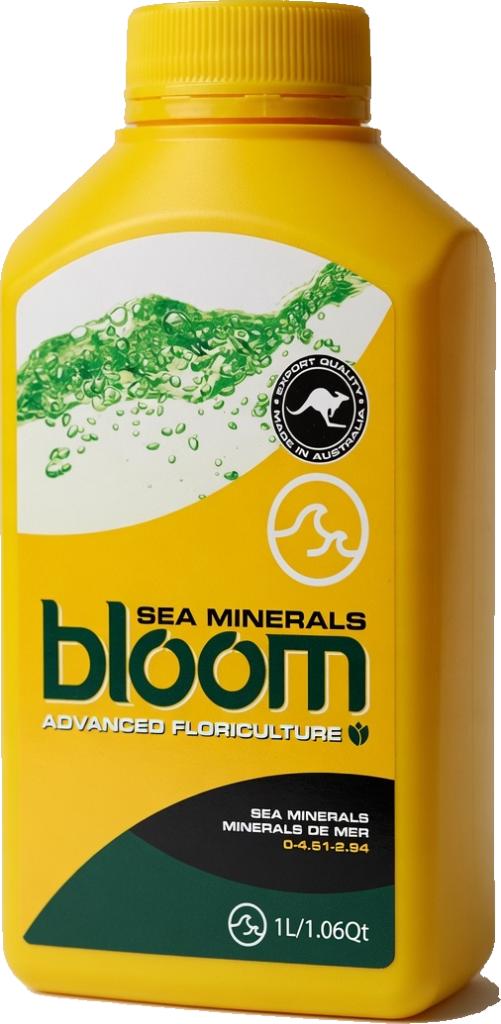
A guaranteed analysis declares plant nutrients at specific, dosed levels. Seawater itself isn’t formulated to do that — it’s roughly 86% sodium and chloride by dissolved weight, with everything else riding along in tiny amounts. Bloom’s own Sea Minerals supplement is a separate, formulated product with its own declared analysis — not a home dilution of ocean water, and not something we’d ask anyone to improvise from a beach bucket.
None of this means the ocean has nothing to offer a garden — it just means a direct dilution of seawater isn’t the way to get it. If a mineral input is worth using, it’s worth using one that was actually formulated and dosed for that purpose, with a label that tells you what’s in it.
The same square-root relationship explains a related piece of folk wisdom worth retiring: that a splash of seawater “can’t hurt” if it’s diluted enough with rainwater or tap water already in the watering can. Because the sodium hazard only falls with the square root of however much it’s cut, a splash that looks heavily diluted by volume is nowhere near as diluted by the measure that actually predicts plant stress. A gardener trusting their eye on this one is trusting the wrong kind of ratio. The same arithmetic problem shows up in miniature in the sodium math behind a home seaweed steep — dilution helps less than it looks like it should.
Sources: Ayers RS, Westcot DW. “Water Quality for Agriculture.” FAO Irrigation and Drainage Paper 29, Rev. 1 (1985). University of Massachusetts Extension, “Water Quality for Crop Production,” Greenhouse Best Management Practices Manual (updated 2025). Seawater composition per University of Hawai’i SOEST oceanography course data and Boyd CE, “Typical chemical characteristics of full-strength seawater,” Global Seafood Alliance (2020).