
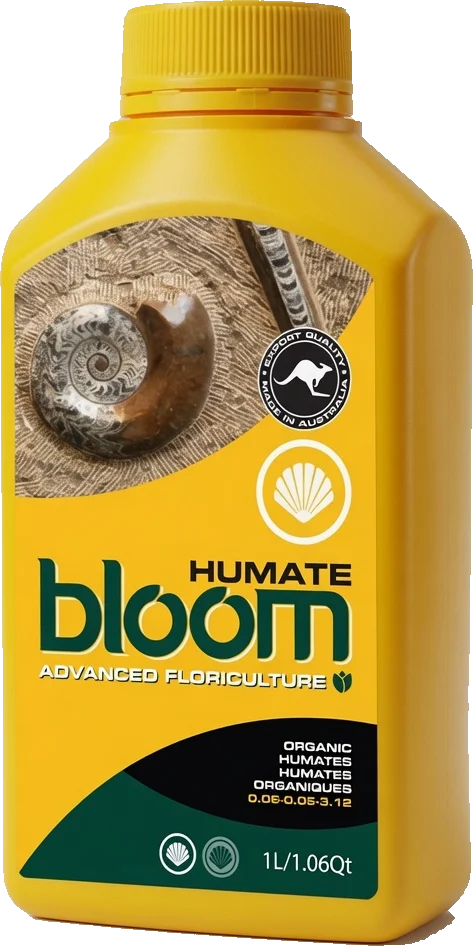
The Potassium Line on the Humate Label Is Doing More Than Feeding the Plant
Floriculture & Ornamental · Product Spotlight
Cut-flower growers already watch nitrogen and phosphorus closely, because those two decide bud count and stem growth. Potassium gets less attention, usually filed under “general health.” But potassium runs a specific, well-documented job inside the plant that has almost nothing to do with growth and almost everything to do with how a stem holds water — which is exactly the thing a vase-life conversation is actually about.
Bloom Humate’s whole declared analysis is one number: 0-0-3.12. No nitrogen, no phosphorus — just 3.12% Soluble Potash (K₂O), derived from potassium hydroxide, plus 10% humic acid from Leonardite as a non-plant-food ingredient. It’s a narrow, single-purpose bottle, and for a floriculture program that’s the point — it’s a potassium and humic-acid top-up layered onto a base feed, not a replacement for one.
What potassium is actually doing at the cell level
Stomata — the pores on a leaf or stem surface that control water loss — open and close because of potassium moving in and out of the guard cells around them. K⁺ flows into a guard cell, water follows it osmotically, the cell swells and the pore opens; K⁺ flows back out, the cell loses turgor, and the pore closes. It’s a potassium pump, not a nitrogen or phosphorus one. A plant running short on potassium is slower to manage that pump, which shows up as weaker turgor control under stress — exactly the kind of stress a cut stem goes through between the field or greenhouse bench and the vase.
Postharvest research on cut flowers has repeatedly linked adequate potassium nutrition in the growing stage to better water relations after the cut — stems that take up water more readily and hold turgor longer in the vase. That isn’t a mechanism unique to Bloom Humate; it’s basic plant physiology. What the label gives you is an honest, single-nutrient way to make sure potassium isn’t the gap in a cut-flower feed program built mostly around N and P.
A base feed dialed for bud count and stem length doesn’t automatically carry enough potassium to run the plant’s water-management system on top of that. Humate is a narrow way to close that specific gap without changing the rest of the program.
The humic acid half of the bottle
The other declared ingredient is 10% humic acid, sourced from Leonardite coal. Humic substances are widely used in substrate and soil management for their effect on cation exchange and water-holding behaviour in the root zone — a slower, root-side complement to the potassium’s fast, cellular job at the stomate. In a greenhouse or field program running peat, coir or a mineral substrate, that root-zone conditioning is a reasonable second reason to run this layer, separate from the potassium question entirely.
Note what isn’t on that label: no nitrogen, no phosphorus, nothing framed as a bloom trigger. It’s one potassium source and one humic-acid source, at 2.5 ml/L of fertiliser solution, meant to sit alongside whatever base program is already running — soil, soilless mix, or a hydroponic bench for ornamentals.
For a cut-flower or greenhouse ornamental program, the useful question isn’t “what does this product promise” — it’s “what nutrient is my base feed light on, and does this bottle actually supply it.” Humate’s label answers that in one line: potassium, 3.12%, nothing else claimed.
Where it fits
Treat Humate the way its label reads: a potassium and humic-acid layer, not a finishing product and not a substitute for base nutrition. If a cut-flower or potted-ornamental program is already carrying adequate K through its base feed, this bottle has less work to do. If potassium has been an afterthought next to N and P — which is common, since most flowering conversations fixate on phosphorus — it’s a straightforward way to close that specific gap at 2.5 ml/L, without touching anything else in the program. Twenty-six years in the US market, same label discipline the whole way through: one nutrient, named, at a stated rate, nothing implied beyond it.
Related reading: Why More Calcium in the Feed Doesn’t Fix Tip Burn, on why a nutrient’s cellular role matters as much as its concentration.