
ROOTS Has Two Numbers on the Same Label — and Repotting Day Is When They Stop Being Interchangeable
Specialty Niche Growers · Product Spotlight
Bonsai repotting, orchid division, replanting a struggling terrarium — these are the moments specialty growers reach for ROOTS, and they’re also the moments most likely to produce a dosing mix-up, because ROOTS’ own label carries two different rates for two different jobs. Miss which one applies and you’re either underdosing a bare-root dip or routinely overdosing an ongoing feed. Neither is dramatic, but neither is what the label intends either.
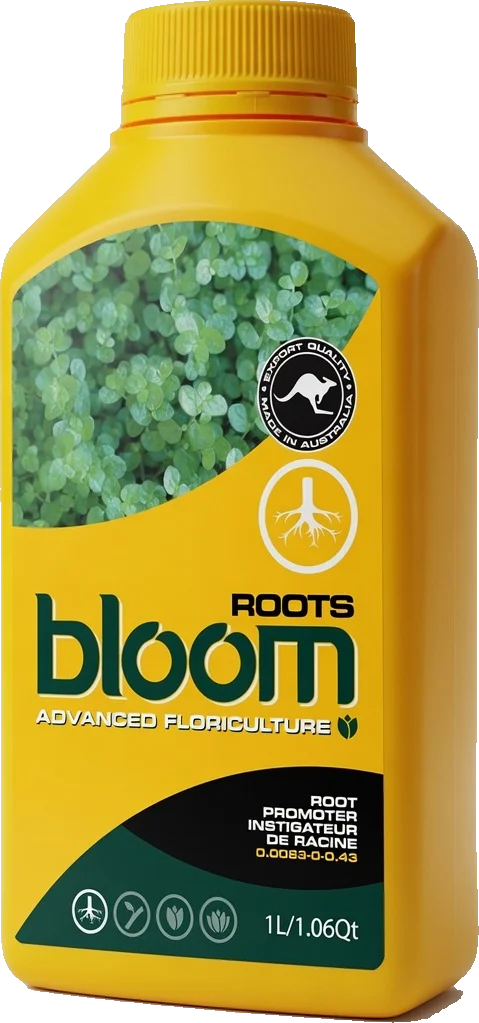
The guaranteed analysis is settled and small by design: 0.0083% total nitrogen, 0.43% soluble potash (K₂O), derived from Durvillaea potatorum seaplant extract, with 0.075% humic acid (from Leonardite) and 0.054% thiamine hydrochloride listed as non-plant-food ingredients. It’s a low-concentration, frequent-use product by design — not a heavy feed, which is exactly why the label gives growers two separate numbers instead of one.
0.5 ml/L is the ongoing feed rate. 1 ml/L — double strength, applied once, briefly — is the dip rate for bare roots at repotting. They are not the same instruction.
Two rates, two very different moments
The reason this particular mix-up matters more for specialty niche collections than for a tray of backyard seedlings is scale. A bonsai’s root mass lives in a pot that will never get meaningfully bigger — the whole point of the discipline is restricting root volume on purpose. An orchid division or a terrarium epiphyte has an even smaller, more exposed root system, often with no growing medium at all. There’s very little buffer in any of these systems to absorb a dosing error. A seedling tray with gallons of soil volume dilutes a mistake; a bonsai pot or a mounted orchid mount does not.
What a repotting day actually looks like with both rates in play
Step 4 is the one growers most often skip — going straight back to a feed-strength 0.5 ml/L dose as part of the next regular watering, rather than continuing to treat the plant at dip strength out of a sense that “more help” post-repot can’t hurt. At 1 ml/L sustained over weeks instead of minutes, that’s roughly double the intended ongoing dose of both the potash and the humic acid fraction — not a dangerous concentration for a dilute, low-N product like this one, but not what the label’s two-number system is designed to deliver either. The label gives two rates because it assumes two different situations, not because either number is a floor.
For a collection where every individual plant gets handled, repotted, and dosed by hand rather than run through an automated schedule, that distinction is worth writing on the pot tag or the propagation log: dip once at 1 ml/L, then feed at 0.5 ml/L going forward. It’s a small thing to get right, but it’s the kind of small thing that specialty growers — working with plants that don’t forgive being treated like a tray crop — tend to care about more than most.
This is also where a precision collection benefits from measuring in milliliters rather than estimating by cap-fulls or “a splash.” At the volumes most specialty growers are mixing — a liter or less of solution for a single pot, a mount, or a propagation tray — the difference between 0.5 ml and 1 ml per liter is the difference between two drops from a syringe, not a visually obvious change in the mix. A kitchen measuring spoon won’t catch that distinction; a small graduated syringe or dropper, the kind already common in reef-keeping and precision houseplant circles, will. It’s a small investment that makes the two-rate system on the label actually usable rather than theoretical.
Dip strength is for the repot. Feed strength is for every week after. The label gives you both numbers on purpose — use the one that matches the moment.
The same two-rate system applies at garden scale too — see ROOTS Has a Feed Rate and a Dip Rate — Fall Transplanting Is When the Difference Matters.