
The Yield You Gain Is the Potency You Lose
Growers argue constantly about how to finish a flower room — flush with plain water, taper the feed, or just keep feeding until chop day. Almost none of that argument is actually about water. It’s about nitrogen. A handful of independent, peer-reviewed cannabis trials have put a real number on what nitrogen does in late flower, and the finding is uncomfortable: you don’t get more yield and more potency from the same plant. You trade one for the other, on a curve, and the trade is nitrogen’s doing.
What the dose-response trials actually measured
Bevan, Jones & Zheng (Frontiers in Plant Science, 2021) ran Gelato in deep water culture across a nitrogen range of 70–290 mg/L applied during flower. Yield peaked around 194 mg/L N, topping out near 144 g per plant — but the paper’s own conclusion was blunt: “there appears to be an inverse relationship between cannabis yield and potency,” and pushing cannabinoid concentration higher with stress “is not ideal for optimising overall plant productivity.” You can aim a plant at bulk or at potency. The same feed schedule doesn’t deliver a maximum of both.
Saloner & Bernstein’s trial, cited in the Bevan paper, found that plants fed 160 mg/L nitrogen carried roughly 30% less THCA and 20% less CBDA than plants fed 30 mg/L — while yielding almost double. Caplan et al. (2017), working with an organic-input fertilizer trial, found the same shape: about 20% less THCA at the highest nitrogen rate tested, against yield that nearly doubled.
Why this isn’t the flushing argument
It’s worth being precise about what this is and isn’t. Separate controlled trials on water-only flushing — withholding all nutrients and feeding plain water for the final 7 to 14 days — found no statistically significant change to yield, potency, terpenes or flower mineral content. That’s a different question with a different answer. The nitrogen-dose trials above weren’t testing whether to stop feeding; they were testing how much nitrogen to feed throughout flower, and the dose itself is what moved the needle on potency.
In plain terms: cutting nitrogen earlier and lower through flower looks like the lever that’s actually connected to the potency you’re chasing. A week of plain water at the very end doesn’t touch that same mechanism.
Why the plant does this at all
Nitrogen is the raw material for making more plant — more leaf, more biomass, more flower mass. A plant running high nitrogen late in flower is still building structure, and building structure competes with the resin and terpene production that happens once the plant shifts out of growth mode. None of the trials claim nitrogen directly suppresses cannabinoid synthesis by some single mechanism; what they consistently show is that more nitrogen buys you more plant, and more plant, on the numbers measured so far, comes with somewhat less concentrated flower.
It’s also worth being honest about the limits of these trials. Bevan’s dose-response curve was run on a single cultivar, Gelato, in deep water culture, over one nitrogen range. Saloner and Bernstein’s comparison and Caplan’s organic-input trial each used their own cultivars, media and fertility programs. None of the three is a universal law carved into every genetic’s biology — they’re three independent data points pointing the same direction, which is a reasonable basis for a feeding philosophy, not a guarantee of a specific percentage shift on your own plants.
What to actually watch, week by week
If nitrogen dose is the lever, the practical question is when to start pulling it, not whether to pull everything at the very end. Bevan’s trial fed a constant nitrogen rate for the whole flower cycle and still found the yield-potency tradeoff at the high end — which argues for starting lower and tapering down through the back half of flower, rather than running a high rate for weeks and then dropping to zero for a handful of days before chop. A short flush at the finish line is trying to undo, in a week, something the feed schedule set up over the preceding six or seven. The nitrogen curve runs the whole cycle; it isn’t a last-minute decision.
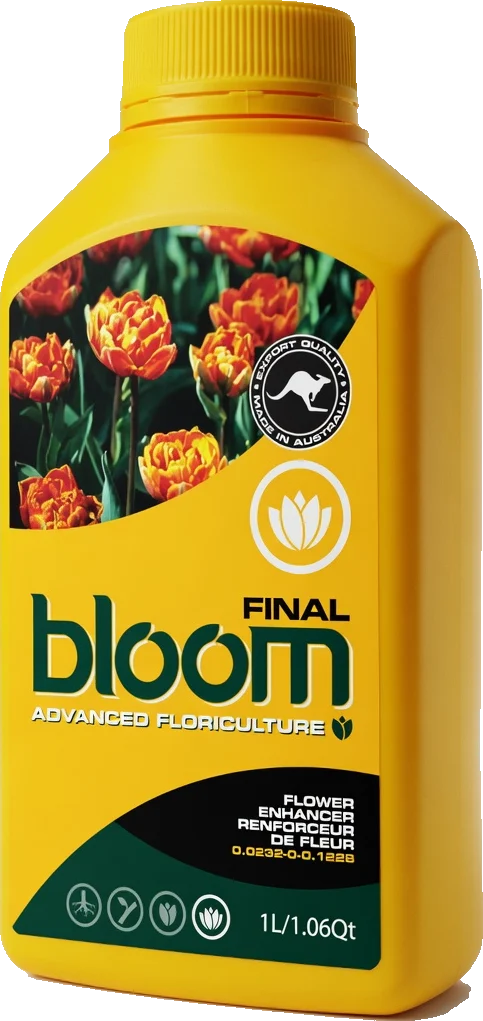
We built our own finishing feed around tapering nitrogen through the back half of flower rather than pulling everything at once, for exactly this reason — it’s a nitrogen decision, not a “stop feeding” decision. We’re not going to print cannabinoid-lift numbers we haven’t trialed ourselves, but the mechanism these independent studies describe is the one worth planning a feed schedule around.