
What Most “Fish Fertilizer” Actually Starts Out As
Walk down the fertilizer aisle and most bottles labeled “fish fertilizer” are fish emulsion. That word sounds finished and deliberate, but the raw material behind it has a name of its own — stickwater — and it’s worth knowing what stickwater actually is before you judge any fish-based bottle by its smell or its price.
Where stickwater comes from
A 2019 USDA technical review of fish-based fertilizers describes the standard commercial process: forage fish are cooked and pressed, the oil is centrifuged off the top, and what’s left — the liquid squeezed out of the fish during pressing — is called stickwater, or “solubles.” It’s concentrated in an evaporator and sold as fish emulsion, often with a stabilizer added. The same review found stickwater runs roughly 65% of the raw fish material that goes into the process.
A patent example for this kind of fish-solubles concentrate lists its composition as roughly 4.5% protein, 1.2% fat, 0.8% ash, and 88.5% water. Most of what’s in the drum, before concentration, is water the fish itself was carrying.
Emulsion and hydrolysate aren’t the same process
The same USDA review found hydrolysate and solubles/emulsion show up in roughly similar numbers across the fish-fertilizer products it surveyed — about 45% of the products it looked at were hydrolysate, 43% were solubles-based. So “most fish fertilizer is emulsion” isn’t quite right; it’s closer to a coin flip. The two processes genuinely differ: emulsion is the pressed, evaporated liquid left over from fish-oil and fishmeal production, usually with a phosphoric-acid stabilizer; hydrolysate is made by breaking down fish tissue itself — whole fish or frames, not just the pressed liquid — typically with heat, enzymes or acid, into a liquid that carries the tissue’s protein and amino acids directly rather than the water squeezed off it.
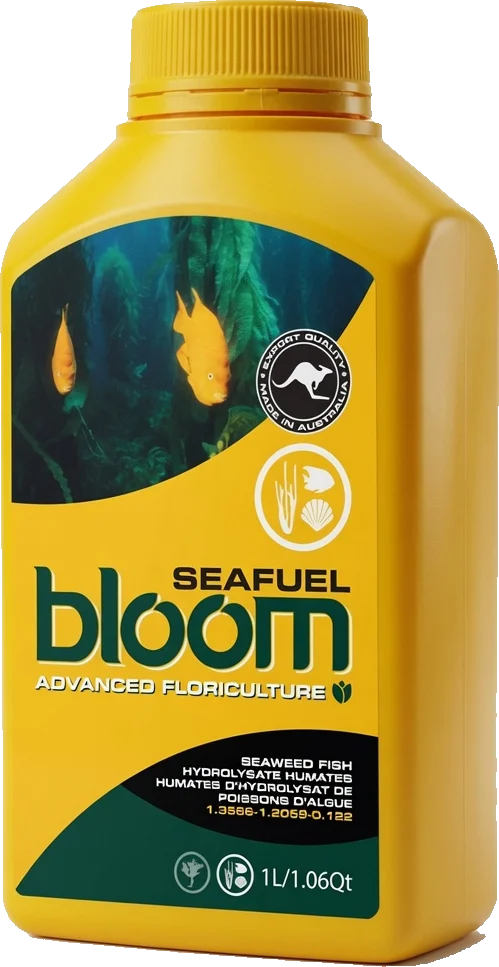
Our Seafuel is made from Southern Bluefin Tuna hydrolysate, not stickwater, and its label declares 0.9% nitrogen and 0.88% soluble potash, used at 1 ml/L. That’s the whole fish’s tissue going into the process, not the liquid left behind after the oil and meal are taken out of it.
What this means for your bottle
None of this makes stickwater-based emulsion a bad product — it has its own published research behind it, including trials on disease suppression in seedlings from other fish-emulsion studies cited in the same literature. It just means the smell, the color, and the price of a “fish fertilizer” don’t tell you which process made it, or how much of the bottle is water that was already in the fish before anyone touched it. Reading the back of the label — hydrolysate versus solubles, versus emulsion — tells you more about what you’re actually feeding than any marketing word on the front.
There’s a reason the two routes exist side by side rather than one replacing the other. Pressing and evaporating stickwater is the byproduct stream of an industry that’s already cooking fish for oil and meal — it’s using material that would otherwise go to waste, and the phosphoric-acid stabilizer that’s typically added keeps a liquid byproduct shelf-stable. Hydrolysis is a dedicated process built around the fish tissue itself, usually with heat, enzymes or acid doing the work of breaking proteins down into something a plant’s roots can take up quickly. Both end up labeled “fish fertilizer.” Only one of them started as fish.
The part the bottle won’t tell you
A gallon of stickwater-based fish emulsion, at roughly 88.5% water before it was ever concentrated, is mostly moving water and a modest amount of dissolved nitrogen around your garden — which is a perfectly fine thing for a fertilizer to do. It just means the nutrient density per gallon, and the amino-acid and protein content a hydrolysate carries, aren’t apples-to-apples between the two categories even when the front label uses the same words. If you’re comparing cost per gallon across fish products, the honest comparison starts with which process made each one, not which one smells stronger on the shelf.
If you want to compare, start with that one word on the ingredient line. It’s the honest difference between a byproduct liquid and a processed-whole-fish input, and it’s printed right there whether a bottle wants you to notice it or not.