
ROOTS Barely Registers as a Nitrogen Source — and the Label Still Splits It Two Ways
Cannabis & Indoor Hydro · Science & Education
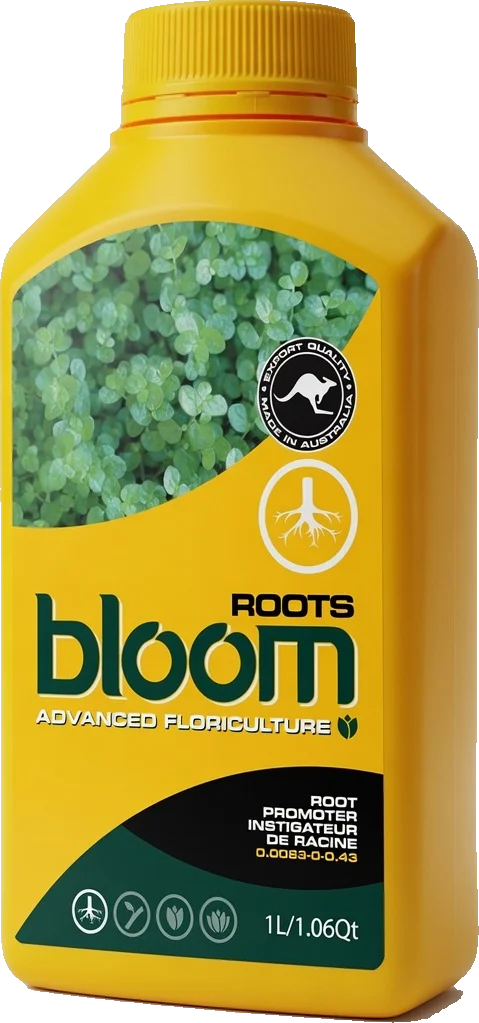
ROOTS‘ guaranteed analysis is 0.0083-0-0.43. That total nitrogen figure is so small it barely clears the floor of what a label has to disclose at all — a 1 ml/L feed dose is contributing a rounding error to a reservoir’s nitrogen budget, nowhere close to the kind of number that shows up on a Cal-Mag or base-nutrient label. So it’s worth asking: if the number is that small, why does the label bother splitting it into two sub-categories at all — 0.0021% Ammoniacal Nitrogen and 0.0062% Water Soluble Organic Nitrogen — instead of just printing one combined figure?
The answer is that “nitrogen” on a fertilizer label isn’t one chemical thing. It’s a bucket for several different molecules that release to the plant on different timelines, and AAPFCO’s labeling rules require manufacturers to disclose which forms are actually present rather than lump them together. ROOTS’ label does that honestly, even though the total is tiny — and the split tells you something real about what’s happening in the bottle.
A guaranteed analysis doesn’t just total the nitrogen in a bottle — it discloses the chemical form, because form decides release speed. ROOTS’ label does this even at a concentration most products wouldn’t bother disclosing at all.
Two forms, two release timelines
Ammoniacal nitrogen is the ammonium ion, NH4+ — already in a form roots can take up directly, no conversion required, and in a recirculating reservoir it’s also the form microbial populations nitrify into nitrate over time. Water Soluble Organic Nitrogen is different: it’s nitrogen still bound inside larger dissolved molecules — amino acids and small peptides carried over from the seaplant extract itself — that has to be broken down by microbial activity before a root can actually use it. One is an immediate, if vanishingly small, nutrient contribution. The other is nitrogen riding along in the extract’s own organic matrix, released slowly as that matrix breaks down in the reservoir or growing medium.
Why the ratio, not the total, is the interesting number
Water Soluble Organic Nitrogen makes up roughly three-quarters of ROOTS’ already-tiny nitrogen total. That ratio is consistent with what you’d expect from a seaplant-extract-derived product: most of the nitrogen present is nitrogen that came along for the ride inside Durvillaea potatorum‘s own amino acids and peptides, not nitrogen added as a standalone salt. A product formulated to supply nitrogen on purpose — a base nutrient, a Cal-Mag — reaches for nitrate or ammonium salts specifically, because those are the fast, controllable forms. ROOTS wasn’t built to do that job, and its nitrogen profile reflects it: mostly organic, mostly incidental, and mostly beside the point of what the product is actually for.
We’ve written before about how much unbudgeted nitrogen rides in on a Cal-Mag label (5.2% on ours, all nitrate). ROOTS is the other end of that spectrum — a booster whose nitrogen contribution a feed chart doesn’t need to count, because the label itself confirms there’s essentially nothing to count.
It matters more once you’re running several boosters in the same reservoir at once, because every one of them has its own guaranteed analysis, and they don’t zero out just because each individual number looks negligible. A cannabis/hydro program stacking ROOTS with Seaweed, Humate, and a finishing layer like OOZE or PHAT is adding several small-but-nonzero nitrogen contributions on top of whatever the base nutrient line is already supplying. None of them individually move an EC reading or a feed-chart target. But “individually negligible” and “collectively irrelevant” aren’t the same claim, and a grower troubleshooting a reservoir that’s running slightly hot on nitrogen late in a cycle is better served by actually reading every bottle’s N line than by assuming boosters don’t carry any.
What this changes about how you read the bottle
Nothing about ROOTS’ dosing changes because of this — the feed rate is still 0.5 ml/L, the one-time bare-root dip is still 1 ml/L, and the product’s job is still the seaplant extract, humic acid, and thiamine HCl on the label, not nitrogen delivery. What changes is how to read a guaranteed analysis generally: a tiny total doesn’t mean the label stopped doing its job. AAPFCO’s form-disclosure rule applies the same way at 0.0083% nitrogen as it does at 5.2%, and reading the sub-lines — not just the headline N-P-K number — is how you tell a booster’s incidental nitrogen apart from a base nutrient’s deliberate one.
Related reading: The Nitrogen You Forgot to Count, on the other end of this same label-reading habit.