
Why CAL’s Chelate Choice Matters More in a Flask Than in a Grow Tent
Specialty Niche Growers · Product Spotlight (CAL)
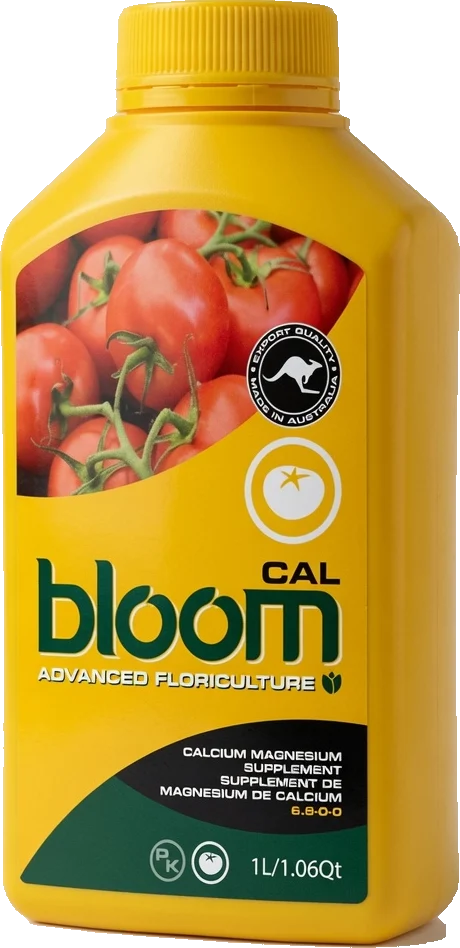
Bloom CAL’s label reads 5.2-0-0, with 5% Calcium and 1.4% Magnesium, plus two chelated micronutrients: 0.5% Iron as Iron DTPA, and 0.036% Zinc as Zinc EDTA. It’s formulated for hydroponic use, and most of the reservoirs it ends up in are tent-scale — gallons, with daily or near-daily attention. Orchid flask culture, mounted epiphyte systems, and small automated-misting terrarium reservoirs are a different category entirely: total solution volumes measured in ounces or ml, often checked weekly rather than daily. That difference changes which part of CAL’s label actually matters most.
Iron DTPA and zinc EDTA are both chelates — organic molecules that wrap around a metal ion and keep it dissolved and plant-available instead of precipitating out as an insoluble compound when the solution’s pH drifts upward. The two chelating agents don’t hold that grip equally well across the pH range. EDTA keeps iron (and here, zinc) soluble up to roughly pH 6.5; above that, it starts losing its grip and the metal can drop out of solution. DTPA holds on considerably further, to around pH 7.5, before the same thing happens.
A chelate’s stability ceiling isn’t a lab footnote — it’s the pH at which your iron silently stops being available, with no color change, no smell, nothing on the leaf until the deficiency shows up days later.
Why a small reservoir drifts faster, and gets checked less
A gallon-scale reservoir in a tented room is usually part of a routine: topped off, pH-checked, and dosed on a schedule measured in days. A two-ounce orchid flask or a terrarium’s misting cup doesn’t get that attention, and it doesn’t need it for most of what it’s doing — but its tiny buffer volume means the same CO2 exchange, evaporation, and microbial activity that nudges a large reservoir’s pH by a tenth of a point over a week can move a flask’s pH by a full point in the same timeframe, just because there’s so much less solution to resist the change. If that drift carries the solution above pH 6.5 and the iron in it were chelated with EDTA instead of DTPA, it would start dropping out of solution precisely during the stretch when nobody’s scheduled to look at it.
What this means for a specialty collection, not a tent
This isn’t a claim that CAL was formulated with orchid flasks in mind — it’s a hydroponic product, and the label says so plainly. But the same chemistry that makes DTPA iron a sound choice at any scale happens to matter more, not less, the smaller and less frequently monitored the reservoir gets. A collector running several small systems — a flask here, a mounted epiphyte there, a terrarium reservoir somewhere else — is relying on the same pH-stability margin a larger grow does, with less chance of catching a problem before it shows up as a leaf symptom. Zinc’s EDTA ceiling is a full point lower, which is worth knowing if a specific system tends to run alkaline; it’s not a reason to avoid the product, just a reason to check that system’s pH a little more often than the others.
The chelate printed on a micronutrient label is a pH ceiling, not a footnote. In a reservoir too small to buffer its own drift, that ceiling is doing more quiet work than almost anything else on the label.
This is also why CAL’s full analysis is worth reading as a set, not just for the iron line. The 5.2% nitrogen is entirely nitrate nitrogen, immediately available and immediately leachable — in a flask that gets flushed or refreshed on its own schedule, that’s a separate variable from pH drift, but it’s still a number worth tracking if a collector is running several calcium sources across different systems. Calcium itself (5%) and magnesium (1.4%) don’t carry the same chelate-stability question that iron and zinc do; they’re supplied as nitrate and sulfate-free salts, not chelated metals, so they don’t drop out of solution the same way a chelated micronutrient can. The chelate-stability issue is specific to the two micronutrients on the label, not the whole formulation — which is exactly why it’s easy to miss if you’re only reading the headline N-P-K number and not the full guaranteed analysis underneath it.
If you’re running CAL in any system smaller than a standard reservoir — a flask, a misting cup, a mounted epiphyte’s drip tray — the practical takeaway is simple: check pH more often than you would in a tent, not because the chemistry is different, but because the volume that would normally absorb a small drift just isn’t there.
Related reading: Why the Chelate on Your Cal-Mag Bottle Matters More in a Passive Reservoir, on the same chemistry at semi-hydro/LECA scale.