
Seafuel’s pH 4–5 Isn’t an Accident: What the MSDS Says About Tank-Mixing on a Propagation Bench
Floriculture & Ornamental · Science & Education
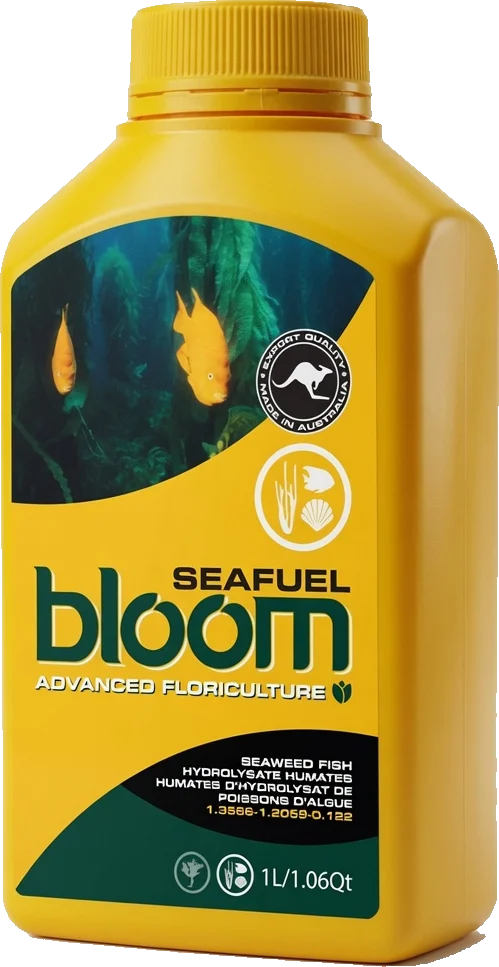
Most of what gets written about Seafuel focuses on the guaranteed analysis, but its N-P-K figures aren’t consistent across printings of the label artwork, so we leave them off rather than print unconfirmed numbers. Seafuel is derived from Durvillaea potatorum seaplant extract and hydrolyzed blue fin tuna. The safety data sheet carries a different set of numbers that rarely make it into a feed chart conversation, but matter just as much on a propagation bench where several products often go into the same mixing tank: a pH of 4 to 5, a specific gravity of 1.2 to 1.4, and an explicit incompatibility note — avoid combining with alkali agents.
None of that is unusual for a hydrolyzed fish protein input. It’s also not a detail to skip past if your bench routine involves tank-mixing Seafuel with anything else before it goes into the reservoir.
A guaranteed analysis tells you what’s in the bottle. A safety data sheet tells you what happens when the bottle meets something else. On a propagation bench running several products through one mixing tank, the second document is the one that prevents a problem.
Why the acidity, and why it matters mixed
Hydrolyzed protein products — the amino acids and peptides that come out of breaking down fish tissue — are generally more stable in solution at a low pH than a high one. That’s a formulation choice, not an accident: keeping the product itself in that 4-to-5 range is part of what keeps its dissolved protein content in suspension on the shelf. The MSDS’s “incompatible with alkali agents” line follows directly from that: introducing a strongly alkaline tank-mix partner shifts the local pH of the mixed solution upward, and a hydrolyzed-protein product that was formulated and shelf-stable at pH 4–5 isn’t guaranteed to behave the same way outside that range. On a cut-flower bench mixing several inputs in sequence, that’s the scenario the warning is actually about.
What this looks like in practice
Most hydroponic and floriculture nutrient lines, including ours, run on the acidic side of neutral already, so in an ordinary feed-tank scenario this is rarely an issue in practice. It becomes relevant specifically when a strongly alkaline product — certain pH-up solutions, some lime-based soil amendments, a few other strongly alkaline inputs — is part of the same mixing routine. The standard precaution for any tank-mix situation applies here without needing anything specific to Seafuel: add products one at a time, check the tank’s pH before and after each addition, and if you’re introducing something you haven’t mixed with it before, test a small batch first rather than committing a full tank. None of this changes Seafuel’s dosing — it’s still the same reservoir-rate product — it’s a mixing-order habit, not a formulation change.
The safety data sheet isn’t paperwork — it’s the part of the label that tells you what the product does when it meets something else in the tank, not just what it does on its own.
The specific gravity line, and why it’s there too
The 1.2–1.4 specific gravity figure is a density measurement — Seafuel is noticeably heavier than water, which tracks with what a hydrolyzed-protein concentrate actually is: dissolved amino acids, peptides, and the seaplant extract’s own solids, carried in a smaller volume than a simple water-based solution would need. It’s not a safety number in the way the pH and incompatibility lines are, but it explains something growers sometimes notice without quite placing it: a concentrated product like this doesn’t pour or measure quite like water does, and a dosing routine built around volume (ml/L) rather than weight should account for that density when precision matters, especially at the small end of a propagation bench’s dosing range.
Put together, the MSDS data describes a product that’s concentrated, acidic by formulation, fully biodegradable, and specifically flagged against one category of tank-mix partner. None of that is a warning about the product’s safety in normal use — it’s biodegradable and the acidity is mild, well within the range of other acidic garden inputs. It’s a reminder that the safety data sheet and the guaranteed analysis are answering two different questions, and a cut-flower propagation bench juggling several bottles in the same mixing tank benefits from reading both.
Related reading: The Fish in Seafuel Comes From a Fishery With Its Own Paperwork Trail, on another document behind the bottle.