
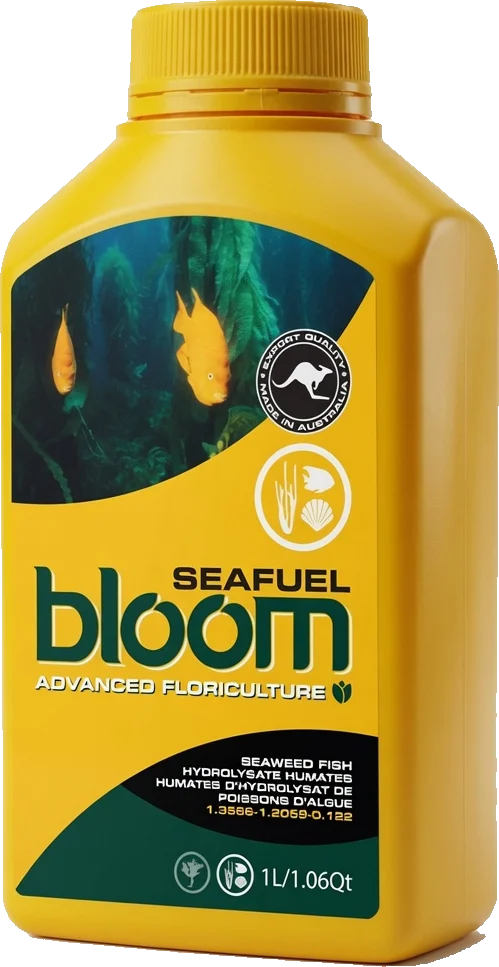
Seafuel’s label declares two sources, plainly: Durvillaea potatorum (seaplant extract) and Hydrolized Blue Fin Tuna (fish hydrolysate). Most growers read “fish hydrolysate” and move on to dosing. Fewer ask where the fish part actually comes from, or whether that fishery is the kind that gets tracked on paper. It is — and the paper trail is worth a few minutes.
One species, one declared route
Southern Bluefin Tuna (Thunnus maccoyii) is the species behind the hydrolysate in Seafuel, Groigen, and Florigen. It isn’t caught and processed ad hoc. The fishery is managed under a Total Allowable Catch set by the Commission for the Conservation of Southern Bluefin Tuna (CCSBT), paired with a Catch Documentation Scheme that tracks individual fish from capture onward. In South Australia specifically, the supply chain runs through sea cages in Spencer Gulf, where wild-caught juveniles are grown out on a diet of local sardines before processing.
That distinction matters more than it sounds. A lot of fish hydrolysate inputs on the market are built from byproduct streams with no single declared species and no catch-level tracking — whatever mixed scraps a processing plant happened to have that week. That’s not a knock on those products; it’s just a different starting point. A single declared species, caught under a quota and tracked by a documentation scheme from the water to the processing step, is a narrower and more auditable supply chain than “assorted fish byproduct,” and it’s the reason Seafuel’s label can name one species instead of a generic “fish protein” line.
What “managed” means here, and what it doesn’t
Southern Bluefin Tuna is still listed as Endangered by the IUCN. That status hasn’t changed. What has changed, per CSIRO’s 2022 stock assessment and the Marine Conservation Society’s Good Fish Guide, is that the stock has reached an interim rebuilding target under the TAC framework — a sign the management system is doing something measurable, not a clean bill of health. We’re not printing a “sustainable” claim here, because that word carries more weight than a rebuilding-target milestone supports. What we can say plainly: this is a quota-managed, catch-documented fishery, not a loosely tracked byproduct stream, and that’s a meaningfully different starting point for a fertilizer input than “fish scraps from wherever.”
What the label actually settles
Here’s what’s confirmed directly off Seafuel’s own label artwork, not inferred: 0.075% Humic Acid derived from Leonardite as a non-plant-food ingredient. The label’s N-P-K figures aren’t consistent across printings of the artwork, so we’re leaving them off rather than printing something unconfirmed. The MSDS adds a few more settled details: pH 4–5, specific gravity 1.2–1.4, a “sweet/fish” odor profile, and full biodegradability.
pH: 4–5
Dosing stays simple regardless
None of the sourcing detail changes the rate on the label: 1 ml/L of nutrient solution, same as always, whether the reservoir is a 5-gallon bucket in a tent or a recirculating system feeding a full room. The fishery story doesn’t change the dose math or the dosing schedule — it just answers a question some growers actually ask once they’ve been running Seafuel for a while: where does the tuna hydrolysate component actually come from, and is it the kind of fishery that gets tracked, or the kind that doesn’t. For this one, the answer happens to be tracked.
It’s also worth separating the sourcing story from the plant-performance story. Nothing above is a claim about yield, potency, or rooting response — this is purely a supply-chain question, answered with fishery-management sources, not a trial result. The feed-chart dose and the mechanism behind what the hydrolysate actually does in a reservoir are a separate conversation, covered elsewhere on this site.
There’s a version of this story that oversells a quota number into a marketing claim. We’re not telling that version. The honest one is smaller: one declared species, one managed fishery with a documentation trail, and a label that holds up when you check it against the artwork directly instead of the website copy.
The same label’s MSDS has its own set of settled details worth knowing before tank-mixing — see Seafuel’s pH 4–5 Isn’t an Accident.