
Most feeding conversations start with N-P-K. Humate doesn’t have much of one — 0-0-3.12 on the label, nothing to write home about. What’s actually doing the work is the other number on that panel: 10% Humic Acid, derived from Leonardite. That’s the ingredient worth talking about, and it’s also the one most growers scroll straight past.
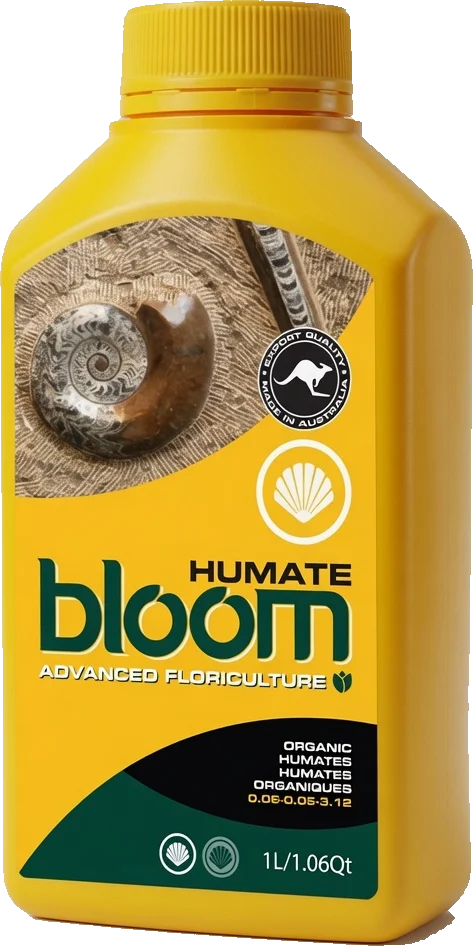
What’s actually in the bottle
Read straight off the label: 3.12% soluble potash (K₂O), derived from potassium hydroxide — and 10% humic acid, derived from Leonardite, a soft brown-coal ore that’s one of the richest natural humic acid sources there is. That KOH-derived potash matters for one specific reason: it leaves potassium behind rather than sodium, which is the input a grower actually wants sitting in the root zone.
On the label
- 3.12% Soluble Potash (K₂O) — derived from Potassium Hydroxide
- 10% Humic Acid — derived from Leonardite
- Rate: 2.5 ml per litre of fertiliser solution
What humic acid is actually doing down there
Humic acid isn’t a nutrient in the N-P-K sense — it’s a soil conditioner. In a living-soil or soil-based system, it works on the growing medium itself: improving structure and porosity, increasing cation exchange capacity (the soil’s ability to hold onto and release nutrients rather than losing them to runoff), and giving the microbial life in the root zone something to work with. None of that shows up on a feed chart, but it’s the difference between a soil that’s just holding a plant upright and one that’s actually feeding it.
Where it fits
Humate isn’t a base program on its own — it’s a layer that sits underneath one. Same principle as the rest of the Bloom range: it adds to whatever you’re already running in soil, rather than asking you to replace it.
Who it’s actually for
This one’s built for soil and living-soil growers. The confirmed rate on the label — 2.5 ml/L of fertiliser solution — is a soil-system rate; Bloom doesn’t currently have a verified hydroponic application rate for Humate, so if you’re running a recirculating or run-to-waste hydro system, this isn’t the product to reach for first. For soil, though, it’s about as low-effort an addition as the range has: mix it into your regular fertiliser solution at 2.5 ml/L and let the humic acid do its slower, structural work in the background while your base program handles feeding.
Quick reference
- Best for: soil and living-soil systems
- Rate: 2.5 ml/L of fertiliser solution
- Pairs with: your existing base program — not a replacement for it
- Key input: 10% Humic Acid from Leonardite
Made the same way it’s been made for 26 years
Humate comes out of the same Green Fields, South Australia facility as the rest of the Bloom range — Agricultural Organics (Aust) P/L has been formulating for the US market for 26 years. Nothing about this one is new or experimental; it’s one of the quieter products in the lineup, doing a job that doesn’t show up in bud weight or leaf color but shows up in how well the soil underneath everything else is actually performing.
Running soil or living soil? Ask your local shop if they carry Bloom Humate — or reach out directly and we’ll point you to a stockist.