
The Best Published Root Data for Our Declared Seaweed Species Isn’t Ours to Claim
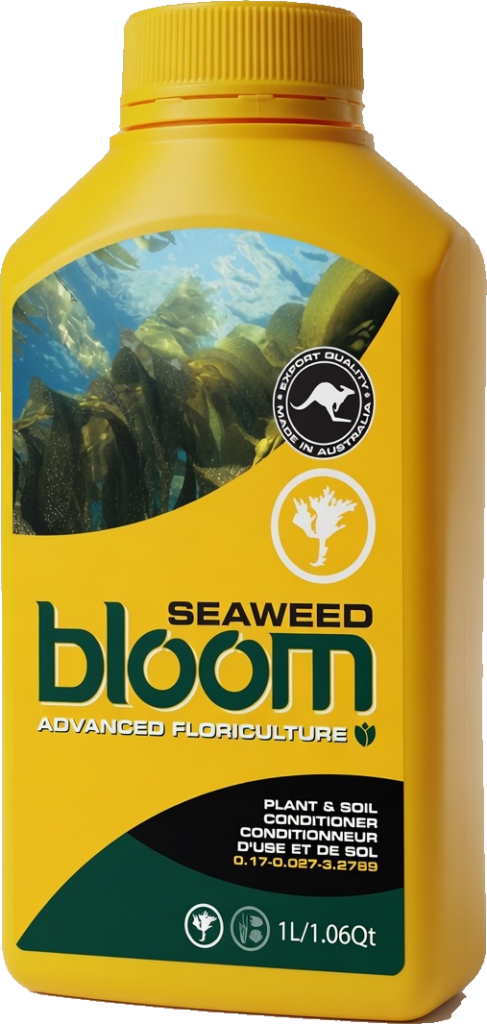
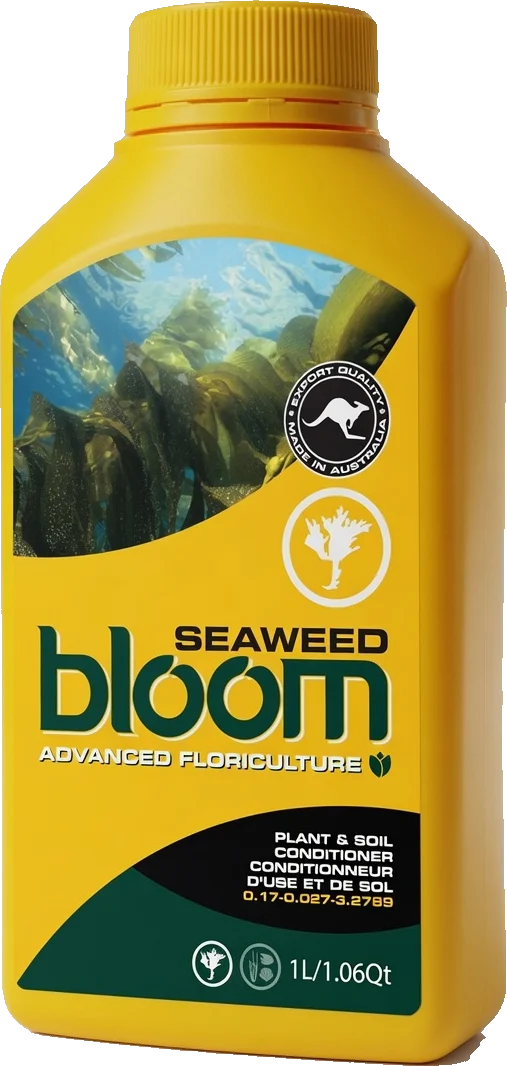
Bloom Seaweed’s label declares one input: Durvillaea potatorum, a brown seaweed harvested off southern Australia, at 0.17-0.027-3.278 and a 1 ml/L rate. It’s a real, useful piece of brand honesty to sit with the fact that the best field trial data on that exact species doesn’t belong to us — and to explain why we’re not borrowing someone else’s number, especially for a cut-flower or ornamental program where root establishment and stem quality are the whole decision.
A published strawberry trial, and whose data it actually is
A peer-reviewed strawberry study tested a commercial seaweed extract made from more than 50% Durvillaea potatorum blended with Ascophyllum nodosum, produced by alkaline hydrolysis. The field results were strong: root length density up 38%, secondary root density up 22%, runner yield up 8–19%, marketable fruit yield up 8%, and root length density correlating with fruit yield at r = 0.94 — a tight relationship by field-trial standards. It’s genuinely the strongest field-scale root evidence that exists for a Durvillaea potatorum-containing product.
It is also not a trial of our bottle. It’s a different company’s commercial extract, blended with a second species, run through alkaline hydrolysis — a specific processing route our own label doesn’t declare one way or the other. Sharing a declared input with a product that performed well in a published trial is not the same thing as having that trial’s number. The honest version of that sentence has two parts, and dropping the second one is exactly the move that gets a sheet in trouble.
Why the processing question stays closed
It would be tempting to lean the other way instead — to argue that a gentler, undisclosed process preserves more of what makes the species work. That argument fails for the same reason: it would be claiming a process Bloom Seaweed hasn’t declared, about a species whose extraction route genuinely does affect the result. A large meta-analysis of seaweed biostimulants across 198 studies and 2,021 treatment comparisons found extraction method matters — alkaline hydrolysis and water extraction both produced significant yield gains across the literature, while enzyme-assisted, acid, and several other routes did not reach significance. The same analysis found soil or fertigation application outperformed foliar spraying on average, 19–21% versus 15.5% — worth knowing before deciding how to apply any seaweed input in a bed or bench program, Bloom’s included. Route and placement are both real variables. We just can’t tell you which route ours uses, so we’re not going to imply an answer either direction.
What that means for a cut-flower or ornamental program
For a grower deciding whether a seaweed input belongs in the propagation or production rotation, the species-level evidence is genuinely reassuring: Durvillaea potatorum has real field-scale root data behind it in a published, peer-reviewed commercial trial, with one of the tighter correlation coefficients you’ll see between a root metric and a yield outcome in this literature. That’s a meaningfully different situation from a seaweed input where the declared species has no trial evidence behind it at all. What it doesn’t do is let us print “38% more root length density” on our own label, because that number was measured on a different formulation, blended with a second species, processed a specific way we haven’t confirmed for our own bottle.
What we’ll actually say
What’s true, and what we can stand behind, is narrower than either the borrowed-credit version or the superior-process version: Durvillaea potatorum is a real, studied input with field-scale root data behind it in at least one published, peer-reviewed commercial trial. Bloom Seaweed declares that same species, at a dose and ratio you can read on the bottle. We haven’t run that specific trial ourselves, and we’re not going to present someone else’s field data as though it describes our product. For a cut-flower or ornamental program weighing whether a seaweed input belongs in the rotation, that’s a fair way to read the evidence: the species has real support, the exact formulation in front of you is still its own thing, and a brand that’s comfortable saying so is one worth the benefit of the doubt on the figures it does print.
Related reading: Why the Same Dose Works With One Seaweed Product and Not Another, on the same declared-formulation honesty applied to dosing.