
Why the Same Dose Works With One Seaweed Product and Not Another
Floriculture & Ornamental · Science & Education
A dose that worked in someone else’s propagation trial, or on a forum thread about a different bottle, doesn’t reliably carry over to the bottle on your own bench — and that’s not a complaint about any single product being unreliable. It’s a documented property of the whole seaweed-extract category.
A 2024 review in Frontiers in Horticulture, focused specifically on commercial seaweed-extract biostimulants in ornamental cutting propagation, put it plainly: outcomes “vary based on crops, cuttings, location, raw materials, composition, dose, application number and procedures, and growth environment,” and the effects are “species-specific and product-specific.” The line worth sitting with: “the same dose can prove effective if administered with one SE commercial product and ineffective with another.”
That’s not a knock on the category — it’s an explanation of why “seaweed extract” functions less like one ingredient with a known dose-response curve, and more like a label that covers many genuinely different formulations.
Why a shared ingredient list still doesn’t share a dose
Part of the reason doses don’t transfer is that seaweed extracts aren’t thought to work through one isolated active compound at a fixed concentration. A separate review on biostimulant mechanisms found that fractionating seaweed extracts into their individual components “has not yielded favorable growth effects” — only whole extracts have been consistently effective, which points to the compounds working together rather than any single one carrying the effect at a dose that would transfer cleanly between formulations. Species, extraction method and concentration all shift at once between commercial products, so a trial’s dose number is really a description of one specific formulation’s results, not a universal seaweed-extract dose.
The same review adds a seasonal wrinkle worth knowing on a propagation bench specifically: “the optimal dose depends on the growing season too” — meaning even a dose that’s right for one formulation on one cutting batch isn’t guaranteed to stay right through a different propagation window for the same plant.
“Seaweed extract” isn’t a dose. It’s a category, and the dose that matters is the one printed on the bottle actually on the bench — not the one from a different bottle’s trial.
What ROOTS’ own rate is actually calibrated to
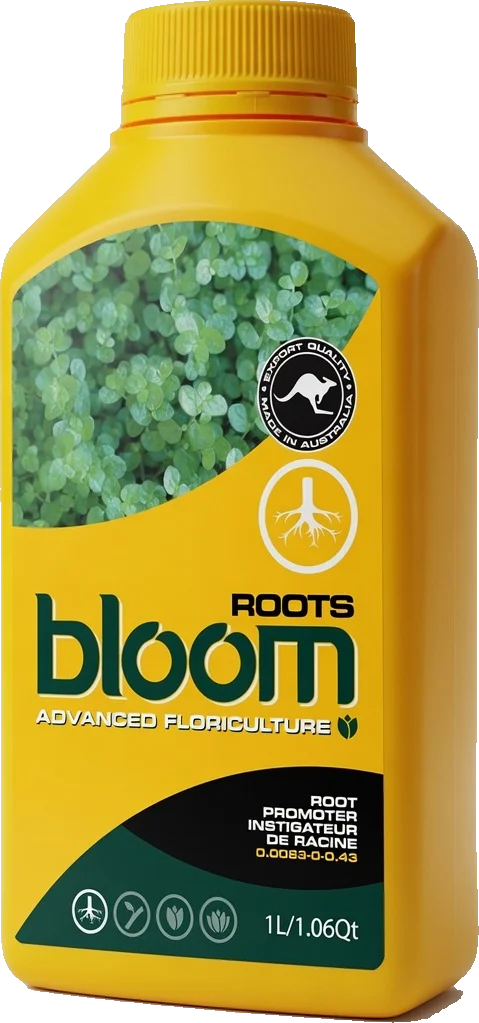
Bloom ROOTS declares its own formulation plainly: Durvillaea potatorum seaplant extract, 0.075% humic acid from Leonardite, 0.054% thiamine hydrochloride, at a fixed 0.5 ml/L feed rate (1 ml/L for a bare-root dip). That number isn’t borrowed from a published trial on a different species or extraction route — it’s the rate declared for this specific formulation. The De Lucia review’s finding doesn’t say that number is right or wrong in some absolute sense; it says that trying to improve on it by importing a dose from a different seaweed-extract product’s trial is exactly the move the literature warns against. The formulations aren’t interchangeable, so the doses aren’t either.
For a propagation bench running several cutting batches through a season, that’s a reason to resist the temptation to tune a dose upward chasing a number seen elsewhere online. The honest takeaway from a review built specifically around cutting propagation is narrower and more useful than a universal “more is better” or “less is safer”: whichever bottle is actually in use, its own printed rate is the one number calibrated to what’s actually inside it.
Where this leaves a grower comparing products
This doesn’t mean published seaweed-extract trials are useless to read — they’re genuinely useful for understanding the category’s mechanism, the kind of effects that show up, and the conditions that tend to help or hurt a cutting’s odds. What they don’t reliably hand over is a transferable number. A trial reporting a strong result at, say, 1 mL per liter of a named commercial extract is reporting on that formulation’s species, extraction process and concentration all at once — change any one of those three and the dose-response relationship the trial measured no longer applies, even if the bottle on the shelf also says “seaweed extract” on the label.
That’s a more useful filter for reading marketing claims than most growers get handed. The next time a dose from someone else’s cutting-propagation success story shows up in a forum thread or a product comparison, the question worth asking isn’t “will this work for me too” — it’s “is this even the same formulation.” If the species, the extraction route or the concentration differs from what’s actually in the bottle on the bench, the literature’s own honest answer is that the dose doesn’t transfer, and the only number worth trusting is the one the label in front of you actually prints.
Related reading: The Best Published Root Data for Our Declared Seaweed Species Isn’t Ours to Claim, on the same declared-species honesty theme; The Ratio That Changes Once a Bloom Sets Color, on what Seaweed’s own N-K ratio is built for at bud set; and Eighteen Types of Gibberellin, and Only One in Twenty Is Doing Anything, on why hormone content isn’t the mechanism either.