
Why Mixing Your Own Cal-Mag Can Leave Chalk at the Bottom of the Bucket
Calcium and magnesium deficiency is a common fall problem in containers and raised beds, and the home-garden fix a lot of people reach for is the same one: calcium nitrate plus Epsom salt, stirred into one concentrate. It’s cheap, the two ingredients are easy to find, and on paper it supplies calcium, magnesium and a bit of nitrogen. What it also does, if you mix it strong enough or let it sit, is quietly make chalk in your own bucket.
The reaction that’s easy to miss until it’s already happened
Epsom salt is magnesium sulfate — it carries a sulfate ion. Calcium nitrate carries a calcium ion. Put calcium and sulfate in the same concentrate together and they have a well-known tendency to pair up and fall out of solution as calcium sulfate — gypsum, the same mineral that’s mined and ground up as a soil amendment in its solid form. In a stock solution it shows up as a fine white cloudiness or a chalky layer settling at the bottom of the container, worse the stronger the mix and the longer it sits before use. Once that calcium has precipitated out, it’s no longer dissolved plant food in your feeding solution — it’s sediment, and it isn’t coming back into solution just by stirring the jug again.
What’s actually in Bloom’s bottle, and why that reaction has nothing to work with
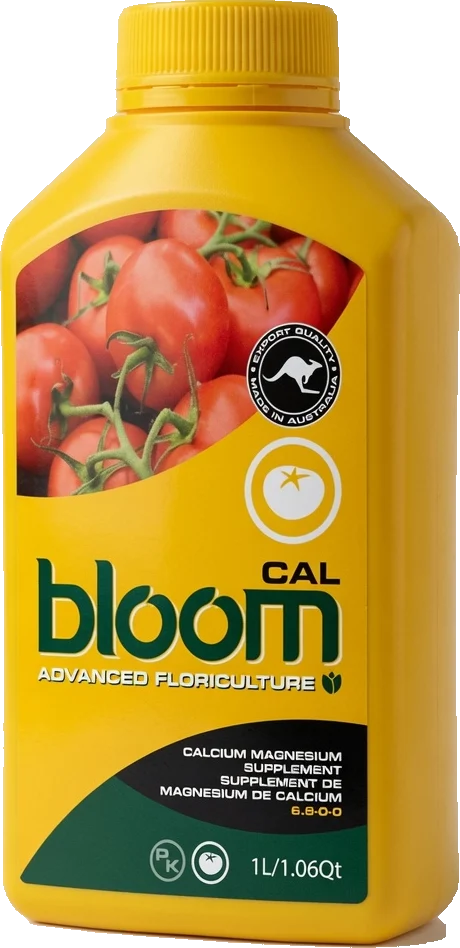
Bloom’s Cal-Mag is labeled 5.2-0-0, with 5% calcium and 1.4% magnesium, derived from calcium nitrate, magnesium nitrate, chelated iron (DTPA) and chelated zinc (EDTA) — there’s no sulfate anywhere in that list. Using magnesium nitrate instead of magnesium sulfate for the magnesium source means the calcium-plus-sulfate pairing simply has nothing to react with. It’s a genuinely different formulation choice from the DIY recipe, not just a different-looking label, and it’s the reason a bottle of Cal-Mag doesn’t develop the same cloudy sediment a home-mixed jug can.
That nitrate source is worth knowing about in its own right. All 5.2% of the nitrogen on Bloom’s Cal-Mag label is nitrate nitrogen — the same nitrogen form you get from calcium nitrate at home. At the standard 1 ml/L dose, that’s roughly 3.8 ml per gallon of water, and it works out to about 52 ppm of nitrogen added with every feeding — worth counting against whatever base fertilizer program is already running, the same way you’d count it from a home-mixed calcium nitrate solution. Cal-Mag isn’t a nitrogen-free additive, bottled or homemade; it’s just one where the second ingredient doesn’t also leave chalk behind.
Why a strong, fresh mix is the riskiest combination
If you’re already mixing your own calcium nitrate and Epsom salt and haven’t noticed a problem, it may simply mean your concentrate is dilute enough, or used quickly enough after mixing, that the reaction hasn’t had time or concentration to show itself yet — gypsum formation is a matter of degree, not an on/off switch. It becomes more likely the stronger the stock solution and the longer it sits mixed before you use it, which is exactly the situation a batch-mixed fall feeding jug tends to create: you mix a gallon of concentrate once a week to save time, and the longer it sits concentrated, the more of that calcium has a chance to find a sulfate ion and drop out. By the time you notice a cloudy jug or a crust on the inside of the container, some unknown fraction of the calcium you measured out has already left the solution — which means the dose your plants actually get is lower and less predictable than the dose you measured.
What this means for a fall feeding routine
The fix at home, if you’re set on mixing your own, is straightforward once you know the mechanism: keep the calcium and magnesium-sulfate concentrates in separate containers until the moment of feeding, mix only what you’ll use that day, and never pre-blend a week’s worth of combined stock solution. Or use a magnesium source that was never going to react with the calcium in the first place, which is the whole reason Bloom’s bottle is built the way it is — one less thing to time, store separately, or watch for a chalky layer at the bottom of the jug.