
The Clog Risk That’s Bigger in a 2 mL Dripper Than a 20 L Watering Can
If you grow orchids in semi-hydro LECA, run a micro-drip ring on a bonsai pot, or keep a closed terrarium’s misting line topped up, your whole system moves water through something narrow: a capillary wick, a 1–2 mm emitter, a syringe tip, a nozzle. In a flood table or an open bed, a stray particle mostly just settles out or washes through. In a system built around one pot and one wick, there’s no wide channel for anything to pass harmlessly through on its way to the only emitter the plant has.
That difference in scale is why a very ordinary DIY cal-mag habit causes more trouble the smaller your system gets. The same logic applies to a backyard aquaponics setup dosing a handful of grow beds through thin tubing, or a Wardian-case terrarium feeding its plants through a single low-flow irrigation line — none of these setups have the luxury of a wide pipe to hide a mistake in.
The classic home mix, and the reaction it sets up
The most common homemade calcium-magnesium supplement is calcium nitrate paired with Epsom salt (magnesium sulfate) — both cheap, both easy to find, both genuinely good sources of calcium and magnesium on their own. The trouble starts when they share the same concentrate. Calcium ions and sulfate ions in solution together form calcium sulfate, better known as gypsum, and gypsum is only slightly soluble in water. It doesn’t fully dissolve back out once it forms; it settles into a fine particulate that keeps accumulating as the stock sits, gets handled, or slowly concentrates through evaporation.
In a 200 L reservoir, that particulate is a small fraction of a large volume — it dilutes, it settles, a pump filter catches most of it. In a 200 mL orchid dip cup or a terrarium’s sump, the same mixing habit reaches the same saturation point in far less water, with far less margin before it reaches the one narrow point downstream.
Why the narrow point is the whole system, at this scale
Picture the comparison below: the same gypsum particulate behaves identically in both cases — it’s the geometry around it that changes the outcome. A wide channel gives it somewhere to go. A capillary wick, a sub-2 mm emitter, or a fine misting nozzle gives it nowhere to go but the one spot the whole dose has to pass through.
What’s actually in the bottle, stated plainly
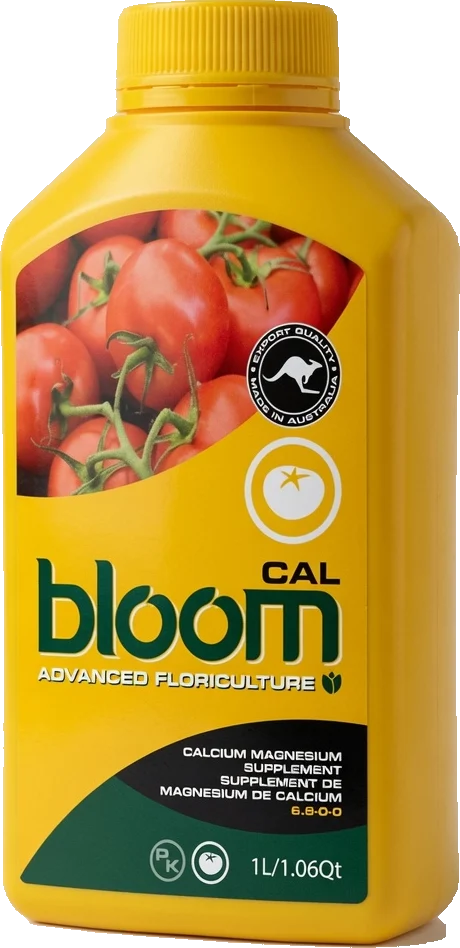
Bloom CAL’s label declares calcium nitrate and magnesium nitrate as its sources — magnesium nitrate, not magnesium sulfate. Sulfate never enters the concentrate in the first place, so the calcium-plus-sulfate reaction that forms gypsum has nothing to work with. That’s a formulation choice, not a magic trick, and it’s worth being just as plain about the number that comes with it: CAL is 5.2% nitrogen, all of it nitrate nitrogen. At the labeled rate of 1 ml per liter, that’s roughly 52 ppm of nitrate nitrogen added with every dose — worth counting in a small reservoir’s total nitrogen budget the same way you’d count any other nitrate source.
The practical takeaway for small-bore setups
None of this is really about one product versus another — it’s about matching the chemistry of whatever you mix to the geometry of what it has to pass through. A gypsum particulate that a flood table shrugs off is a real liability for a wick thread, a sub-2 mm emitter, or a fine mist line, simply because there’s no slack in the system for it to hide in. Whatever cal-mag source you’re running, it’s worth knowing which two ions are sharing a bottle before they share a wick. If you’re premixing your own calcium and magnesium for a semi-hydro tray, a bonsai drip ring, or a terrarium sump, it costs nothing to check the two labels against each other first — nitrate against nitrate causes no reaction at all, which is the whole point.
And whatever you’re running, it’s good practice on any semi-hydro or micro-drip setup to check wick ends and emitter tips now and then — the smallest part of the system is usually the one doing the most work.