
The Combined Route That Beat Water in a 2026 Wheat Trial — and the One That Didn’t
Most of what gets argued about fish-based inputs comes down to a nitrogen percentage on a label. A 2026 trial on fish-processing by-products took a different measurement: instead of stopping at the declared number, it grew wheat with several different hydrolysis routes and a plain water control, and measured what actually came up out of the soil three weeks later. The results split the routes apart in a way a guaranteed analysis alone never would have.
Three routes, one wheat trial
The study ran fish by-product hydrolysates through three separate processing routes — a purely microbial route (M), a protease-only enzymatic route (P), and a combined microbial-plus-protease route (MP) — alongside a plain water control and a commercial reference product. Declared nitrogen across the three experimental routes came out close together: 1.59%, 1.65% and 1.53% by weight. The commercial reference’s own label, by contrast, claimed 3.00% N — roughly double what any of the lab routes actually measured.
At 21 days, wheat grown with the MP combined route reached 54 cm with 2.3 g of measured plant biomass; the microbial-only route reached 52 cm and 1.7 g; the untreated water control reached 44 cm and 0.7 g. The MP route also produced the most reactive amino nitrogen of the three — 226 millimolar of alpha-amino groups, against 170 for the microbial route alone and 100 for the enzymatic route alone. And the commercial reference product, the one declaring the highest nitrogen number on its own label, showed no measurable improvement over the plain water control.
Why one route out-produced the others
The mechanism isn’t a mystery. A separate review of protein-hydrolysate biostimulants explains that heat-and-acid processing — the older emulsion route — partially or totally destroys several amino acids, including tryptophan, cysteine, serine and threonine, and converts others from their biologically active L-form into the D-form through a process called racemization. Enzymatic processing avoids that heat-and-acid step entirely, which is why it retains a higher ratio of intact peptides and L-form amino acids. A combined microbial-plus-enzymatic route appears to compound that advantage rather than simply repeat it: more reactive nitrogen available, measured directly as alpha-amino groups, translated into more biomass at harvest.
That’s also the honest answer to why a declared percentage on a label and a result in the ground can disagree so sharply. The commercial reference in this same trial declared the highest nitrogen figure of anything tested, and it was the one treatment that didn’t separate from plain water. A number on a label describes what’s in the bottle. It doesn’t describe what the plant does with it, and those are two different questions that this trial happened to ask side by side.
What this means for a small, unflushed reservoir
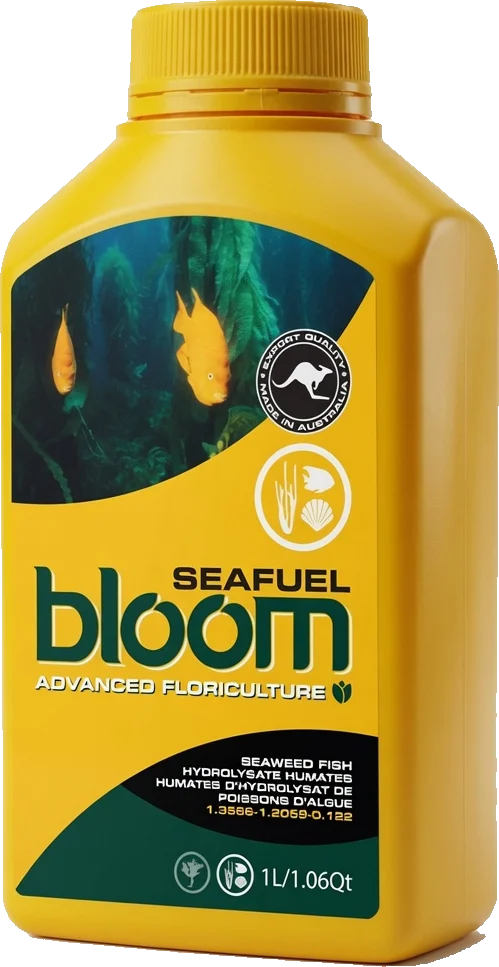
None of these three experimental routes is Bloom’s SeaFuel, and we’re not claiming otherwise. What we can say, because it’s on our own label, is that Bloom SeaFuel’s declared inputs are seaplant extract from Durvillaea potatorum and hydrolyzed blue fin tuna — stated plainly as a fish hydrolysate, not an emulsion — alongside 0.075% humic acid derived from Leonardite as a non-plant-food addition. The safety data sheet puts it at pH 4–5, fully biodegradable, with a stated incompatibility with alkali agents, which lines up with an enzymatic process rather than the old heat-and-acid emulsion route. We don’t have a current, settled guaranteed-analysis figure we’re comfortable printing for SeaFuel in this piece — that number has a known internal discrepancy we’re still working through — so we’re leaving it off here deliberately rather than guessing.
For a semi-hydro or houseplant reservoir that isn’t getting flushed every day, the process question matters more than it would in a run-to-waste system, simply because whatever doesn’t get used sits there longer. A route that delivers more usable nitrogen in a form the plant can actually take up is worth more in that kind of system than a bigger number on a label that the ground doesn’t reward.
It’s also worth being honest about what this one trial doesn’t settle. It’s wheat, not a houseplant or an ornamental, grown in open soil rather than a passive reservoir, over a single 21-day window. We’re not stretching it into a universal rule — we’re using it for the narrower, defensible point it actually supports: that two inputs can share a processing family and still behave nothing alike once something is actually growing in them, and that the number on the front of a bottle is the start of that conversation, not the end of it.