
The Powder Seaweed Switch Nobody Mentions
LECA growers switch to powdered seaweed products constantly — less bottle volume to store in a small grow space, no liquid to spill near a passive reservoir, longer shelf life. It’s a completely reasonable swap on convenience grounds. What rarely gets mentioned is that drying a liquid seaweed extract into powder form doesn’t just remove the water. According to one survey of twenty commercial extracts, it can remove something else entirely.
What the twenty-product survey found
A 2022 Frontiers in Plant Science study tested twenty commercial brown-seaweed extracts — sixteen liquid, four solid — across a full composition panel: polyphenols, flavonoids, potassium, alginic acid, mannitol, carotenoids, and the plant auxin IAA. The spreads between products were enormous on nearly every axis (polyphenols varied roughly 60-fold, flavonoids about 144-fold, potassium about 36-fold). But one line in the results stands apart from the rest: IAA was below the detection limit in every single solid formulation tested. Not low. Undetectable.
The study’s own conclusion was that extraction methodology — not just the starting seaweed — significantly shapes the finished composition profile. Going from liquid to solid form isn’t a neutral change in packaging; it’s a different manufacturing step, and that step appears to cost the extract its measurable auxin.
Why this matters less than it sounds like it should
Here’s the honest caveat, because it cuts the other way too: the industry’s own standards body, EBIC, has concluded that even in liquid extracts, whatever trace hormone is present sits far below the concentration needed to produce a measurable plant response on its own. One commercial liquid extract measured at roughly 60 times below the auxin activity threshold, undiluted, before a grower ever adds water. So the liquid extracts in that twenty-product survey weren’t delivering meaningful hormone activity either — they just had a measurable trace of it, and the solids didn’t.
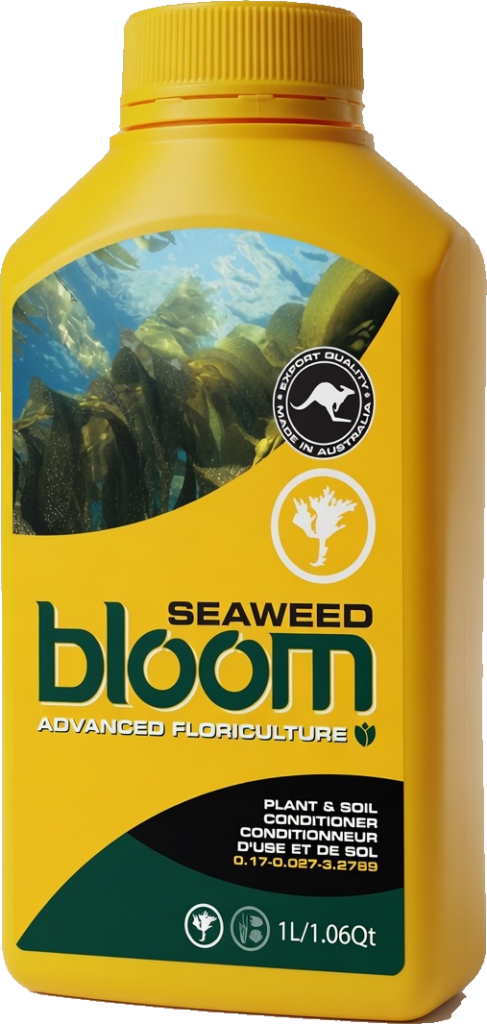
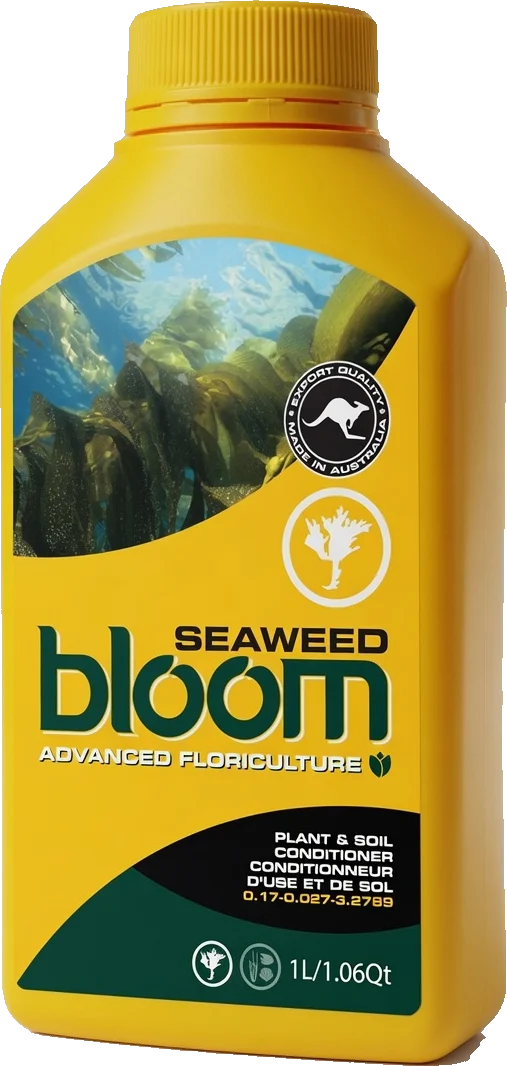
Our own Bloom Seaweed is a liquid, derived from Durvillaea potatorum, declaring 0.17% nitrogen, 0.027% available phosphate and 3.278% soluble potash at 1 ml/L — and the label carries no hormone figure at all, because there isn’t one worth declaring.
What a powder switch is actually giving up
If you’ve switched a LECA setup to a powdered seaweed product for the shelf life and the storage space, that’s a perfectly sound trade on its own terms — a passive reservoir with no soil buffer rewards shelf-stable inputs. Just be clear about what you’re actually trading. It isn’t “hormone activity for convenience,” because neither form is delivering meaningful hormone activity in the first place. It’s one unmeasured manufacturing variable for another: a liquid extract whose trace auxin was always functionally irrelevant, for a solid extract where that same trace apparently doesn’t survive the drying process at all. Neither is the reason a seaweed extract works on a houseplant; the polysaccharide and polyphenol fraction is still doing whatever work either form is doing.
Why the drying step is the likely culprit
The same survey found the twenty products varied by up to roughly 36-fold in potassium and 29-fold in alginic acid content depending on extraction method, which already tells you the finishing process reshapes a seaweed extract’s chemistry well beyond just adding or removing water. Auxin-type compounds in seaweed extracts are present at vanishingly small concentrations to begin with — nanomolar, not percent — and heat, drying time and the carrier used to turn a liquid into a shelf-stable solid are exactly the kind of processing steps that can degrade or dilute a trace compound below what an instrument can pick up. Nobody in the survey measured the drying step itself, so this is the likely explanation, not a confirmed one. What’s confirmed is the outcome: four for four, the dried products came back with no detectable IAA at all.
For a LECA reservoir that gets topped off rather than fully flushed between feedings, this is worth knowing less because of the hormone question — which, again, was never doing meaningful work in either form — and more as a reminder that “the same product, just dried” is rarely literally true. Whatever convenience a powder buys you, assume its chemistry has moved, and judge it on what it actually delivers rather than on the assumption that drying only removed the water.