
A two-liter LECA reservoir doesn’t forgive guesswork the way a raised bed does. There’s no soil microbiome to buffer a mistake, no large volume to dilute an error, and whatever goes into that reservoir is what the roots sit in until the next refill. That’s exactly the scale where it matters most that a seaweed-based input is a liquid extract with a declared number on the label, rather than something steeped at home from whatever kelp was on hand.
Most of a seaweed frond doesn’t dissolve in cold water
Brown seaweed’s bulk is dominated by alginic acid — typically 15 to 45% of its dry weight, depending on species — and that fraction sits in the cell wall as an insoluble matrix bound up with calcium and other minerals. It physically encloses the polysaccharides researchers are usually interested in, like laminarin and fucoidan. Published extraction work on fucoidan specifically notes that pulling it out of intact tissue generally needs sustained heat — 60 to 100°C for one to eight hours — or a strong acid step, plus pre-treatment like drying and milling to increase surface area. None of that happens in a jar of cold water on a windowsill.
What a cold, room-temperature soak does pull out is mannitol and the soluble mineral ions — real, but a different and much smaller part of what the plant-biostimulant literature is actually interested in. Two independent published studies comparing boiling against a multi-day cold soak of the same biomass both found heat extracted meaningfully more of the compounds associated with growth response. Neither study, worth noting honestly, tested whole fresh or beach-cast seaweed rather than dried and milled material — so even that comparison doesn’t fully answer what a home grower steeping a whole frond actually ends up with. What it does establish is that a cold soak is, chemically, a comparatively light extraction.
Composition ranges per published brown-algae extraction literature.
What that means at reservoir scale
In a raised bed or a field, an inconsistent, partially-extracted DIY steep is diluted into a huge volume and the variability mostly washes out. In a two-liter semi-hydro reservoir, there’s nowhere for that variability to go. Whatever concentration you happened to steep is the concentration your plant’s roots sit in for days. A declared liquid extract sidesteps that problem by design — not because the extraction process is a mystery solved, but because the final product is standardized before it ever reaches your reservoir, and the dose is written on the bottle rather than guessed from a jar.
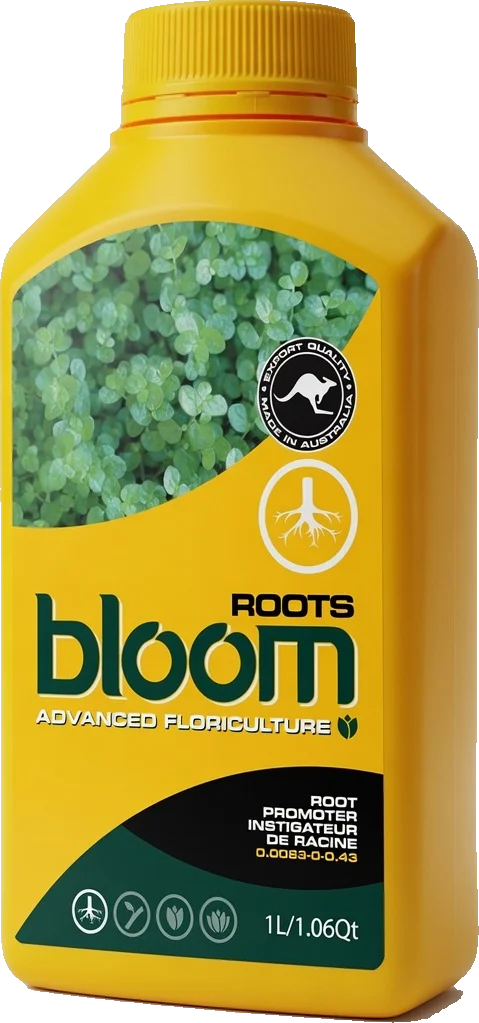
0.0083 – 0 – 0.43
That 0.5 ml/L figure isn’t arbitrary — in a 2-liter reservoir it’s exactly 1 ml, a number any syringe can hit precisely, every single refill. A home steep, by contrast, varies with how much seaweed you gathered, how long it soaked, and what was in the water to begin with — three variables a labeled product removes entirely. None of this is a claim about what process produced Bloom’s own extract; the label doesn’t declare one, and we’re not going to invent one. It’s a claim about consistency: the same declared numbers, reservoir after reservoir, which is worth more at two liters than it is at two hundred gallons.
It also helps to know what a declared dose isn’t claiming. ROOTS lists thiamine hydrochloride at 0.054% and humic acid at 0.075% specifically because those are the figures CDFA’s registration review process checked and accepted — small numbers, printed precisely, rather than rounded to a friendlier-looking figure. A home steep has no equivalent step: there’s no registration body checking what actually ended up in the jar, and no printed number to compare a bad batch against. That absence of a checked figure is easy to overlook because a steep feels more natural, but at reservoir scale “natural” and “known concentration” aren’t the same property, and only one of them is what keeps a small root zone stable refill after refill. It’s the same consistency question behind what a Bloom label actually commits to and which bottles actually belong in a clear LECA reservoir in the first place — and the same reasoning applies to anything fermented at home before it goes into a small reservoir, as a home fish ferment’s safety profile shows just as clearly.
Sources: Pepin A, Stebbing SL, Eyers L, et al. “A Comparative Review of Alternative Fucoidan Extraction Techniques from Seaweed.” Marine Drugs 23(1):27 (2025). Godlewska K, et al. “Plant growth biostimulants based on different methods of seaweed extraction with water.” BioMed Research International 2016:5973760. Guaranteed analysis per Bloom Roots label artwork.