
The Sodium Ratio Your LECA Reservoir Can’t Dilute Away
<p style=”font-size:19px;line-height:1.6;”>Seawater and "sea mineral" tonics have an obvious appeal for semi-hydro and houseplant growers running small LECA reservoirs: diluted enough, the salt load drops fast, and it feels like a free source of trace minerals. The math behind that intuition is only half right, and the half that’s wrong matters more in a 1–2 liter reservoir than almost anywhere else.</p>
<h2 style=”font-family:Georgia,serif;font-weight:400;color:#105732;”>Two Numbers, Two Different Dilution Curves</h2>
<p style=”font-size:19px;line-height:1.6;”>Electrical conductivity (EC) — the standard proxy for total salt concentration — falls in a straight line as you dilute. Cut a solution’s strength by half and its EC is cut by half. The sodium adsorption ratio (SAR), the standard measure of sodium’s specific hazard relative to calcium and magnesium (per the FAO’s Ayers & Westcot 1985 water-quality guidelines), does not follow that same line. SAR falls only at the square root of the dilution factor — because it’s calculated from sodium divided by the square root of (calcium plus magnesium), and square roots shrink much more slowly than the numbers inside them.</p>
<p style=”font-size:19px;line-height:1.6;”>Seawater’s starting point is roughly EC 50 dS/m and a SAR near 58.8 (Boyd 2020; SOEST OCN623 oceanography reference data). Run the dilution forward and the two curves pull apart fast.</p>
<div style=”background:#fff;border:1px solid #e2ddc9;border-radius:8px;padding:20px 24px;margin:24px 0;”>
<p style=”font-size:19px;line-height:1.6;margin:0;”><strong>The dilution table:</strong> at 1:71, EC has already fallen into FAO’s "no restriction" irrigation band — but SAR is still 7.0. At 1:215, sodium itself drops under UMass’s 50 ppm ornamental ceiling — but SAR is still 4.0. Not until roughly 1:384 does SAR reach its own "no restriction" line (≤3). By 1:863, SAR is under 2 — but by then the magnesium delivered is down to about 3.4 mg/L, only 7–11% of UMass’s desirable 30–50 ppm range for container ornamentals.</p>
</div>
<svg viewBox=”0 0 620 280″ xmlns=”http://www.w3.org/2000/svg” style=”width:100%;height:auto;background:#F5F2E7;border-radius:8px;”>
<rect x=”0″ y=”0″ width=”620″ height=”280″ fill=”#F5F2E7″/>
<line x1=”60″ y1=”230″ x2=”580″ y2=”230″ stroke=”#111311″ stroke-width=”2″/>
<line x1=”60″ y1=”30″ x2=”60″ y2=”230″ stroke=”#111311″ stroke-width=”2″/>
<text x=”320″ y=”260″ text-anchor=”middle” font-family=”Georgia,serif” font-size=”14″ fill=”#111311″>Dilution step (1:1 → 1:863)</text>
<polyline points=”60,40 150,110 250,160 350,190 450,205 560,215″ fill=”none” stroke=”#105732″ stroke-width=”5″ stroke-linecap=”round”/>
<polyline points=”60,40 150,55 250,70 350,85 450,100 560,112″ fill=”none” stroke=”#FFD200″ stroke-width=”5″ stroke-linecap=”round”/>
<rect x=”420″ y=”35″ width=”14″ height=”14″ fill=”#105732″/>
<text x=”440″ y=”47″ font-family=”Georgia,serif” font-size=”13″ fill=”#111311″>SAR — falls slowly</text>
<rect x=”420″ y=”58″ width=”14″ height=”14″ fill=”#FFD200″/>
<text x=”440″ y=”70″ font-family=”Georgia,serif” font-size=”13″ fill=”#111311″>EC — falls fast</text>
</svg>
<div style=”display:flex;flex-wrap:wrap;gap:12px;margin:24px 0;”>
<div style=”flex:1;min-width:150px;background:#105732;color:#F5F2E7;border-radius:8px;padding:16px;text-align:center;”>
<div style=”font-size:26px;font-weight:bold;”>1:71</div>
<div style=”font-size:14px;”>EC reaches "safe" — SAR still 7.0</div>
</div>
<div style=”flex:1;min-width:150px;background:#FFD200;color:#111311;border-radius:8px;padding:16px;text-align:center;”>
<div style=”font-size:26px;font-weight:bold;”>1:384</div>
<div style=”font-size:14px;”>SAR finally reaches "no restriction"</div>
</div>
<div style=”flex:1;min-width:150px;background:#fff;border:1px solid #e2ddc9;border-radius:8px;padding:16px;text-align:center;”>
<div style=”font-size:26px;font-weight:bold;color:#111311;”>1:863</div>
<div style=”font-size:14px;color:#111311;”>SAR<2, but only 3.4 mg/L Mg left</div>
</div>
</div>
<h2 style=”font-family:Georgia,serif;font-weight:400;color:#105732;”>Why a LECA Reservoir Can’t Dilute Its Way Around This</h2>
<p style=”font-size:19px;line-height:1.6;”>In a soil bed, cation exchange capacity gives sodium somewhere to sit other than the root surface, and periodic leaching flushes it out. A passive, top-off-only LECA reservoir has neither buffer: whatever sodium ratio is sitting in the water is what the roots sit in continuously, with no clay mineral surface to intercept it and no regular full flush unless the grower does one deliberately. UMass’s own ornamental/container thresholds reflect this — sodium under 50 ppm, chloride under 140 ppm, EC under 1.5 dS/m, with calcium and magnesium kept in a 40–100 / 30–50 ppm "desirable" band specifically because sodium interferes with calcium uptake and can displace both calcium and magnesium out of the root zone over time.</p>
<p style=”font-size:19px;line-height:1.6;”>Put those two things together and the practical problem is this: the dilution level needed to make seawater’s sodium ratio genuinely safe is high enough that the calcium and magnesium it was supposed to deliver have themselves been diluted down to almost nothing. There isn’t a middle dilution where seawater is both a meaningful mineral source and sodium-safe for a small reservoir — the math doesn’t allow it.</p>
<h2 style=”font-family:Georgia,serif;font-weight:400;color:#105732;”>What a Dosed Extract Is Doing Differently</h2>
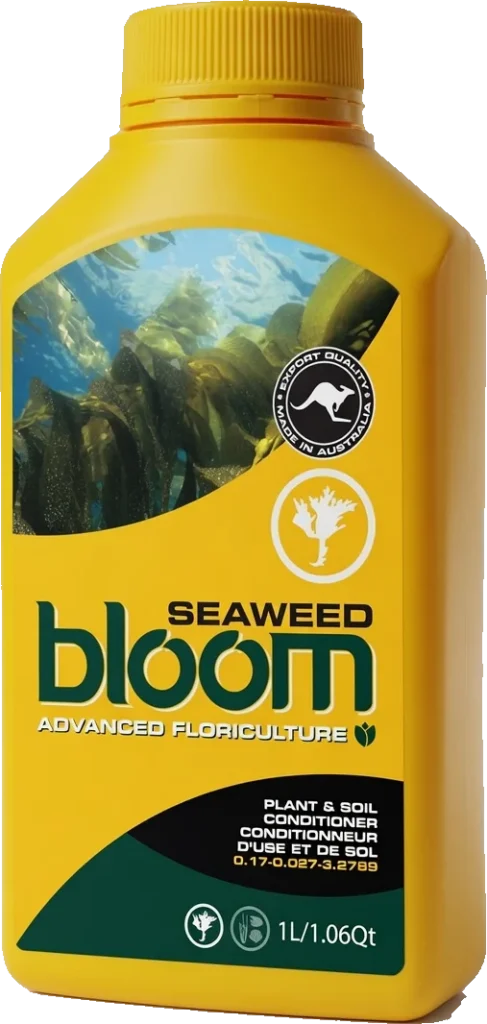
<p style=”font-size:19px;line-height:1.6;”>Bloom SEAWEED, by contrast, is a dosed extract, not diluted seawater — a different category of product entirely. Its label declares 0.17% total nitrogen, 0.027% available phosphate, and 3.278% soluble potash, derived from <em>Durvillaea potatorum</em> seaplant extract, at a rate of 1 ml/L. Worth being precise here: that guaranteed analysis doesn’t include a sodium or chloride figure, because US fertilizer labels in this category generally don’t carry one — so this isn’t a claim that Bloom’s sodium content is unusually low, only that the product is formulated and dosed as a concentrate with a declared NPK, not as a raw seawater dilution a grower is trying to thread through a sodium-hazard calculation on their own.</p>
<p style=”font-size:19px;line-height:1.6;”>For a reservoir too small to buffer a mistake, that distinction — a labeled dose versus a seawater ratio you’re solving for by trial and error — is the whole point.</p>