
The Clear-Reservoir Rule: Why Not Every Bloom Bottle Belongs in a LECA Setup
Semi-hydro and LECA growers run a different kind of system than a drain-to-waste hydro tent. The reservoir is passive — water sits in a net pot or self-watering base for days or weeks between top-ups, not flushed and refreshed every feed like a recirculating hydro system. That one difference changes which additives make sense, and it has nothing to do with how “strong” a product is.
It comes down to what’s actually happening inside a sealed, mostly-undisturbed column of water.
What a passive reservoir actually is
In a drain-to-waste or recirculating hydro system, nutrient solution is mixed, used over a short feed cycle, and discarded or replaced. Anything biologically active in that solution — enzymes, fermentation by-products, organic carbon — gets refreshed before it has much chance to do anything other than feed the plant. In a passive LECA reservoir, the same solution can sit, static, in the dark, for a week or more. There’s no flush schedule forcing a reset.
That’s fine for an input that’s chemically simple and stays that way in solution. It’s a different story for an input that’s biologically active by design.
Why some Bloom products are flush-and-refill only
Bloom’s own guidance for semi-hydro growers is specific on this point: products carrying fermentation-derived or microbially active material — in Bloom’s range, that’s SWTNR and Seafuel, both built around live biological activity alongside their declared seaplant and fish inputs — are meant for systems where the solution turns over regularly. Leave that same biological activity sitting in a static reservoir for days, and it doesn’t pause. It keeps working in the water itself, which is exactly the mechanism behind a passive reservoir turning cloudy or growing a biofilm on the LECA surface. That’s not a defect in the product. It’s a mismatch between what the product assumes about its environment and what a passive system actually provides.
What’s built for a passive system
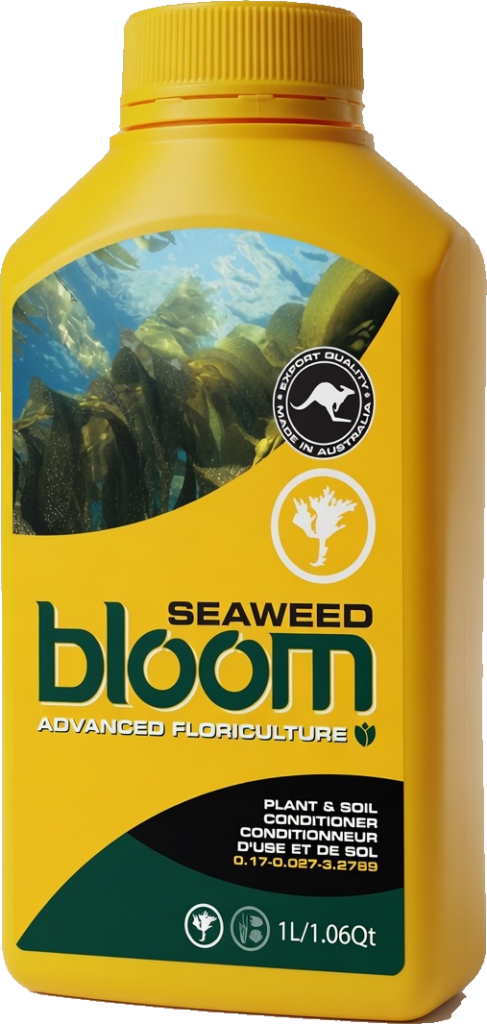
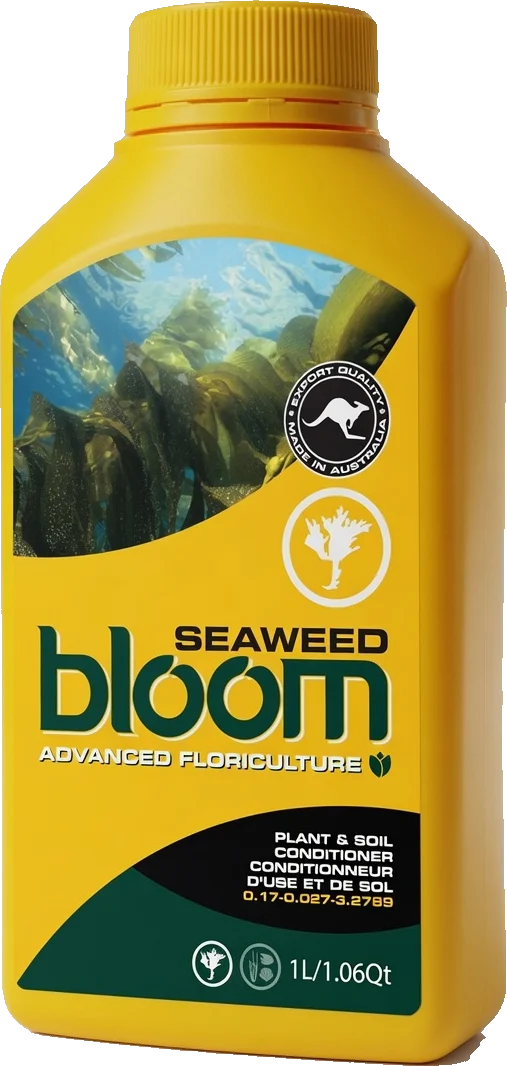
Bloom Seaweed is the cleaner fit for that kind of reservoir, and the label tells you why: it declares one input, Durvillaea potatorum seaplant extract, at 0.17-0.027-3.278, with nothing else on the panel. There’s no fermentation step, no live biology, nothing in the declared composition that behaves differently sitting still in the dark than it does moving through a drip line. The feed rate on the label is 1 ml/L of nutrient solution — straightforward to hold at a low, steady concentration in a reservoir that only gets topped up, not fully swapped.
Why this matters more in a small pot
LECA setups usually run smaller reservoirs per plant than a hydro tent runs per tray — a self-watering pot might hold less than a liter below the clay balls. Whatever happens in that water happens close to the roots, with less dilution and less time between you noticing and the plant noticing. A cloudy reservoir in a 50-liter hydro tank is an annoyance you flush out on the next feed. A cloudy reservoir in a half-liter LECA pot is the plant’s entire root environment, sitting that way until you intervene.
None of this ranks one Bloom product above another — a biologically active input isn’t a worse product, it’s a product built around a different water schedule. The point is matching the tool to the system: save fermentation-derived and microbially active inputs for setups where the reservoir turns over, and reach for a simple, single-input extract like Seaweed for the ones that don’t.
The practical version
If you’re running LECA or passive semi-hydro and you want to add something beyond your base feed, start with what’s on the label, not what the bottle promises. A single declared input with no live biology travels through weeks of standing water the same way it goes in. Anything built around active fermentation or enzymatic breakdown is doing exactly what it’s supposed to do — just not in that reservoir.
A simple way to test it yourself
You don’t need to take anyone’s word for this, including ours. Run two identical small reservoirs side by side — same LECA, same light, same plant if you can manage it — and dose one with a simple seaplant extract and the other with a biologically active input, both at label rate, both topped up on the same schedule without a full flush. Check the water clarity at the same point each week. The difference between the two reservoirs will usually show up in the water before it shows up in the roots, which is exactly the early-warning signal a passive system is missing compared to a tank you’re draining and refilling anyway.
The same logic applies to Humate, which sits in a different category again: its only declared input is potassium hydroxide delivering 3.12% soluble potash, plus 10% humic acid derived from Leonardite. No live biology, but a meaningfully alkaline product by design — worth checking against your reservoir’s starting pH before adding it to a passive system rather than assuming it behaves like a neutral top-up. The same pH-drift logic is the whole story behind which chelate your Cal-Mag bottle uses. The same scale-down thinking applies to finishing-stage products on a much smaller flowering houseplant sitting in the same kind of passive setup. And when one of our own labels has a figure we can’t yet confirm, like SWTNR’s still-unresolved guaranteed analysis, that same low-tolerance-for-error logic is exactly why we’d rather leave a number off than guess in a reservoir that doesn’t get flushed.