
The One Metal Where Kelp Foraging Actually Deserves a Second Thought
If you steep your own seaweed tea, you’ve probably heard the heavy-metal warning: kelp pulls cadmium out of seawater, so a home brew is a cadmium risk. The data says otherwise — and points at a different metal entirely, one that depends almost completely on which species you picked up.
Cadmium isn’t the problem people think it is
A 2022 Nordic Council of Ministers food-safety review measured cadmium across the common edible brown seaweeds: sugar kelp 0.44–2.3 mg/kg dry weight, winged kelp 1.5–3.6, bladderwrack 0.48–1.4, oarweed 0.08–1.8, rockweed 0.29–0.47. Compare that to the ceiling AAPFCO sets for a low-phosphate specialty fertilizer making no micronutrient claim — 20 ppm cadmium — and raw brown seaweed sits 6 to 250 times below that limit, across every species tested. If you’ve been avoiding beach kelp over cadmium, the numbers don’t back it up.
Arsenic is the one that’s species-specific
The same Nordic review found inorganic arsenic in oarweed (Laminaria digitata) averaging 24 mg/kg dry weight, with a measured range of 0.06 to 79 mg/kg across 33 samples. Set against AAPFCO’s 10 ppm arsenic ceiling for that same fertilizer category, that’s 2.4 times over at the mean, and up to 7.9 times over at the high end. Every other common species tested — sugar kelp (0.04–0.2 mg/kg), winged kelp (0.77), bladderwrack (0.185–0.24) — stays nowhere near that line. This isn’t a seaweed problem. It’s an oarweed problem.
One nuance worth stating plainly: arsenic occurs in both organic and inorganic forms, and the adverse-effect concerns are specific to the inorganic fraction — which is exactly the number used above, not a total-arsenic figure padded with the less-concerning organic share. There’s also some evidence that ordinary kitchen processing moves the needle on marine metals generally. The same food-safety review found that washing, soaking, blanching and boiling reduced iodine in seaweed anywhere from “no substantial reduction to more than 90% reduction,” depending on method and species, and a separate soaking study on winged kelp found a hypersaline rinse lowered the relative cadmium content of the biomass. No comparable rinse study exists specifically for inorganic arsenic in oarweed, so we’re not printing a reduction percentage for it — but it’s a reasonable argument for rinsing wild-harvested material before you use it, species identification aside.
Inorganic arsenic, by species (mg/kg dry weight)
Source: Nordic Council of Ministers, TemaNord 2022:564. Bars not to a strict linear scale above 24 — shown for species comparison, not precise plotting.
What that means before you steep anything
If you’re foraging wild kelp or buying dried seaweed meal without a clear species label, the honest move is to find out what you’ve actually got before you brew a tea from it, the same way you’d check a fertilizer label before trusting a number on it. Oarweed is a real, documented exception. Sugar kelp, bladderwrack and winged kelp are not — and neither cadmium nor arsenic is a reason to avoid seaweed as a category.
Telling the species apart doesn’t take a lab. Oarweed (Laminaria digitata) grows a single long, flattened, finger-split blade off a smooth, flexible stipe, usually low in the intertidal or just below it. Sugar kelp (Saccharina latissima) has a single undivided, ruffled-edge blade with a short stipe. Bladderwrack (Fucus vesiculosus) is the one with paired air bladders running up a branching, strap-like frond — it’s one of the easiest of the group to identify on sight. If you’re buying dried kelp meal rather than foraging it fresh, the bag should name a species; if it just says “kelp” or “seaweed,” that absence of a species name is itself the information you’re missing, the same way an undeclared figure on a fertilizer label is information you’re missing.
Where Bloom’s own seaweed input stands
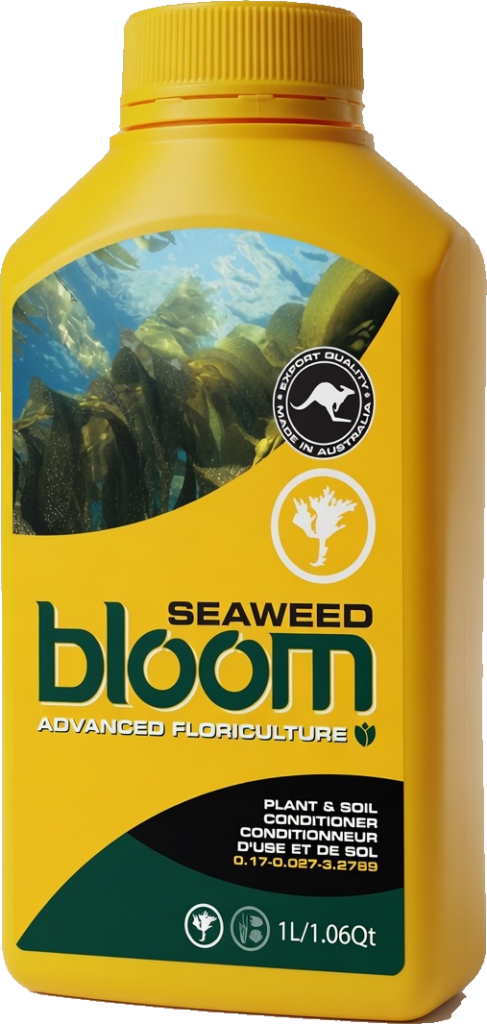
Bloom Seaweed declares one input on its label: Durvillaea potatorum, guaranteed analysis 0.17-0.027-3.278, dosed at 1 ml/L. Durvillaea isn’t on the arsenic-concern list above at all — it isn’t one of the species the Nordic review flagged. Like every Bloom label, Seaweed’s also carries the standing pointer to AAPFCO’s own metals page, because that’s the framework the whole category is measured against, Bloom included.
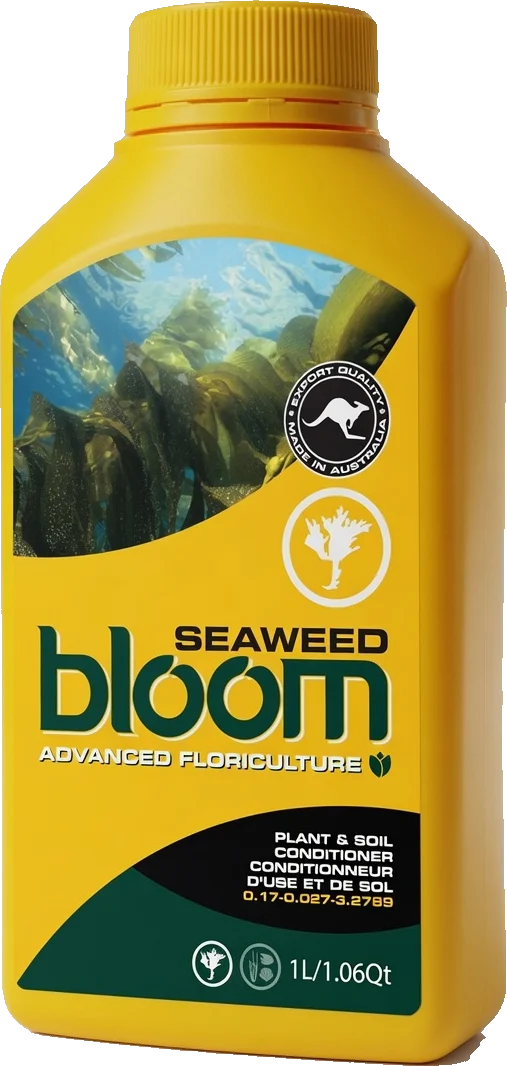
Bloom Seaweed — Durvillaea potatorum extract, 0.17-0.027-3.278, 1 ml/L.
None of this is an argument against foraging your own kelp. It’s an argument for knowing which kelp you’re holding before you decide what to worry about.
Sources: A Nordic approach to food safety risk management of seaweed for use as food, TemaNord 2022:564, Nordic Council of Ministers. AAPFCO Heavy Metals Labeling Aid, August 2019 (hosted by CDFA). Bloom Seaweed label artwork, verified label facts register.