
Why You Can’t Isolate the “One Active Ingredient” in a Seaweed Extract
Specialty growers who keep a small, closely watched collection — bonsai, orchids, terrarium epiphytes — tend to think in ingredients. If a seaweed extract is doing something good for root development, the instinct is to ask which molecule in the bottle is responsible, isolate it, and maybe dose it more precisely or swap in a cheaper source of the same compound. It’s a reasonable question. The research on seaweed biostimulants gives a surprisingly firm answer, and it isn’t the one most people expect.
Fractionation has been tried, and it fails
A 2021 review in Plants summarized what happens when researchers split seaweed extracts into their component parts — alginates here, laminarin there, free amino acids somewhere else — and test each piece on its own. The finding: “fractionation of seaweed extracts into their components…has not yielded favorable growth effects. Only the whole seaweed extracts have been consistently proven to be very effective.” That’s not a hedge. Researchers who went looking for the one compound doing the work came back without one.
The mechanism work explains why. A 2019 review in Frontiers in Plant Science tracked what root-applied Ascophyllum nodosum extract actually does at the gene level: it activates the cytokinin-responsive ARR5 promoter and induces three separate cytokinin-synthesis genes (IPT3, IPT4, IPT5), while leaving two others (IPT2, IPT9) alone. That’s a signalling cascade, not a single compound crossing a threshold. The extract is nudging the plant’s own hormone-synthesis machinery in several places at once — which is a very different thing from delivering a measured dose of one active ingredient.
The hormone numbers don’t even agree with each other
If you tried to isolate “the hormone” anyway, you’d run into a second problem: nobody agrees on how much is there. Reported IAA content for A. nodosum-based extracts spans roughly three orders of magnitude depending on the study — from about 50 mg per gram of dry extract in one report, down to 6.63 mg per gram in a commercial product, down again to 25–35 nanograms per gram by one analytical method. The 2019 review attributes the spread to “method of extraction and processing, as well as the geographical location” of the source material. If the number itself moves a thousand-fold between labs testing nominally similar products, it was never a stable target to isolate in the first place.
And the effect is product-specific, not ingredient-specific
A 2024 review in Frontiers in Horticulture focused specifically on cutting propagation — the exact use case a specialty collector cares about — and the conclusion is blunt: outcomes “vary based on crops, cuttings, location, raw materials, composition, dose, application number and procedures, and growth environment,” and critically, “the same dose can prove effective if administered with one SE commercial product and ineffective with another.” That’s not a knock on seaweed extracts. It’s a description of why whole-product testing, not ingredient substitution, is the only honest way to know what a given extract does.
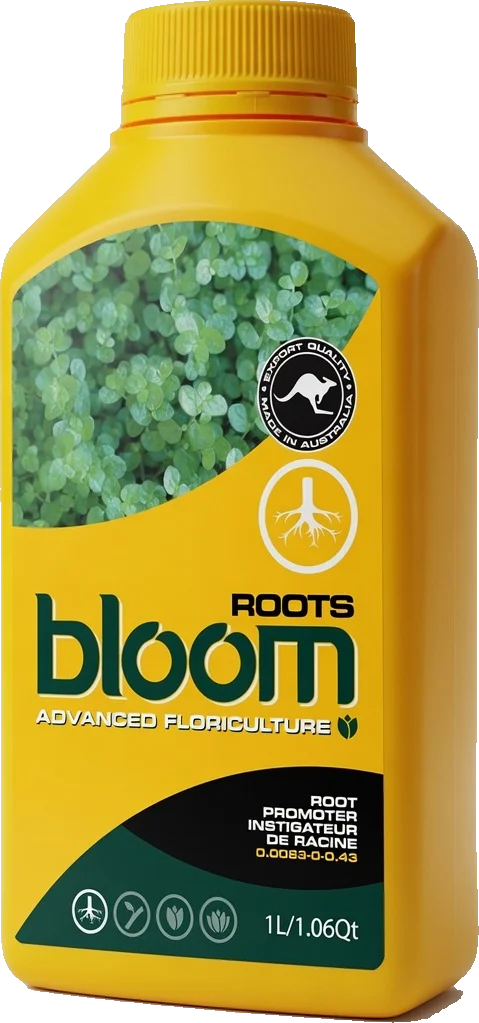
Bloom’s ROOTS states exactly what it is and nothing more: Durvillaea potatorum (seaplant extract) as the sole declared source, with 0.075% humic acid (from Leonardite) and 0.054% thiamine hydrochloride listed as non-plant-food components, at 0.5 ml/L in solution or 1 ml/L as a dip. No hormone is claimed, because the literature doesn’t support claiming one. What’s being delivered is the whole extract, as sold.
For a grower weighing whether a cheaper powdered “kelp extract” or a homemade fraction can substitute for a finished product, the research says the substitution question is the wrong one. The relevant question is whether the whole product, as sold, has been shown to do the job — because nobody, in any lab that’s tried, has found the one ingredient you could swap in instead.
The composition data backs this up from a different angle. A 2022 survey in Frontiers in Plant Science tested twenty commercial seaweed extracts — cold, acid-media, and alkaline-extracted, liquid and solid — and found total polyphenols spanning a roughly 60-fold range between products, total flavonoids a roughly 144-fold range, and potassium a roughly 36-fold range. Products marketed for the same purpose, from the same two source species, don’t even agree on how much of any one measurable compound they contain. That’s one more reason a specialty grower comparing bottles by a single printed number is comparing the wrong thing — the whole-product response is what’s been tested, and it’s the whole product, not any single figure on the label, that the research actually speaks to.