
Terrarium growers and anyone running a windowsill of small succulents in two- or three-inch pots live with a math problem most feed-chart writers never think about: the numbers on a label are almost always written for a one-liter reservoir or a gallon watering can, and scaling them down to a shot glass of water isn’t as simple as it looks.
Why smaller volume raises the stakes on precision, not lowers them
A labeled dose rate — say, 1 ml of a seaweed extract per liter of water — is a ratio, not a fixed amount, and that’s exactly why it works at any scale. Mix 50 ml of water for a terrarium instead of a liter, and the same ratio asks for 0.05 ml of concentrate: one drop, roughly, from a standard dropper. That’s a genuinely tiny quantity, and it’s easy to assume “a little extra won’t matter” at that scale. It’s actually the reverse. In a 50 ml reservoir, a dosing error that would be a rounding error in a 10-gallon tank becomes the entire difference between the label’s intended concentration and something many times stronger or weaker than intended.
This is the same reason a home-mixed steep or tea is a harder proposition in a terrarium than almost anywhere else a grower might use one. There’s no large body of water to average out an inconsistent batch, and no root zone big enough to buffer a miscalculation the way an outdoor bed can. A labeled product’s whole value proposition — a declared concentration you can trust and divide down predictably — matters most exactly where the margin for error is smallest.
Illustrative scaling of a 1 ml/L label ratio — not a declared Bloom rate for terrarium-specific use.
Why fewer, more deliberate inputs make more sense here
This is also an argument for simplicity over variety at this scale. A twelve-bottle feeding program built for an outdoor bed or a hydro tent is hard enough to measure accurately in a one-gallon mixing jug; shrunk down to terrarium volumes, most of those individual doses fall below what a standard dropper or syringe can measure with any confidence. A micro-scale grower is usually better served picking one or two declared, single-purpose inputs and measuring those carefully, rather than trying to proportion an entire program down.
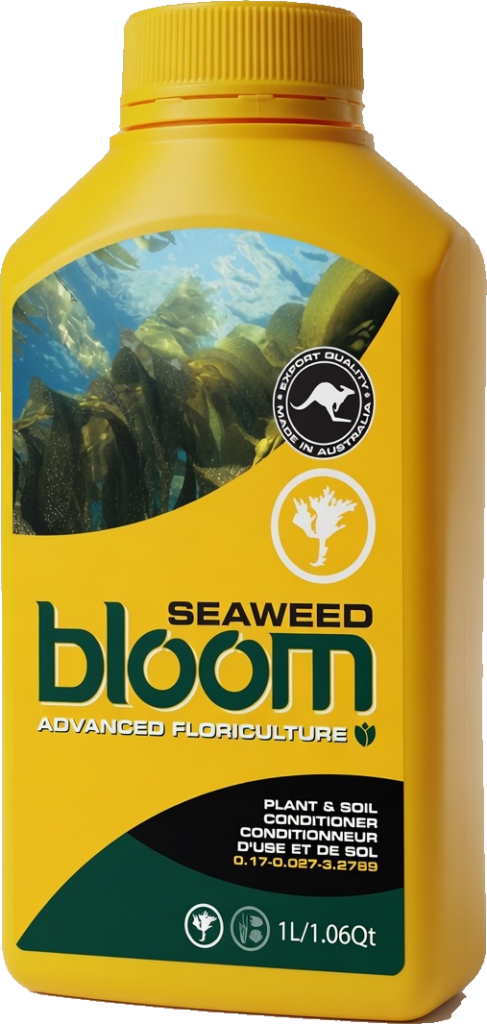
Bloom’s booster line is built around exactly that kind of single-purpose dosing — one declared input per bottle, one ratio on the label. ROOTS carries Durvillaea potatorum seaplant extract plus 0.075% humic acid and 0.054% thiamine hydrochloride, dosed at 0.5 ml per liter. Bloom Seaweed carries only Durvillaea potatorum, at 1 ml per liter. Scaling either one down to a terrarium-sized reservoir is simple fraction math precisely because there’s only one ratio to track, not an entire program’s worth.
A practical note, not a guarantee
Bloom doesn’t publish a dedicated terrarium rate — the labeled ratio is the same one printed on every bottle, meant to scale by proportion. A kitchen measuring syringe graduated in fractions of a milliliter is worth owning if you’re dosing reservoirs this small; eyeballing a drop at this scale is where most measurement error actually happens.
None of this changes what’s declared on the label or how it’s dosed at full scale — it’s the same ratio whether the reservoir holds a gallon or a shot glass. What changes is how much that precision is worth to you, and in the smallest pots we sell into, it’s worth more than almost anywhere else in the lineup.
There’s a second, quieter benefit to keeping the program down to one or two declared inputs at this scale: fewer things to get wrong also means fewer variables to untangle if a plant does start struggling. A terrarium or a three-inch succulent pot gives you very little room to run a controlled experiment — there’s no spare plant to test a theory on — so every additional bottle in the rotation is one more thing you’d have to rule out later. A grower running just a base feed and a single declared booster always knows exactly what’s in the water, which matters more when there’s less water to be wrong about.
It’s worth saying plainly that none of this is specific to Bloom’s lineup — any correctly labeled liquid concentrate scales the same way, by the same ratio math. What differs between products is simply whether there’s one clean ratio to scale in the first place, or a program built from several bottles each asking for their own small fraction of an already tiny volume. The fewer fractions a micro-scale grower has to juggle at once, the fewer places a measuring mistake has to hide. A bonsai pot runs into a related version of this same confinement problem — see what a permanently fixed root zone means for humic acid and seaplant extract.
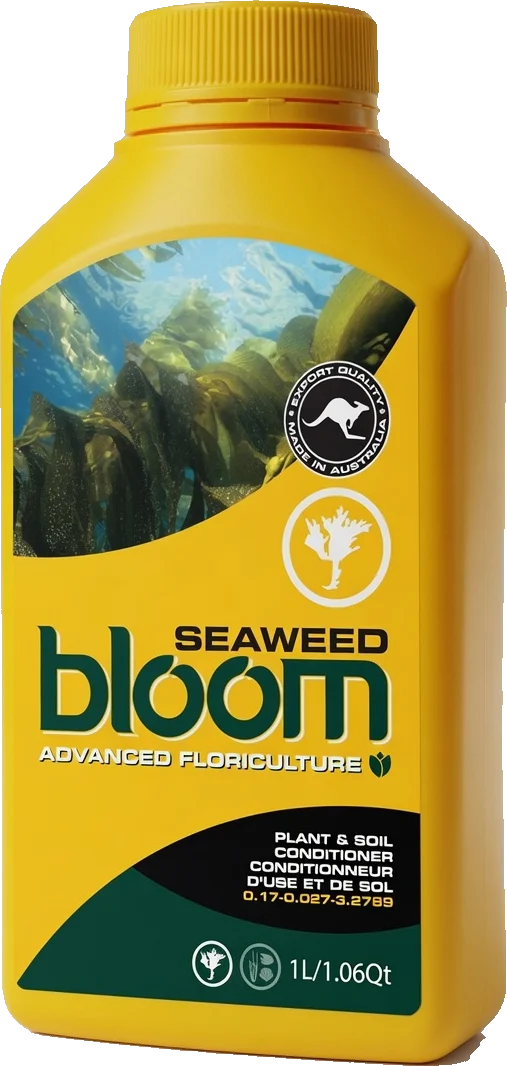
Guaranteed analyses and dose rates per Bloom ROOTS and Bloom Seaweed label artwork.