
The Four Lines That Appear on Every Bloom Label
A sealed reservoir is an unforgiving place to find out an input isn’t what you thought it was. There’s no soil to buffer a mistake, no drainage to carry away something that shouldn’t be there — whatever goes into a small, recirculating or passive system stays in contact with the roots until the next full change. Growers running semi-hydro and LECA setups tend to read labels more carefully than most, for exactly that reason. It’s worth knowing what’s actually on them, because the same handful of lines turn up on every bottle in the Bloom range, and together they say something real about how the line is built.
The line that points you to an outside source
Every Bloom label carries a sentence that doesn’t appear on most fertilizer bottles at all: a direct pointer to an external verification source for heavy metals. “Information regarding the contents and levels of metals in this product is available on the internet at http://www.aapfco.org/metals.htm.” That’s a reference to the Association of American Plant Food Control Officials, the body that sets the cumulative metals framework every state fertilizer regulator works from. A company doesn’t print a line sending growers to check a third party’s framework unless it expects the product to hold up against it.
The line that refuses a claim most competitors don’t even make
The second recurring line is a disclaimer, not a claim: “Not for use in organic crop or organic food in the state of California.” Bloom carries no USDA organic certification, and the label says so directly rather than leaving it ambiguous. In a market where “organic-sounding” language gets used loosely on products that hold no certification at all, a label that states the negative plainly is doing something most marketing copy avoids.
The line that tells you who actually made it
The third constant: the manufacturer address. Agricultural Organics (Aust) P/L, 5 Belfree Drive, Green Fields SA 5107, Australia — on ROOTS, on Seaweed, on Humate, on CAL, the same name and the same street address. In a category where private-label fertilizers get repackaged and relabeled by a dozen brands from a single unnamed contract manufacturer, naming the actual facility, and naming the same one every time, is a choice. It means there’s one place to look if a question ever needs answering about how a product was actually made — not a web of co-packers and distributors with no single address a regulator, or a grower, could actually write to.
The line that names what’s actually in the bottle
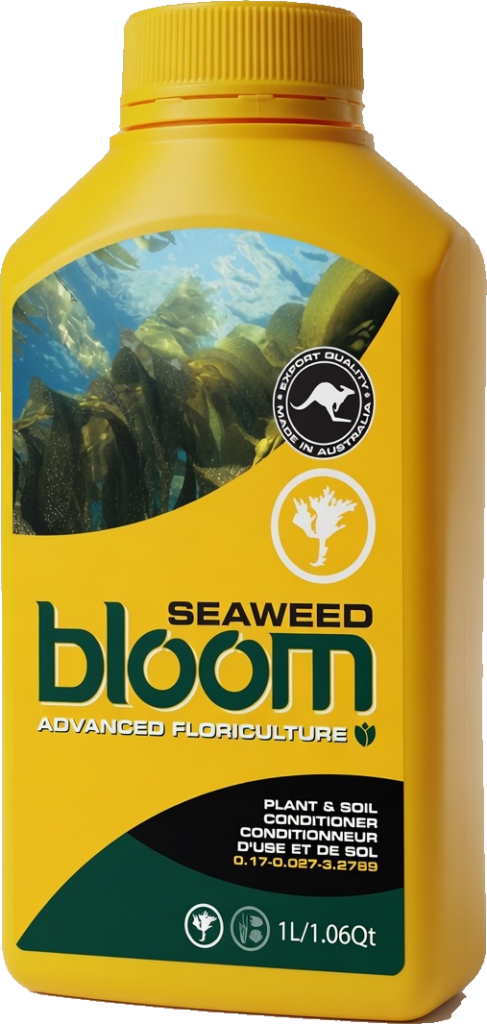
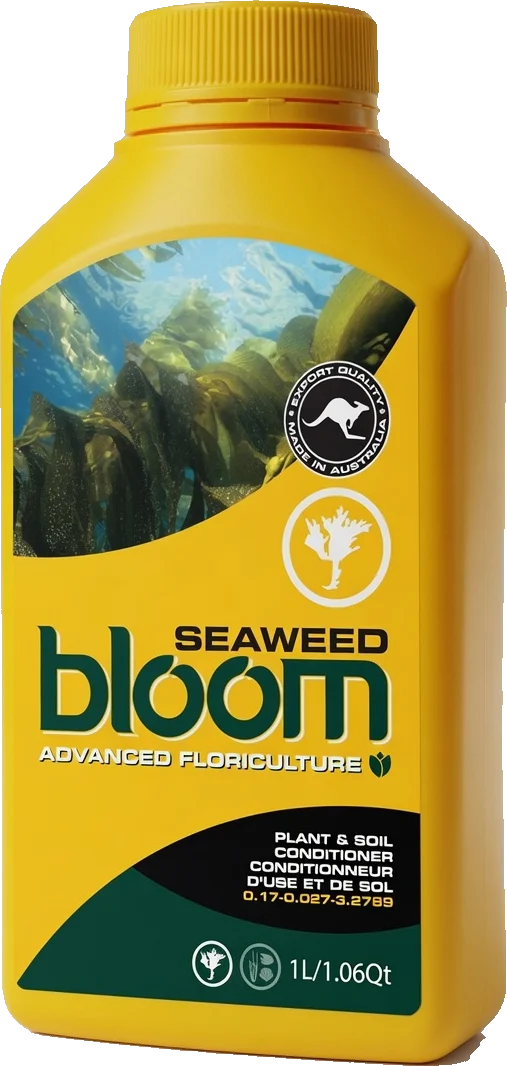
The fourth: a “Derived From” statement naming the actual input behind the guaranteed analysis, every time, with no exceptions found across the labels pulled for this series. ROOTS: Durvillaea potatorum (seaplant extract). Seaweed: the same species, declared as the sole input. CAL: calcium nitrate, magnesium nitrate, iron DTPA, zinc EDTA — chelate form named explicitly, not left for a grower to guess at. Humate: potassium hydroxide, with the humic acid separately declared as derived from Leonardite. A “Derived From” line exists specifically so a grower doesn’t have to take a guaranteed analysis on faith — it’s the regulatory mechanism that ties a declared number to an actual, named source.
None of this is a claim about performance. It’s a claim about what a label is required to say, said consistently, across nineteen different bottles, for years. For a grower deciding what goes into a reservoir with nowhere for a mistake to drain to, that consistency is the thing actually worth checking — more than any single number on any single bottle.
It’s also not the only layer of outside check these products have been through. Several Bloom lines — Silica, Seaweed, Seafuel, and SWTNR among them — have real, on-file state registration-review correspondence from a fertilizer control official going back to 2018, with the underlying guaranteed-analysis summary sheet still being actively maintained today. A label is the part every grower sees; the registration review is the part that happens before a product is even allowed to carry that label in the first place. Read the bottle for yourself: pick up any Bloom label, and those four lines are there, worded almost identically to the last one you checked. The same label-first habit is worth carrying into how a product’s own declared processing route gets checked against published trial results, rather than taken on the strength of the number alone.