
Every propagation season, some version of the same claim does the rounds on grower forums: a splash of fresh aloe gel in the dip water, and your strike rate jumps. The claim usually points at one trial or another to back it up. Worth actually reading those trials before a cutting bench gets built around them — because what they show is narrower, and shakier, than the headline number suggests.
The number that gets quoted
A 2023 pomegranate cutting trial reported aloe vera gel hitting 100% rooting, right alongside a synthetic IBA treatment at 93.3% and an untreated control at 66.7%. On its face, that reads as aloe beating a commercial rooting hormone. Read past the headline and the picture changes: the trial ran 10 cuttings per treatment, in one greenhouse, for one season, and the paper never specifies the aloe concentration, preparation method, or soak time that was actually used. At 10 cuttings, the gap between “100%” and “93.3%” is exactly one cutting. Two of the other “organic” treatments in the same trial — garlic and banana — landed well below the untreated control, which is the kind of scatter that signals noise in a small sample, not a real treatment effect.
That’s not a reason to dismiss aloe outright. Aloe gel does contain amino acids and some hormone-type compounds — auxins and gibberellins are mentioned in the literature, though without a quantified figure anyone can point to. What it mostly contains is water: roughly 99% of the gel by weight. And the one compound aloe is best known for, acemannan, is chemically fragile — its structure shifts with light exposure, oxygen, storage time, and drying temperatures above about 60°C. Composition also varies by cultivar, plant age, and growing conditions. None of that is disqualifying on its own. It just means “aloe gel” isn’t one consistent input, and the one trial most often cited for it doesn’t have the sample size or the specification to settle the question either way.
What the one real cutting-propagation study needed
There is a published trial on ornamental cuttings specifically — chrysanthemum and lavender — testing a standardized commercial plant-extract complex. It reported a real improvement in rooting and branching. But the dose that worked was 1.06 microliters per liter of a lab-standardized extract — a concentration so precise it has to be measured, not guessed, and a batch-to-batch consistency a kitchen preparation has no way to hold. (That trial comes from a research group that publishes repeatedly on one commercial product family, so it’s worth reading as industry-adjacent peer review, not treating as the final word on its own — but the dose precision it required is the point here regardless of who ran it.)
Put those two studies side by side and the pattern is consistent: the propagation literature that actually shows something real does it with a specified, repeatable dose of a defined extract — not an amount of leaf gel someone eyeballed into a jar. A cutting bench running real volume for a season doesn’t get to re-run the trial every time the aloe plant changes; it needs to know what’s going into the dip water every single time.
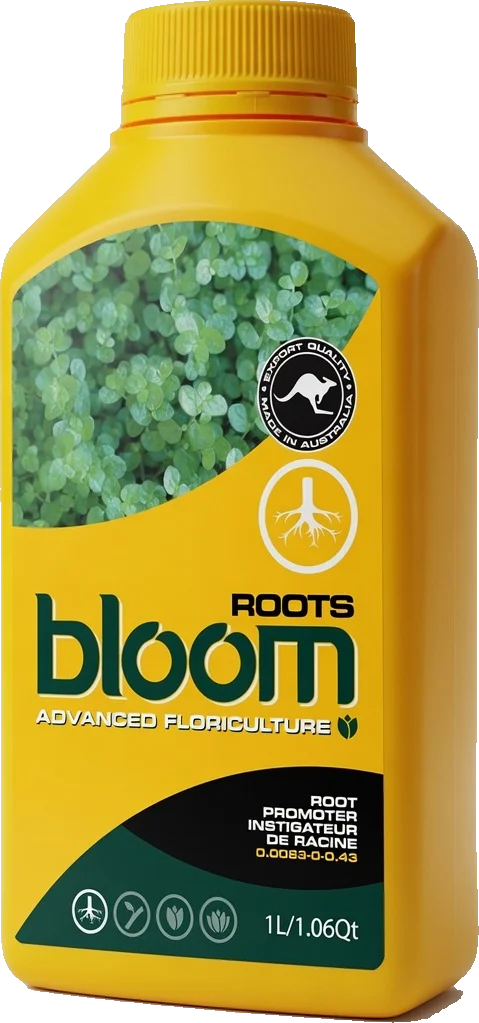
0.0083 – 0 – 0.43
Why Bloom puts the number on the bottle
This is the actual argument for a declared, labeled input over a home remedy — not that one works and the other doesn’t, but that one tells you exactly what you’re applying and the other can’t. ROOTS carries one declared seaplant extract, two declared non-plant-food ingredients at fixed percentages, and a stated dip rate. Every bottle is the same bottle. There’s no season-to-season drift from how the raw material was grown, stored, or handled before it got to the jar — the kind of drift that makes the aloe and willow-water literature so hard to pin down in the first place.
None of this is a claim that ROOTS causes roots to form faster or more reliably than any specific alternative — that’s not what a propagation bench needs from this piece, and it’s not what the label supports. What it does support is a plain comparison: a declared seaplant extract at a declared rate against an undefined gel at an undefined concentration. For a bench running real cutting volume through a season, that’s the difference that actually matters — not whether one headline trial number looked impressive, but whether what’s in the dip cup is the same thing every time. For a closer look at what a declared seaplant extract brings to a working propagation bench, see our breakdown of ROOTS on a cutting bench.
Sources: Aryan S, Gulab G, Safi Z, et al. “Enhancement of Propagation Using Organic Materials and Growth Hormone: A Study on the Effectiveness of Growth and Rooting of Pomegranate Cuttings.” Horticulturae 9(9):999 (2023). Matei CE, Visan AI, Cristescu R. “Aloe Vera Polysaccharides as Therapeutic Agents.” Polysaccharides 6(2):36 (2025). Wise K, Gill H, Selby-Pham J. “Willow bark extract and the biostimulant complex Root Nectar® increase propagation efficiency in chrysanthemum and lavender cuttings.” Scientia Horticulturae 263:109108 (2020). Guaranteed analysis per Bloom ROOTS label artwork.