
The pH Line Your Biofilter Cares About More Than Your Fish Do
Specialty Niche Growers · Science & Education
Ask an aquaponics grower what they’re protecting and the answer is always the fish. Fair enough — the fish are the part of the system that breathes, eats and can clearly suffer. But the part actually running your nitrogen cycle is a few billion bacteria living in your biofilter media that nobody names, nobody feeds directly, and almost nobody checks on. They have an opinion about pH. It’s a stricter opinion than your fish’s.
This matters to us because people ask whether they can pour Bloom products straight into the loop instead of spraying the leaf — it’s one bottle doing double duty, and we get why that’s appealing. The honest answer isn’t about the fish at all. It’s about whether the ammonia-eating bacteria downstream of them keep working.
Two different bacteria, two overlapping windows
Your biofilter runs on two groups of nitrifying bacteria in sequence: Nitrosomonas converts ammonia to nitrite, then Nitrobacter converts that nitrite to the nitrate your plants can actually use. The FAO’s own aquaponics manual gives each group’s preferred range — Nitrosomonas at pH 7.2–7.8, Nitrobacter at pH 7.2–8.2 — and notes most systems are actually run at pH 6–7 as a deliberate compromise across fish, bacteria and plants at once (Somerville, C., Cohen, M., Pantanella, E., Stankus, A., Lovatelli, A. Small-Scale Aquaponic Food Production, FAO, 2014).
Nobody actually runs their system in the bacteria’s favourite zone. Everyone runs it a little low, for the fish’s sake. That’s already a compromise before anything else goes in the tank.
Two bottles, pulling in opposite directions
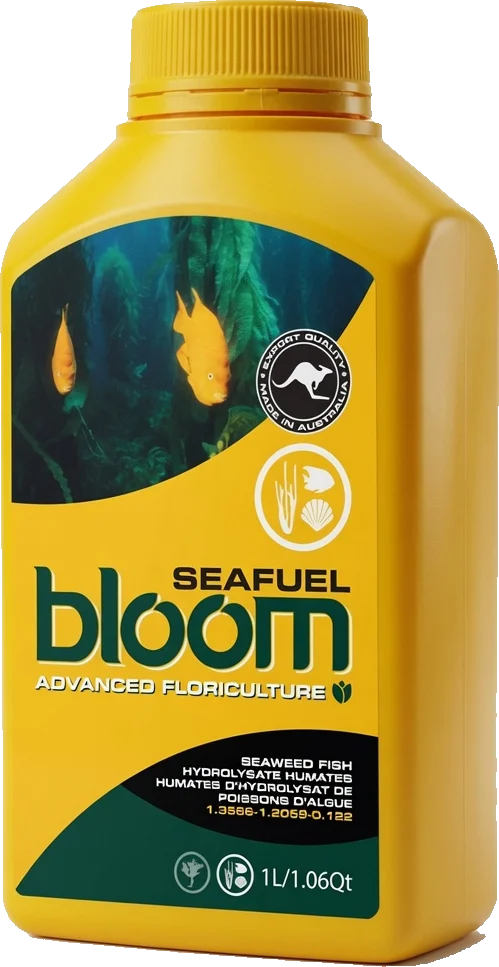
SeaFuel’s label declares Durvillaea potatorum (seaplant extract) and Hydrolized Blue Fin Tuna (fish hydrolysate), plus 0.075% humic acid from Leonardite. Its own MSDS puts the product at pH 4–5. That’s not a flaw — it’s how a lot of fish hydrolysate sits, and the label is the label. But dropped straight into a loop, it’s an acid addition sitting well under the compromise zone every aquaponics guide already runs at the low end of.
Humate sits at the other end. Its guaranteed analysis is 0-0-3.12, with 10% humic acid from Leonardite — and the potash is declared as derived from Potassium Hydroxide. KOH is an alkali. It’s the same family of chemical pond and reef keepers reach for when they want to push pH up, not down. Neither bottle was built with your biofilter’s pH window in mind, because neither bottle was built for a fish tank. They were built for a fertigation line or a watering can, where 2.5 ml/L of a mild alkali or 1 ml/L of a mild acid gets absorbed into soil or substrate buffering that a closed loop of water simply doesn’t have.
So it goes on the leaf, every time. Not because we’re certain the fish couldn’t tolerate a dose of fish hydrolysate or a splash of humic acid — we haven’t tested either in live aquaponic water and won’t guess at an answer we don’t have. It’s because the bacteria that make the whole loop function run on a narrower margin than anyone selling into this space likes to advertise, and conceding that ground costs us nothing next to what it would cost a grower’s biofilter.
What the numbers actually say, side by side
Nitrosomonas
Lay those four ranges on one line and the pattern is obvious: the aquaponics compromise zone most growers already run in sits below where either nitrifying bacterium actually prefers to work, and SeaFuel’s own acidity sits below that again. There’s no slack left to spend on a biostimulant that was never formulated with a biofilter’s tolerances in mind — ours included.
We’re not going to dress this up as a worse problem than it is, either. A single foliar-strength dose of SeaFuel or Humate, correctly diluted and misted onto leaves above the water line, never reaches the loop at all — which is exactly why the leaf is the right answer here, not a workaround. If a grower wants a genuine water-safe answer instead of a leaf-only one, that takes real testing in real aquaponic water, at system scale, over time — not a label reading and a pH strip. We haven’t run that testing yet. Until we have, this is where the page stays: spray it, don’t pour it, and keep your buffering decisions with the tools built for exactly that job.