
A bonsai sits in a shallow, fixed pot. A semi-hydro reservoir sits in a cup of clay pebbles. Both of those setups still have a growing medium — something between the roots and the open air that can hold or buffer whatever gets applied. A mounted staghorn fern, a tillandsia wired to driftwood, an orchid lashed to a slab of cork bark: none of that. There’s no medium at all. Every input a mounted or air-grown plant gets arrives as a mist or a dip, lands directly on exposed roots or absorptive leaf tissue, and either gets taken up or it doesn’t — there’s nothing downstream to average out a mistake.
What “no buffer” actually means for dosing
In a pot of soil or a reservoir of water, a slightly-off dose gets diluted by everything else already in the medium — the mistake is real but it’s cushioned. On a bare root mounted to bark, there’s no cushion. Whatever concentration hits the root surface is the concentration the root surface experiences, full stop, for as long as it stays wet. That’s exactly the situation a labeled dip rate is built for: a specific concentration, a specific contact method, with nothing between the bottle and the plant to get it wrong — which is also why a seaweed extract’s whole-product consistency matters more here than it does anywhere else in the lineup.
What’s actually in ROOTS
Bloom ROOTS declares 0.0083-0-0.43 — total nitrogen 0.0083% (split between ammoniacal and water-soluble organic nitrogen) and soluble potash 0.43%, derived from a single named input: Durvillaea potatorum, a seaplant extract. The non-plant-food fraction on the label adds 0.075% humic acid, sourced from Leonardite, and 0.054% thiamine hydrochloride — vitamin B1. Those are small numbers by design; this isn’t a bulk fertilizer, it’s a low-concentration seaplant and humic input meant to be run at a precise rate. The label gives two: 0.5 ml/L for general use, and 1 ml/L run specifically as a dip.
1 ml/L
That dip rate is worth noticing on its own: it’s not the same as the regular-use rate, and the label doesn’t treat the two methods as interchangeable. Dipping concentrates the exposure into a shorter window at a higher concentration, which is a deliberate trade against misting at a lower concentration over a longer, less controlled window. Either way, the number on the label is a number, not a range to eyeball — which matters more, not less, on a plant that has no pot of medium sitting between the bottle and the roots to catch an error.
None of this is a claim that mounted or air culture needs a different chemistry than anything else gets — the seaplant extract, humic acid and thiamine on the ROOTS label are the same declared inputs whether they’re going into a reservoir, a watering can, or a dip bucket for a slab-mounted fern. What changes is the margin for error, and that’s exactly why a measured rate — printed on the bottle, not estimated by eye — carries more weight on a plant with nothing else standing between the dose and the root.
Mounted and air culture has grown well past the handful of niche hobbyists who started it — staghorn fern walls, tillandsia displays and bark-mounted orchids are common enough now that the “what do I feed it” question comes up constantly, and the answer people usually reach for is whatever’s already on the shelf for potted plants, diluted by guesswork because there’s no obvious reference point for a plant with no pot. That guesswork is the exact failure mode a labeled rate exists to remove. It doesn’t matter whether the measuring is happening for a single prized mount or a wall of forty — the math scales the same way a kitchen recipe does, and the stakes of getting it wrong scale right along with how little margin the plant has to absorb a mistake.
The humic acid and thiamine on the label aren’t incidental, either. Humic acid’s role is generally understood as a buffering and chelating one — moderating pH shifts and helping hold other nutrients in a plant-available form at the point of contact — which matters more, not less, when that point of contact is a bare root with nothing else around it to do the same job. A dip bucket mixed to the labeled 1 ml/L rate is, in effect, the closest thing an air-grown plant gets to a root zone at all, for the few seconds or minutes it’s submerged.
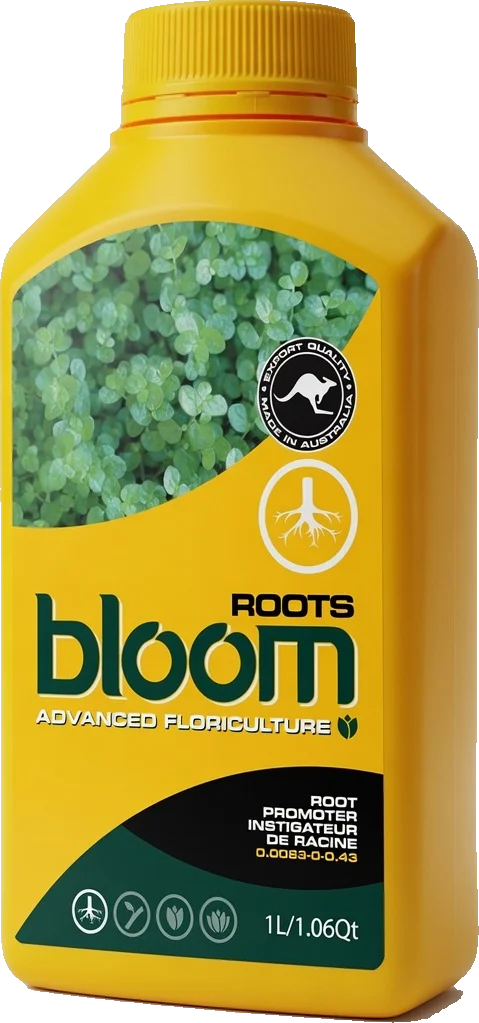
Sources: Guaranteed analysis, derived-from statement, and application rates per Bloom ROOTS label artwork.