
Humate is one of the quieter bottles in the Bloom lineup — no flashy flowering-stage claims, no finishing-layer story, just a straightforward potash-and-humic-acid input that a lot of backyard growers reach for once a season and then forget about. Fall is actually a good window to work it back in, and we’ve got plenty on the shelf to see gardeners through it. This isn’t a clearance push — we’re not discontinuing anything here — it’s just a reminder that this bottle earns a spot in the rotation, and a look at what’s actually declared on its label.
What’s on the label
Bloom Humate’s guaranteed analysis is 0-0-3.12 — soluble potash (K₂O) at 3.12%, nothing declared for nitrogen or phosphate. The label lists the potash as derived from Potassium Hydroxide, and carries a non-plant-food declaration of 10% Humic Acid, derived from Leonardite. The application rate on the label is 2.5 ml per litre of fertilizer solution.
0 – 0 – 3.12
Why “derived from Potassium Hydroxide” is worth reading carefully
On a US fertilizer label, the “Derived From” line names the source of the guaranteed plant nutrient — here, the 3.12% K₂O. It’s not a process claim; it doesn’t by itself tell you that potassium hydroxide was the extraction reagent used on the raw humic ore, since it could just as easily be acting as a neutralizer. What the label does establish, plainly, is that potassium — not sodium — is the cation sitting in the bottle.
That distinction actually matters over a growing season. Humic acid in its raw, mined form sits mostly as insoluble calcium, iron and aluminum humates, locked in a protonated form that needs an alkali to free it up. Different alkalis leave different things behind: a sodium hydroxide route leaves sodium, a potassium hydroxide route leaves potassium. For a garden bed you’re feeding week after week, potassium is a nutrient you’re already budgeting for. Sodium is something you’re trying to keep out of the soil profile long-term. Knowing which one a humic input is built on isn’t a trivia point — it’s the difference between an input that adds to your feed program and one that quietly works against your soil over a few seasons.
Bloom Humate’s label names Potassium Hydroxide as the source of its declared K₂O.
Why humic acid earns a spot at all
Humic acid gets talked about as a cure-all more often than any other single input in the garden aisle, and we’d rather undersell it than oversell it. What’s broadly accepted in soil science, without needing a specific trial number attached, is that humic substances act as a buffer in the soil’s cation exchange — they help hold onto nutrient ions so they’re less prone to leaching straight through a bed after a heavy watering or a fall rain. That’s a structural, slow-acting role, not a flowering trigger or a yield guarantee, and it’s exactly the kind of input that pays off more at the end of a season of feeding than in any single application.
It’s also worth separating this from the DIY-extraction conversation that comes up around humic acid. Raw humic ore doesn’t give up its humic fraction easily — it needs a real alkali treatment to pull the acid out of its insoluble mineral-bound form, which is a large part of why a manufactured, labeled input and a backyard experiment with raw leonardite or compost extracts aren’t really doing the same job. We’re not running that comparison here; it’s enough to say the 10% figure on this label reflects a declared, measured concentration, not a guess.
Working it into a fall feed
Humic acid itself doesn’t carry a yield claim on this bottle, and we’re not going to invent one — the label is specifically a potash-plus-humic input, not a growth promoter. What it’s good for, in plain terms, is adding to a soil’s existing organic-matter complex at the point in the season when beds are winding down and getting prepped for next year. At 2.5 ml per litre, it’s an easy one to fold into whatever watering routine is already running, without adding a separate step to the week.
We keep this one stocked through the fall feeding window specifically because it tends to get overlooked next to the flashier flowering-stage bottles — not because it’s going anywhere. If you’ve been running a program without it, this is a reasonable season to add it back in.
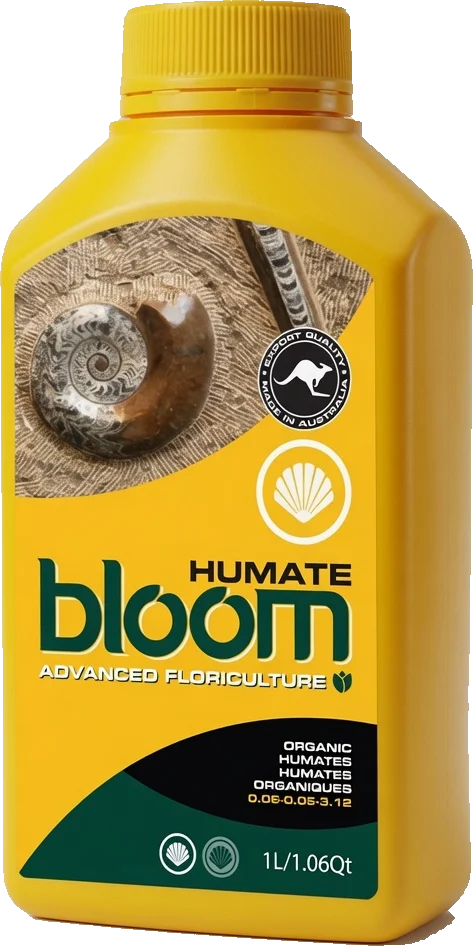
Figures per Bloom Humate label artwork (bloom HUMATE label example 05122018.pdf). The render’s nitrogen and phosphate figures are not reflected here as they are unverified against this label.