
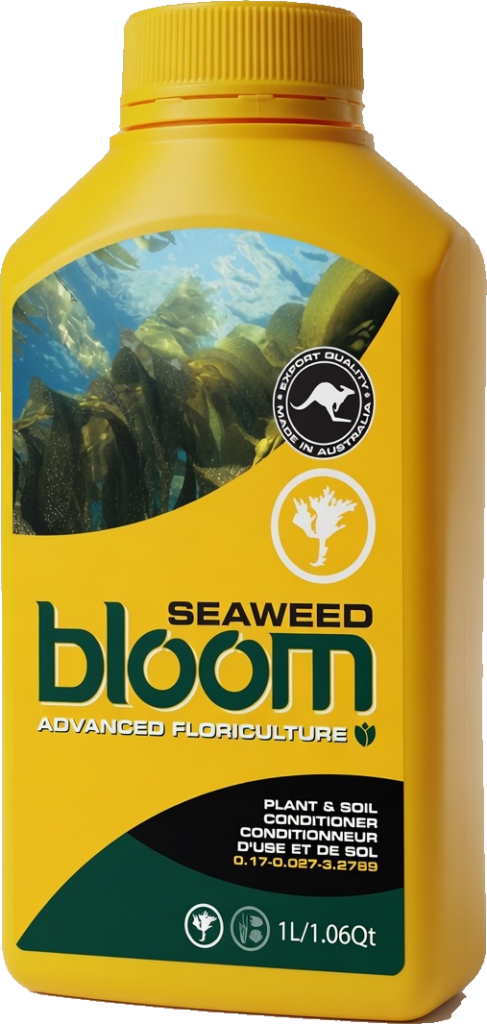
“Seaweed extract” gets printed on a lot of bottles as if it’s a single, consistent category — something with a known composition you can reason about in the abstract. The actual research on commercial seaweed products says otherwise, and the spread between them is bigger than most growers would guess.
What a side-by-side comparison actually found
A 2022 study ran a direct chemical comparison across 20 commercial brown seaweed extracts — a mix of liquid and solid formulations, made from Ascophyllum nodosum and Ecklonia maxima, produced by cold extraction, acid-media extraction, and alkaline (KOH) extraction. All twenty are marketed under the same general “seaweed extract” label. The chemistry inside them was nowhere close to uniform:
- Total polyphenols ranged from 1.80 to 107 grams per kilogram — a roughly 60-fold spread.
- Total flavonoids ranged from 1.90 to 274 grams per kilogram — a roughly 144-fold spread.
- Potassium ranged from 5.04 to 180 grams per kilogram — a roughly 36-fold spread.
- Alginic acid ranged from 0.61% to 18.0% — a roughly 29-fold spread.
The study’s own conclusion was that extraction methodology significantly influenced the final composition profile — in other words, how a seaweed product is processed determines what ends up in the bottle at least as much as which seaweed went in. One more detail worth sitting with: auxin-type hormone content (IAA) came back non-detectable in every single solid formulation tested. Whatever these twenty products are doing, it isn’t reliably delivering a hormone dose — a separate, independently documented point about seaweed extracts generally, not specific to any one brand here (the same non-detect pattern shows up in the DIY rooting-aid literature too — see our piece on why willow water isn’t a rooting hormone).
Why the spread exists in the first place
This isn’t a quality-control failure on any one maker’s part — it’s a structural feature of the category. A separate, larger meta-analysis covering 198 studies and over 2,000 treatment comparisons found that extraction route is itself a variable that changes whether a seaweed product produces a measurable yield response at all: alkaline hydrolysis and plain water extraction both showed significant effects, while enzyme-assisted, acid, ultrasound, supercritical, and pressurized-liquid extraction did not, in that dataset. Route, species, and raw-material handling all stack on top of each other before a drop ever reaches a reservoir. Two products can share a label phrase and share almost nothing else.
That’s the real problem with buying on the words “seaweed extract” alone — not that the category doesn’t work, but that the words don’t tell you which version of the category you’re getting. A grower comparing two bottles by that phrase is comparing a number that could legitimately differ by well over an order of magnitude on the compounds that matter most.
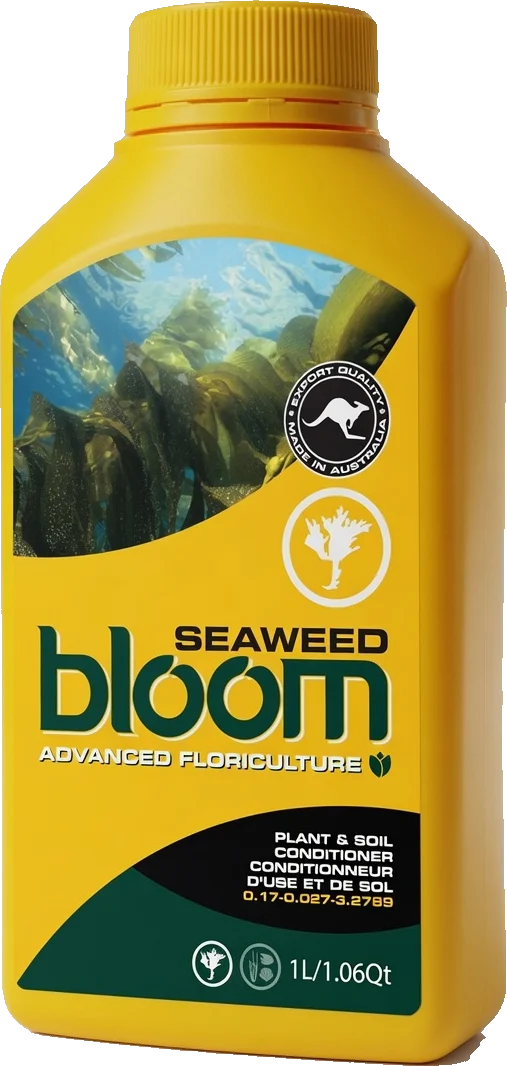
0.17 – 0.027 – 3.278
What a fixed number actually buys you
This isn’t an argument that Bloom Seaweed’s chemistry falls at some particular point on that 60-to-144-fold spread — that figure was never measured against the broader category and this piece makes no claim about it. The actual point is simpler: a guaranteed analysis is a fixed, legally accountable number tied to one declared input, run through state fertilizer-registration review. “Seaweed extract” as a phrase is not that. It’s a category umbrella wide enough to cover a 144-fold difference in flavonoid content between two products sitting on the same shelf.
For a tank where dosing precision actually matters — and in cannabis cultivation, where a grower is tracking outcomes closely enough to notice a difference week to week, it usually does — that distinction is the whole reason to read past the category name on the front of the bottle and down to the guaranteed analysis printed on the back of it. The front of the bottle tells you what family of product you’re holding. The back tells you what’s actually in it.
It also means two bottles that look identical on a feed chart — both labeled “seaweed extract,” both dosed at a similar rate — can be delivering very different amounts of the compounds that actually drive a biostimulant response. A grower switching products mid-cycle because of a sale price or a supply gap isn’t necessarily swapping in an equivalent input; depending on where the two products sit on that spread, they could be swapping in something meaningfully stronger or weaker without any way to tell from the front label alone. The guaranteed analysis is the only place that difference would actually show up.
Sources: Valverde S, Williams PL, Mayans B, Lucena JJ, Hernández-Apaolaza L. “Comparative study of the chemical composition and antifungal activity of commercial brown seaweed extracts.” Frontiers in Plant Science 13:1017925 (2022). Pérez-Oñate CJ, et al. “Crop yield responses to seaweed extract-based biostimulants depend on application strategy, formulation, and extraction methods: a meta-analysis.” Frontiers in Plant Science 17:1803269 (2026). Guaranteed analysis per Bloom Seaweed label artwork.