Most growers skim right past the word “hydrolysate” on a fish-input label. It reads like packaging language. It isn’t — it’s naming a specific manufacturing choice, and that choice shows up later as a measurable difference in what actually reaches the plant.
Two different ways to take a fish apart
The USDA’s own technical evaluation of liquid fish products draws a clean line between the two routes fish by-products take into a bottle. Fish emulsion is “cooked at temperatures in excess of 180°F to kill most of the putrefaction bacteria,” often with acid added to stabilize it. Fish hydrolysate instead adds enzymes to digest the proteins, after which “the oil is skimmed off, and the remains are boiled down” at much gentler conditions. Same raw material, two different processes — and the USDA notes the typical guaranteed analyses even come out a different shape: emulsion runs roughly 5-2-2, hydrolysate closer to 2-5-3.
Why the route matters at the amino-acid level
A 2017 review in Frontiers in Plant Science on protein-hydrolysate biostimulants spells out what the heat-and-acid route costs: “during the acid hydrolysis some amino acids like tryptophan, cysteine, serine and threonine are partially or totally destroyed and many other amino acids are converted from the L-form to D-form (racemisation) thus losing their biological activity.” Plants build proteins from L-amino acids. A D-form version of the same molecule isn’t toxic — it’s just biologically inert for that purpose, which means a fraction of what’s in the bottle is along for the ride rather than doing anything.
Enzymatic hydrolysates, the same review notes, “contain higher peptides:free amino acids ratio, and proportion of L-amino acids in comparison with those obtained by chemical hydrolysis.” A separate 2024 review on fish-viscera hydrolysates found the two routes can land at similar overall free-amino-acid yields on paper — low-50s percent on a dry-matter basis either way in that comparison — while still differing in which amino acids survive the trip and in what form. Yield tells you how much broke down. It doesn’t tell you how much of it a plant can actually use.
And “manufactured” isn’t automatically the win
This is the part worth sitting with: a 2026 study in Frontiers in Nutrition comparing lab-made fish-by-product hydrolysates against a commercial reference product found the commercial product claimed 3.00% nitrogen on its label, while the lab hydrolysates measured 1.53–1.65% N — and on wheat, the combined enzymatic-plus-microbial lab hydrolysate pushed biomass to 2.3 g against a 0.7 g control, while “the commercial reference showed no significant improvement over a water control.” A declared number on a label and a measured result in a pot are two different things, and in that comparison they didn’t agree. The lesson isn’t that manufactured products are suspect — a separate safety review of animal-derived hydrolysates found “no genotoxicity, ecotoxicity, or phytotoxicity” across the category. The lesson is narrower and more useful: the process named on the label is the thing worth checking, not the fact that something went through a factory at all.
What this means in a small reservoir
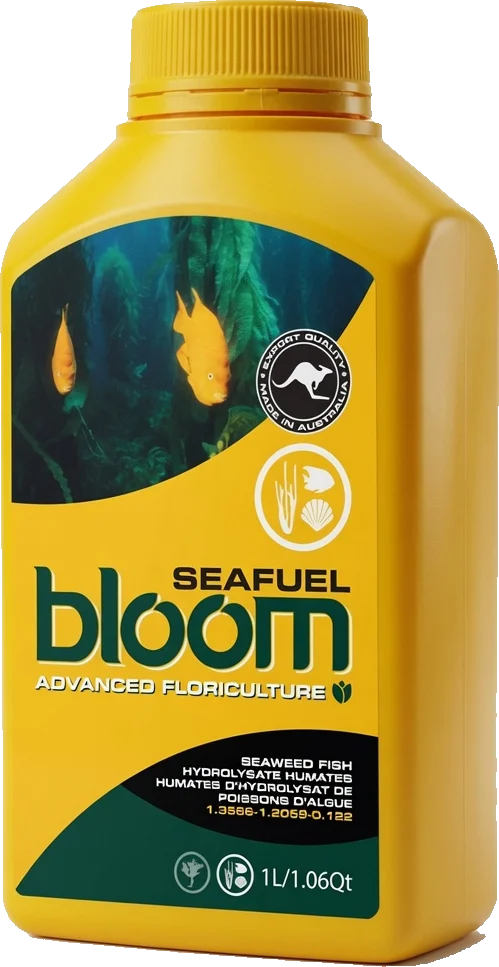
Semi-hydro and houseplant setups run small total volumes, so whatever is in the bottle matters proportionally more per drop than it would in a run-to-waste field system. That’s exactly where the declared process earns its place on the label. Bloom SeaFuel’s label states its inputs plainly: Durvillaea potatorum (seaplant extract) and Hydrolized Blue Fin Tuna — named as a fish hydrolysate, not an emulsion — plus 0.075% humic acid derived from Leonardite, under the descriptor “Seaweed and Humates.” The product’s MSDS lists a pH of 4–5 and a specific gravity of 1.2–1.4. None of that is a performance claim. It’s a process declaration, which is the one thing the research above says is actually worth reading.
What the label tells you, at a glance:
The Valencia comparison above is about fish hydrolysates as a category in the published literature, not a head-to-head lab test of this specific bottle — worth saying plainly, because that distinction is the whole point of this piece. What you can check, on any bottle, is which process it names. That’s the number that doesn’t move.
In a tent or a windowsill setup with a two- or three-liter reservoir, that habit pays off more than it would in a thousand-gallon tank, simply because there’s nowhere for an inert or poorly matched input to get diluted away. Reading the process line on the label before reading the NPK numbers is a small habit, and it’s the one the research above actually supports.