Shop around for a sea-mineral garden product and you’ll run into two completely opposite philosophies, both sold with confidence. One camp strips the sodium chloride out before bottling. The other camp leaves it in on purpose — and argues that removing it is the real mistake. Neither side is lying. They’re just solving for different things, and a home gardener deserves to know that before picking a side.
Two answers to the same question
Sodium chloride makes up somewhere around 86% of everything dissolved in seawater — sodium and chloride together dwarf every other ion combined. That single fact is where the industry splits. Processors on one side treat that sodium load as the thing standing between a seawater concentrate and something you can put on a garden bed, and they publish typical analyses showing the chloride cut by something like 95% from where raw seawater starts. Processors on the other side treat sodium removal as the marketing move, arguing that a product has to keep its minerals “in the exact proportions as in seawater” to count as a true sea-mineral product at all — and they sell concentrates that are still roughly three-quarters sodium chloride by weight, solar-evaporated straight out of a retention pond.
Why a guaranteed analysis sidesteps the argument entirely
Notice what both of those sales pitches have in common: neither one leads with a guaranteed analysis in the sense a fertilizer label actually means it. They lead with a “typical analysis” listing dozens of elements in parts per million, because a product that’s mostly sodium chloride doesn’t have much of a nutrient story to guarantee. A genuine seawater concentrate, undiluted, would be dominated by sodium and chloride on a real guaranteed analysis — which is exactly why that category of product tends not to use one.
This is also where it’s worth being honest about garden products that do carry a real guaranteed analysis declaring meaningful phosphate or potash. Seawater itself carries phosphorus at levels so low they’re barely measurable, and potassium at roughly 400 mg/L. A product declaring several percent available phosphate or soluble potash isn’t a seawater evaporate with the inconvenient part filtered out — it’s a different kind of product, built from added minerals, however it’s marketed. The ocean simply doesn’t carry phosphorus at the concentration a guaranteed analysis like that implies.
Bloom’s approach: say what’s in it, let the label carry the weight
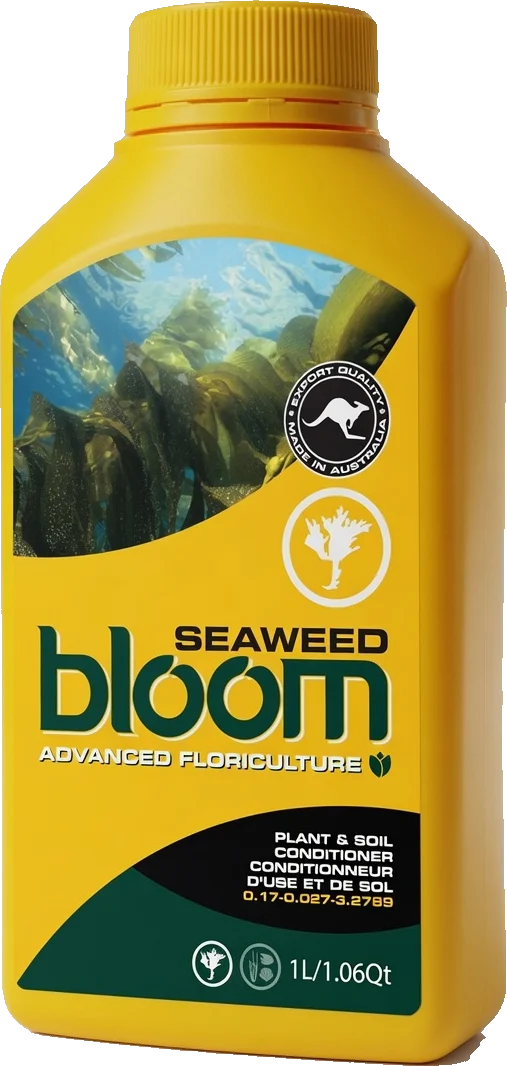
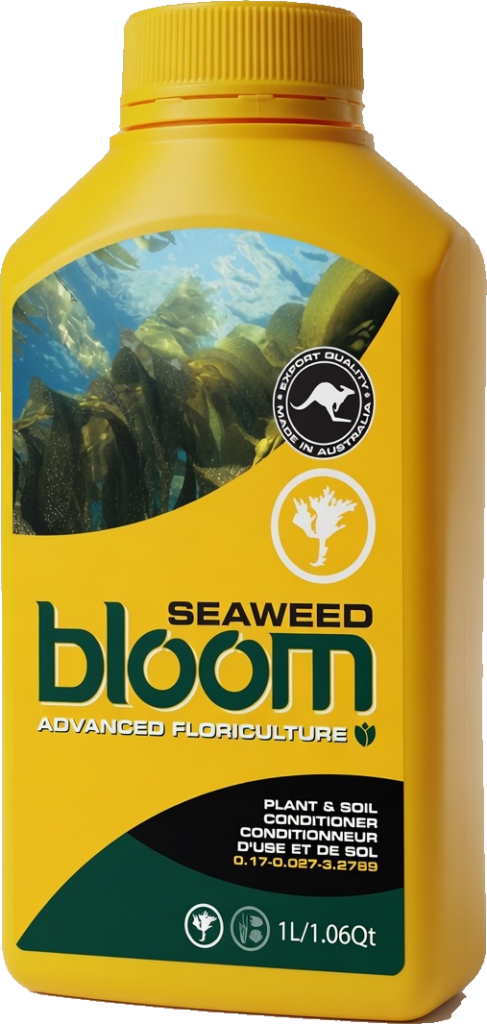
Bloom doesn’t try to settle the sodium argument by picking a side in it. Instead, products like Seaweed carry a declared guaranteed analysis — 0.17% nitrogen, 0.027% available phosphate, 3.278% soluble potash, derived from Durvillaea potatorum seaweed extract — and that’s the whole claim. No typical-analysis list of ninety trace elements, no argument about what percentage of sea salt belongs in the bottle, because the product isn’t positioned as a seawater stand-in at all. It’s a seaweed extract, declared the way a seaweed extract is supposed to be declared.
What to actually check on any sea-derived product:
Two companies can look at the same raw material and build two opposite products out of it, each with a story that sounds reasonable on its own. The way through that isn’t picking the more persuasive pitch — it’s reading the one document that’s legally required to tell the truth: the guaranteed analysis.
Why this matters more in a backyard bed than it sounds
A backyard gardener doesn’t have the luxury of a soil test lab on standby, which means a mislabeled or vaguely labeled mineral product does its damage quietly — a slow sodium buildup in a raised bed doesn’t announce itself the way a nitrogen deficiency does. It shows up later as poor water infiltration and stunted roots, well after anyone remembers which bag of “ocean minerals” it came from. That’s the practical reason the guaranteed-analysis question isn’t pedantic: it’s the difference between a product whose contents you can actually plan a season around, and one whose contents you’re taking on faith from whichever side of the sodium argument sounded more scientific in the moment.
None of this requires taking a position on sea minerals as a category. It just means asking the same question of every bag or bottle before it goes on the bed: does the label say what’s actually guaranteed, or does it say what’s typically present? Those are different promises, and only one of them is enforceable.