
It’s a reasonable instinct in a hydro room: if a fish hydrolysate feed is helping root development, a stronger dose should help more. A 2024 root-drench trial on primrose tested that instinct directly, at three doses of an enzymatically processed anchovy by-product hydrolysate, and the answer it got back was not a straight line.
The dose curve bends, it doesn’t climb
The trial used an enzymatically hydrolyzed anchovy by-product (Flavourzyme enzyme, 50°C, 1.5 hours, pH 7.0 — the gentler, enzyme-led processing route rather than the heat-and-acid route used for fish emulsion) and drenched it onto pots at three concentrations: 0.5, 1.0, and 1.5 grams per liter, 100 mL per pot. If more active material simply meant more root response, 1.5 g/L should have won. It didn’t. The 1.0 g/L dose produced the strongest root architecture of the three — root length 259.59 cm against an untreated control surface area of 207.93 cm², with 612.66 root tips and 1,286.9 root forks — and the highest dose fell back off that peak rather than extending it.
That shape — a peak in the middle, not at the top of the range tested — is the opposite of what a “feed more, grow more” assumption predicts. It matches a pattern seen elsewhere in biostimulant research: past a certain concentration, the same compounds that help root signaling at a moderate dose can start working against it, whether through osmotic stress at the root zone or saturation of whatever receptor or signaling pathway is actually responding. The trial didn’t pin down the exact mechanism for the falloff — it measured the outcome, not the cause — but the outcome itself is the useful part for anyone dosing a hydro reservoir.
Why the processing route matters before the dose even comes up
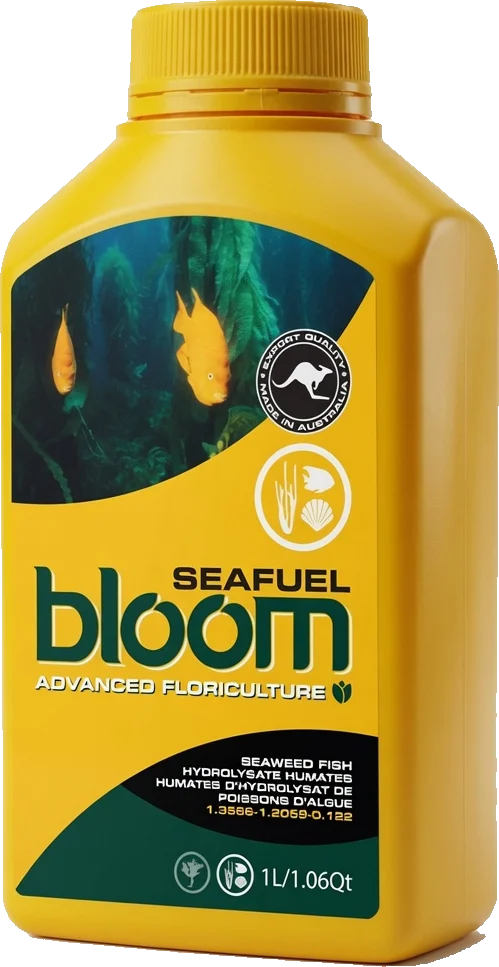
The dose-response question only makes sense once the input itself is pinned down, and fish inputs split into two genuinely different products depending on how they’re made. Fish emulsion is cooked at temperatures above 180°F with acid added to control bacterial activity; fish hydrolysate uses enzymes instead of heat to break the proteins down. The difference isn’t cosmetic — heat-and-acid processing partially or totally destroys several amino acids and racemizes others from the L-form plants can use into the D-form they can’t, while enzymatic hydrolysis retains a higher ratio of intact peptides and L-amino acids. Bloom’s SEAFUEL is built on the hydrolysate route: the label declares it as Durvillaea potatorum seaplant extract plus hydrolyzed blue fin tuna fish hydrolysate, carrying 0.075% humic acid from Leonardite coal, with an independently measured pH of 4–5 on its own safety data sheet.
1.0 g/L — not 1.5
None of this hands a hydro grower a Bloom-specific dose number lifted from an unrelated anchovy trial — that would be exactly the kind of borrowed figure this project’s own fact-checking rules exist to stop, and the trial measured a different species, process parameters, and application method than anything on a Bloom feed chart. What it does support is a more useful habit than chasing a stronger dose when a feed isn’t performing: check the rate on the actual feed chart or label for the product in the tank, rather than assuming the fix for a slow room is simply more of what’s already going in. The research says the ceiling on a hydrolysate’s benefit can sit lower than intuition expects, and that a measured, labeled dose rate is doing real work, not just being conservative.
The broader lesson travels past fish hydrolysate specifically. A genuine biostimulant effect — root architecture, nutrient uptake efficiency, stress tolerance — tends to show up across a real but bounded dose window, not an open-ended one. That’s as true of a seaweed extract as it is of a fish input, and it’s the reason a declared rate on a label is worth following rather than treating as a floor.
Delivery route matters just as much as dose. A pooled 198-study analysis of seaweed-extract biostimulants found root-zone feeding outperformed foliar spraying — the same root-drench logic this dose curve was built on.
Sources: Tütüncü, M. Effects of Protein Hydrolysate Derived from Anchovy By-Product on Plant Growth of Primrose and Root System Architecture Analysis with Machine Learning. Horticulturae 10(4):400 (2024). USDA Agricultural Marketing Service, National Organic Program, Technical Evaluation Report: Liquid Fish Products — Crops (2006). Colla G, et al. Biostimulant action of protein hydrolysates. Frontiers in Plant Science 8:2202 (2017). Guaranteed analysis and MSDS per Bloom SEAFUEL label artwork and safety data sheet.