
Willow bark’s reputation as a DIY rooting aid usually gets explained through salicylic acid — the same compound behind aspirin, and a real plant signaling molecule. What rarely makes it into the pitch is that salicylic acid’s effect on root formation isn’t a dial you can turn up for a stronger result. It’s a narrow window with inhibition sitting on both sides of it, and a cutting bench is exactly the setting where that distinction matters.
A promoting range, then a reversal
Research on salicylic acid and adventitious rooting describes a genuinely biphasic response: low concentrations — in the range of roughly 3 to 50 micromolar in some studies, higher in others depending on species and tissue — increase the percentage of cuttings that form adventitious roots. Push past that low window and the same compound reverses course, reducing lateral root number and lateral root primordia instead of encouraging them. There isn’t a version of “more salicylic acid, more roots” in the literature. There’s a promoting range, a peak, and then suppression.
And that’s assuming the input even reliably delivers salicylic acid in the first place, which willow bark doesn’t do cleanly either. Willow’s actual constituents are salicin and related glycosides — salicortin, acetylsalicortin, tremulacin — not free salicylic acid itself; salicylic acid only appears as a downstream breakdown product. Content varies by an order of magnitude or more between willow species (one survey put common white willow, Salix alba, at the low end of the range, around 0.5% total salicin, against 4–8% for other species), and by roughly 25-fold between individual clones of the same species grown at the same site. A home steep has no way to know which side of that spread it landed on, let alone which side of the promoting-versus-inhibiting line the resulting concentration falls on once it’s diluted into a dip or drench.
What a cut-flower propagation bench actually needs instead
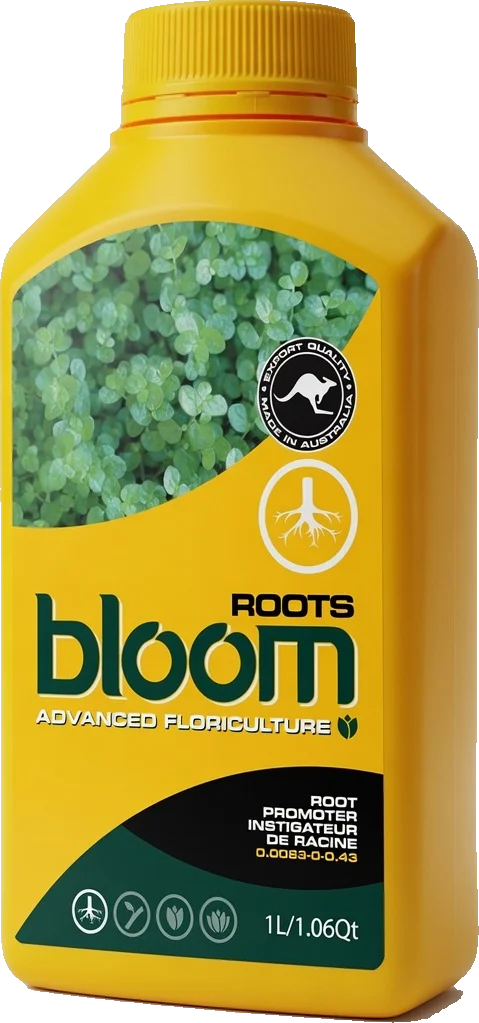
This is exactly the gap Bloom’s ROOTS doesn’t try to fill with an undeclared hormone dose. The label declares what’s in the bottle plainly: a seaplant extract derived from Durvillaea potatorum, carrying 0.075% humic acid from Leonardite and 0.054% thiamine hydrochloride (vitamin B1) as non-plant-food ingredients, guaranteed at 0.0083-0-0.43. There is no auxin figure on that label and no salicylic acid figure either, and that’s not an omission to paper over — it’s the honest alternative to a product claiming a hormone concentration it can’t actually calibrate for a grower. ROOTS is run at 0.5 ml/L in solution, or as a 1 ml/L dip for cuttings specifically — a measured, repeatable rate, which is the one thing a willow steep structurally cannot offer.
~25×
For a cut-flower propagation bench specifically, the stakes of overshooting aren’t abstract. A cutting that fails to root is a lost slot in the bench and a lost cycle on the production calendar — a cost measured in turns per season, not just in the one cutting. A bench running dozens or hundreds of cuttings through the same dip solution needs that solution to land in the same narrow window every time, batch after batch, which is a consistency problem a variable, unmeasured steep is not built to solve even once, let alone repeatedly across a full propagation run.
None of this is an argument that salicylic acid signaling isn’t real — the biphasic dose-response itself is good evidence that the molecule does something at the right concentration. It’s an argument that “the right concentration” is a narrow, species-dependent, clone-dependent target that a kitchen-counter steep has no reliable way to hit, and that overshooting it doesn’t just waste the batch — it can actively work against the rooting a propagator is trying to get. If what a cutting bench needs is a precise, repeatable auxin dose, the honest answer is the same one that applies to willow water generally: buy a product that actually declares one, like a commercial IBA rooting compound. If what it needs is the seaplant-extract and humic-acid support ROOTS actually provides, the label tells you exactly what you’re getting and at what rate — which, on this particular axis, a steeped bucket of bark simply can’t match.
Sources: Zemlyanskaya EV, et al. Salicylic Acid in Root Growth and Development. International Journal of Molecular Sciences 23(4):2228 (2022). Committee on Herbal Medicinal Products (HMPC). Assessment report on Salix cortex. European Medicines Agency, EMA/HMPC/80628/2016 (2017). Förster N, et al. Chemoprofiling as Breeding Tool for Pharmaceutical Use of Salix. Frontiers in Plant Science 12:579820 (2021). Guaranteed analysis per Bloom ROOTS label artwork.