
The Reason a Home Fish Ferment Won’t Keep Through Winter the Way a Bottle Does
Fall is when a lot of backyard growers put up a batch of something to carry them through the off-season — and a homemade fish fertilizer is a common one to start brewing before the garden slows down. Before that bucket goes into the shed for the winter, it’s worth knowing about the one ingredient everyone assumes is a bonus that’s actually the reason a home batch has a shelf life at all, while a bottled one doesn’t have the same clock running.
The ingredient everyone keeps on purpose
A traditional home fish ferment — whether it’s a straight fish-scrap bucket or a fermented fish-amino-acid brew made with brown sugar — keeps the whole fish, oil included, because that’s simply what’s in the raw material. Commercial processing takes a different path for a specific reason: FAO’s own technical documentation on fish silage production describes the oil as something that deteriorates rapidly during storage, with free fatty acids increasing steadily the longer the material sits, through ordinary lipid breakdown. In an enzymatic, skimmed process, the oil is deliberately removed from the hydrolysate before the finished product is bottled — not because the oil is worthless, but because it’s the single fastest part of the mixture to go rancid.
That’s the whole mechanism. A bucket that still has its oil in it has a built-in expiration clock that a bottle with the oil skimmed out simply doesn’t carry. It isn’t a flaw in the home method — whole fish has whole-fish oil in it, and removing it takes an extra processing step most home setups aren’t set up to do. It’s just a trade-off worth knowing about before a batch gets tucked away for four or five months of storage.
What pH does and doesn’t fix
Keeping a home ferment stable isn’t only about the oil. FAO’s guidance on fish silage is specific that the acidity of the mixture has to be brought down to roughly pH 4 or lower to prevent bacterial spoilage — and that if the acid and fish aren’t mixed thoroughly throughout the batch, a pocket of under-treated material inside the bucket can putrefy even while the rest of the batch reads fine. A Korean Natural Farming–style fish-amino-acid ferment, built on brown sugar fermentation rather than acid, doesn’t carry a published pH target or shelf-life figure at all in the extension documentation we’ve reviewed — the standard check described is simply whether the finished product smells “sweet, slightly fishy,” which is a judgment call, not a measurement. Acidity controls bacterial spoilage. It does nothing to slow down the oil that’s still sitting in the mix going rancid on its own separate timeline.
Why this is a real reason to stock up before the stretch, not after
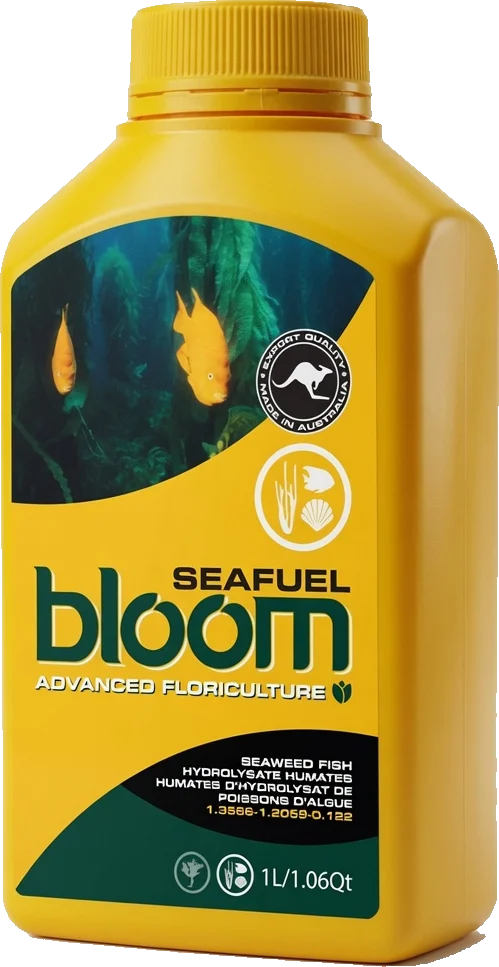
Bloom SeaFuel‘s own declared inputs are seaplant extract from Durvillaea potatorum and hydrolyzed blue fin tuna, stated on the label as a fish hydrolysate — the enzymatic route, not the old heat-and-acid emulsion process — with 0.075% humic acid from Leonardite listed as a non-plant-food addition. Its safety data sheet lists it at pH 4–5, fully biodegradable, with a sweet-fish odor profile consistent with that processing route. We’re not printing a specific guaranteed-analysis figure for SeaFuel here — that number carries a known discrepancy against the render we’ve seen versus the label we’ve read, which we’re still sorting out, so we’re leaving it off rather than guess.
The practical point for a backyard grower heading into the off-season is straightforward: a bottled, enzymatically processed input doesn’t carry the oil-spoilage clock a homemade batch does, which is exactly the kind of thing that matters if a container is going to sit in a shed through a cold winter rather than get used up in a week. That’s not a knock on making your own — it’s a reason the shelf-stable version earns its place in a fall stock-up specifically, rather than the mid-season rotation where either one works fine.
If you do keep brewing your own through the colder months, the two things worth watching are the ones this mechanism actually points to: keep the acidity where FAO’s guidance says it needs to be to hold off bacteria, and store the batch somewhere cool and dark to slow the oil’s own separate decline, since nothing about acidity touches that half of the equation. Neither step eliminates the clock. Both just make it a slower one.
Worth knowing too: the nitrogen number this piece intentionally leaves off isn’t unique to SeaFuel’s render discrepancy — some published home-ferment methods, like Fish Amino Acid, never declare one at all, by design.