
Most product writing about biostimulants cites the studies where the input won. It’s worth being upfront about the studies where it didn’t, because the honest picture in the literature on fish-derived inputs is genuinely mixed — and a garden-variety understanding of what “mixed” actually means helps more than another highlight reel would.
The study that went the other way
A review of fish by-product biostimulants describes a trial where an animal-derived biostimulant applied to strawberries “did not have a beneficial influence on the number of strawberry runners, their length, and their diameter” — and instead measurably decreased the plants’ overall weight. That’s a straightforward negative result from a peer-reviewed source, on a real crop, with a real fish-derived input. It sits in the same body of literature as several positive ones: a protein hydrolysate containing 11.3% L-amino acids that increased tomato yields over a control, and a collagen-derived hydrolysate that measurably improved root and leaf dry weight and root-to-shoot ratio in maize.
That spread isn’t a reason to throw out the category — it’s a reason to be specific about what varies between those trials. Different crops respond differently to the same biostimulant class, and that’s a documented, unremarkable fact of plant biology, not a sign that any particular result is wrong. What it does mean is that a single glowing trial, cited alone, oversells the certainty a gardener should actually have walking into their own backyard with their own crop.
Why we’re printing the one that didn’t work
A separate 2026 trial made the same point from a different angle, comparing lab-made fish-byproduct hydrolysates against a commercial reference product. The lab hydrolysates measurably outperformed a water control on wheat growth and biomass. The commercial reference product — the one with the bigger marketing claim on its label — showed no significant improvement over plain water at all. Being manufactured and bottled isn’t automatically the same thing as being effective; the literature doesn’t support that shortcut, and a brand that only quotes the trials favoring the category while skipping the ones that don’t is making the same shortcut by omission.
no significant difference
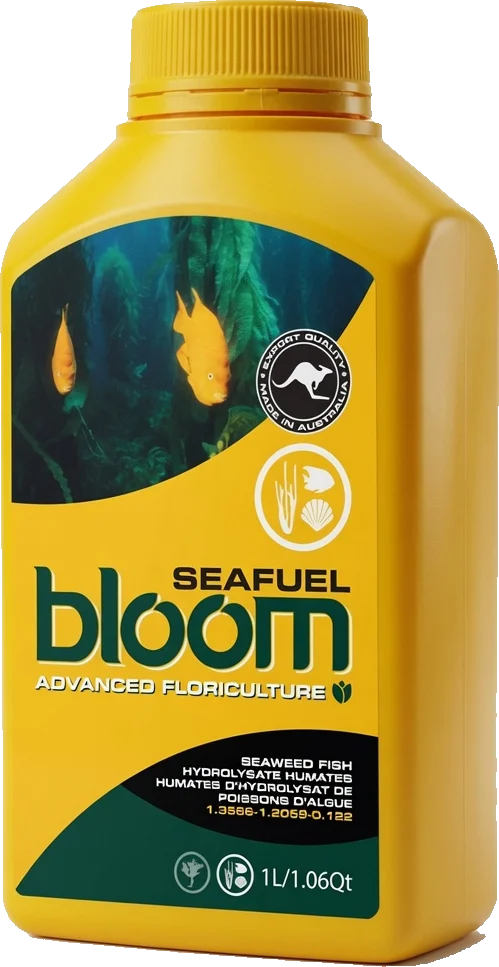
Bloom’s SEAFUEL is built on the enzymatic hydrolysate route specifically — fish hydrolysate plus a Durvillaea potatorum seaplant extract, with 0.075% humic acid, a declared, label-verified composition rather than a marketing number — and it hasn’t been run through that specific wheat trial or the strawberry one. We’re not claiming it would land on the winning side of every comparison in this category; the honest statement is narrower than that. What a grower can actually check is what’s declared on the label and what rate the feed chart calls for, and treat any fish-derived input — ours included — as a real but bounded tool, not a guarantee, because that’s what the published research on the category actually shows.
For a backyard gardener deciding whether to add a fish-based feed to tomatoes, strawberries, or anything else in a mixed bed, the practical takeaway isn’t to avoid the category — it’s to stay skeptical of any single trial used as a universal promise, including a positive one about a crop that isn’t the crop actually being grown. The same unevenness that shows up between strawberries, tomatoes, and maize in these three studies will show up between a backyard’s specific soil, climate, and cultivar and whatever test plot generated a favorable headline. Reading the label for what’s actually declared, and the feed chart for the rate that’s actually been tested, is a more reliable guide than any one study’s result — ours included.
Printing the negative result alongside the positive ones isn’t a hedge. It’s closer to what a garden actually needs from a brand: an accurate map of where a product reliably helps and where the evidence just doesn’t reach, rather than a highlight reel that quietly assumes every crop behaves like the one study that worked. The same enzymatic route is also why a bottled hydrolysate holds up through a winter in storage in a way a home ferment with its oil still in it doesn’t.
Sources: Madende M, Hayes M. Fish By-Product Use as Biostimulants: An Overview of the Current State of the Art. Molecules 25(5):1122 (2020). Valencia P, et al. Valorization of fish processing by-products through combined enzymatic and microbial hydrolysis: nitrogen recovery and fertilizer efficiency in wheat. Frontiers in Nutrition 13:1757182 (2026). Guaranteed analysis per Bloom SEAFUEL label artwork.