
The Fish Behind Seafuel, By the Numbers
“Fish hydrolysate” on a label tells you almost nothing — it could be menhaden scrap, salmon trim, or something else entirely, all lumped under one generic phrase. Seafuel’s label is specific: Southern Bluefin Tuna, Thunnus maccoyii. In a reservoir that might only hold a liter or two, knowing the actual species is worth more than it sounds.
A fish with a documented composition, not a mystery slurry
Southern Bluefin Tuna is one of the better-characterized fish species on the water, precisely because it’s commercially valuable enough that multiple bodies have measured it. Per 100 g raw tissue, the Australian Southern Bluefin Tuna Industry Association reports protein at 21.6 g in lean cuts and 20.3 g in fatty cuts, fat at 3.5 g and 28.3 g respectively, DHA at 0.40–3.30 g, and EPA at 0.17–1.40 g. FishBase’s independent figures land close: protein 23.2%, omega-3 content 0.74 g, selenium 31.2 µg per 100 g. USDA’s own composition entry for raw bluefin lists water at 68.1 g, protein 23.3 g, and fat 4.9 g per 100 g.
The three sources don’t line up to the decimal — FishBase’s 23.2% protein, ASBTIA’s 20.3–21.6 g, and USDA’s 23.3 g are independent measurements of a biological material that varies by individual fish, season and tissue cut, not a single fixed number. That spread is itself useful information: it tells you the input going into a hydrolysate is a real, variable animal tissue with a documented range, not a single invented average. Southern Bluefin Tuna is also a tracked, quota-managed species — catch is governed by the Commission for the Conservation of Southern Bluefin Tuna’s total allowable catch and a formal catch documentation scheme, and farming is concentrated in sea cages in South Australia’s Spencer Gulf. None of that is a sustainability claim; it’s a sourcing-transparency one. The fish behind the hydrolysate is traceable in a way “forage fish” generally isn’t.
Why that matters more at houseplant and LECA scale
At field scale, variability in a raw material averages out across a tank the size of a swimming pool. In a semi-hydro or LECA reservoir that might hold a liter, it doesn’t average out — it’s the whole batch. A hydrolysate made from a single, consistently sourced, cold-water species (Southern Bluefin Tuna is a temperate fish, typically found in 5–20°C water) is a more predictable starting material than a generic blend of whatever forage fish came through the plant that week.
This is also where a product label’s wording earns a closer read. “Fish hydrolysate,” “fish emulsion,” and “fish-derived” sound interchangeable but describe genuinely different manufacturing routes — hydrolysis breaks proteins down into free amino acids enzymatically or chemically, while emulsion production typically cooks the fish and centrifuges off the oil before concentrating the remaining liquid. Seafuel’s label specifies which route and which species; Groigen and Florigen, the other two Bloom products built on the same Southern Bluefin Tuna base, use it as a 20 ml/L foliar spray rather than a reservoir dose — different jobs for the same raw material, which is its own story.
Raw tissue composition per 100 g (ASBTIA)
Bars scaled per gram shown; fat scale compressed above 30g for display. Source: ASBTIA, per 100g raw tissue.
What’s actually on the Seafuel label
Seafuel is dosed at 1 ml/L and is made from Durvillaea potatorum (seaplant extract) and hydrolysed Southern Bluefin Tuna (fish hydrolysate), with 0.075% humic acid derived from Leonardite. Its N-P-K figures aren’t consistent across printings of the label artwork, so we leave them off rather than print numbers we can’t confirm.
The MSDS for Seafuel lists a pH of 4–5, a specific gravity of 1.2–1.4, and an odor described as “sweet/fish” — small details, but ones that matter in a small enclosed reservoir where smell and pH drift are two of the few things a grower can actually monitor day to day without test strips in hand. It also notes the product is fully biodegradable and incompatible with alkaline agents, which is worth knowing before mixing it into a tank that’s also carrying a high-pH amendment.
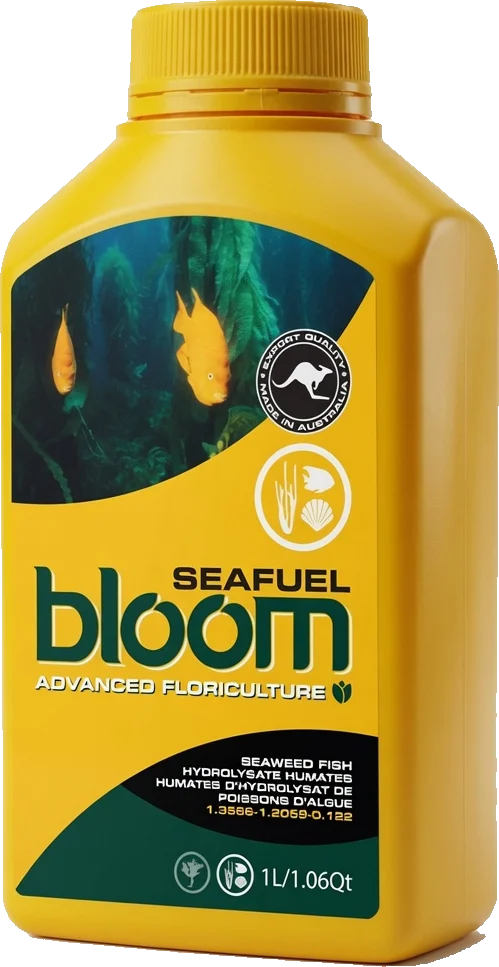
Bloom Seafuel — Durvillaea potatorum + Southern Bluefin Tuna hydrolysate, 1 ml/L.
A species name on a label doesn’t change the plant science. What it changes is whether you’re dosing a known quantity or a guess — and in a reservoir that small, that’s not a minor difference.
Sources: Australian Southern Bluefin Tuna Industry Association (asbtia.com.au); FishBase species summary, Thunnus maccoyii; USDA FoodData Central, raw bluefin tuna (generic); Bloom Seafuel label artwork, verified label facts register.
Related reading: The Bottle-Size Math Nobody Runs for a LECA Reservoir, on sizing a bottle to a small passive reservoir.