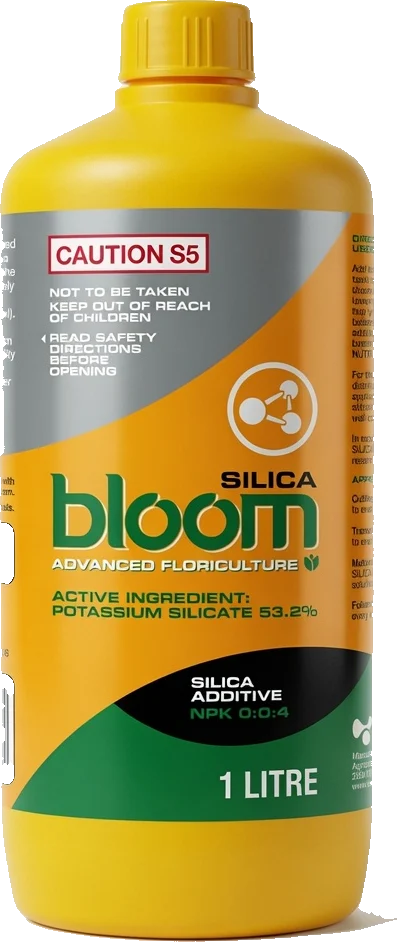
Specialty collectors — bonsai benches, orchid racks, small succulent and terrarium setups — are some of the heaviest users of dropper-bottle silicon supplements, added a few drops or milliliters at a time to a reservoir that might hold less than a liter. It’s a category where growers genuinely compare labels side by side before buying. The problem is that “the number on the label” isn’t measuring the same thing from one bottle to the next.
Three units, one element
Silicon supplements show up on labels in at least three different forms: as a percentage of monosilicic acid, as a percentage of silicon dioxide (SiO₂), or as a percentage of elemental silicon itself. These are not three brands of the same number — they’re three different ways of counting the same atom, and converting between them changes the printed figure substantially. One widely used hydroponics industry reference gives the conversion math plainly: monosilicic acid % × 0.2922 = elemental Si %, and SiO₂ % × 0.4674 = elemental Si %.
Two bottles that both say “2%” on the front label can be declaring very different actual silicon loads if one is reporting monosilicic acid and the other is reporting SiO₂ — and a third bottle reporting elemental silicon directly at “2%” is describing something larger again. None of that is a trick; it’s just that the industry hasn’t settled on one convention, and a specialty grower comparing two dropper bottles by eye is comparing numbers that don’t share a common basis unless the units are converted first.
Why the stakes are higher in a small reservoir
At hobbyist scale this isn’t academic. A terrarium or small succulent reservoir might hold a few hundred milliliters to a couple liters — a labeling mismatch that looks like a rounding error in percentage terms turns into a meaningfully different amount of actual silicon delivered per drop once the whole reservoir is that small. The smaller the system, the less room there is for a unit confusion to average itself out.
And the units question is the easier of two problems
Knowing which unit a label uses only tells you what’s claimed to be in the bottle — it doesn’t tell you whether it stays usable once mixed into your reservoir. Stable, soluble silicate ions exist only in a narrow, strongly alkaline window, roughly pH 11–12 and above, per technical evaluation documentation reviewed for organic-input manufacturing. Solubility drops sharply at pH 9, and below that, most of the dissolved silicate precipitates out as amorphous silica gel rather than staying available to a root. Most reservoirs — hydroponic, semi-hydro, or a terrarium kept in a comfortable growing range — sit well below pH 9. The conversion math only matters if the product is still in solution by the time it reaches the plant.
Worth being direct about where Bloom stands in this: Bloom’s own Silica label hasn’t been read into our verified figures yet, so this isn’t a page that can tell you which unit, or which manufacturing route, Bloom’s product uses — that’s a gap we’re working to close, not one we’re papering over. What we can say with confidence is the general chemistry above, which applies to any silicon supplement on the shelf, Bloom’s included: check which unit a label is actually using before comparing two numbers, and remember that the number only matters if the product is still dissolved by the time it reaches the root.
The same unit confusion shows up in DIY comparisons too
It isn’t only commercial bottles that run into this. Growers who compare a dropper-bottle supplement against a home horsetail extraction often do the comparison on mismatched terms without realizing it. A materia-medica reference puts horsetail’s declared silicic acid content at roughly 5–8% of the dried plant’s dry weight — but the one quantified extraction experiment found in the literature, a three-hour boil of dried horsetail, recovered only about 2.75% soluble silicic acid by weight, well under half the declared total. Declared content and what an actual extraction recovers are two different numbers even before any unit-conversion math enters the picture, and no study has tested what a cold, room-temperature steep of horsetail recovers at all.
Put the two problems together and the honest picture is this: a specialty grower weighing a bottled silicon product against a DIY option is really asking two separate questions — what unit is each one reporting, and how much of what’s claimed actually ends up dissolved and usable. Skipping either question and going straight to “which number is bigger” is how a grower ends up either overdosing a small reservoir or underdosing it while thinking they’ve matched a stronger product.