
Walk through any bonsai forum, succulent-collector group, or terrarium swap, and sooner or later someone recommends horsetail tea. The logic sounds solid: Equisetum arvense, the common field horsetail, has a centuries-old reputation as the “silica plant,” and silicon has a real, well-documented role in strengthening cell walls and helping plants cope with stress. So growers chop it, boil it, strain it, and pour it on collections that live in small, fixed-volume pots where every input matters more than it would in open ground.
The question nobody usually asks is simpler than the chemistry: how much of horsetail’s silica actually ends up in the water you pour?
What horsetail is said to contain
A widely cited materia-medica reference puts horsetail’s silicic acid content at roughly 5–8% of its dry weight. That’s the number that gets repeated in growing circles, usually without a source attached. It’s a real figure, traceable to older phytochemical surveys — but it describes what’s locked inside the plant’s tissue, not what comes out when you steep it.
What a real extraction actually recovered
Only one quantified extraction experiment on this exact question turned up in the research pass for this piece. Researchers boiled 2.0 grams of dried horsetail in 200 mL of water for three hours — a far longer, hotter process than a windowsill steep — and measured 55 milligrams of soluble silicon in the resulting liquid.
Run the math on that and you get 2.75% soluble silicic acid by weight of the dried plant. That’s roughly a third to half of the 5–8% the plant is said to contain, and that’s the result of a three-hour boil — not a cold soak, not an overnight steep, not the method most growers actually use.
Why the gap exists
This isn’t a horsetail-specific mystery — it’s the same barrier that shows up everywhere plant-available silicon is discussed. Plants themselves can only take up silicon once it’s dissolved as silicic acid (Si(OH)₄) in soil water; dedicated root transporters move it in, and once it’s deposited in shoot tissue as the plant loses water through transpiration, it polymerizes into solid silica gel and effectively stays put. The same logic runs in reverse for an extraction: silicon sitting in solid, structural plant tissue doesn’t just dissolve into a steep at room temperature. Heat, time, and often a pH push are what free it — which is exactly why the one study that measured this used a three-hour boil, not a splash of cold water.
Boiled 3 hrs: 2.75%
Cold steep: no data
What this means for a small, fixed-volume collection
For a bonsai pot, a mounted staghorn fern, or a terrarium — all places where a grower cannot flush and start over the way an open bed or a run-to-waste hydro system can — guessing at concentration is a bigger risk than it looks. If a three-hour boil only recovers a third to half of what’s “in” the plant, a quick cold steep almost certainly recovers less, and there’s no published number to say how much less. That’s not a reason to avoid trying it. It’s a reason to treat the result as unknown, not as a measured dose.
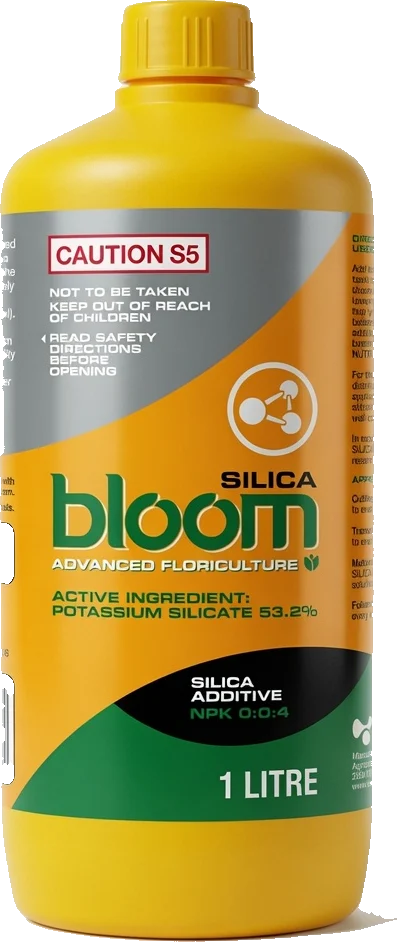
Bloom does sell a bottled Silica supplement, and we’re not going to pretend otherwise in a piece about DIY silicon. But we’re also not going to print a guaranteed-analysis number for it here, because — same as every other product on this site — we only print a figure once we’ve read it directly off our own label artwork, and that specific read hasn’t happened yet for Silica. That’s the same label-authority rule that governs everything else we publish. When it’s done, we’ll print the number. Until then, we’d rather say nothing than guess.