
The One Willow Trial With Real Rooting Numbers Used a Lab Dilution, Not a Jar on a Windowsill
Floriculture & Ornamental · Product Spotlight — ROOTS
Willow water shows up in almost every propagation forum as the free rooting aid: strip some bark, soak it, water your cuttings with it. One of the few controlled trials that actually tested willow bark extract on ornamental cuttings — chrysanthemum and lavender, both real cut-flower and bedding crops — found a genuine effect. The detail that gets left out when the trial gets quoted: the extract that worked was diluted to 1.06 microliters per liter, measured in a lab, from a standardized starting material. A commercial biostimulant product tested alongside it worked at 1 mL/L. Neither number is something a grower steeping bark in a bucket can reproduce or verify.
That’s worth sitting with. A home willow brew has no declared concentration, no species control, and (per the research on willow chemistry) no meaningful rooting hormone to begin with — willow’s actual compounds are salicin-type glycosides, not auxin, and the species commonly on hand (weeping willow, Salix alba) carries the lowest measured salicin content of the willows studied. The trial that found a real propagation benefit worked because it was precise down to the microliter. A propagation bench that can’t be precise isn’t getting that benefit — it’s getting a guess.
The researchers behind that willow-extract trial have published repeatedly on one commercial biostimulant line, which is worth knowing before leaning on the result too hard — call it industry-adjacent peer review, not an independent replication. Even taking the result at face value, the number that made it work is a lab dilution, not a backyard recipe.
What a declared rate actually buys you
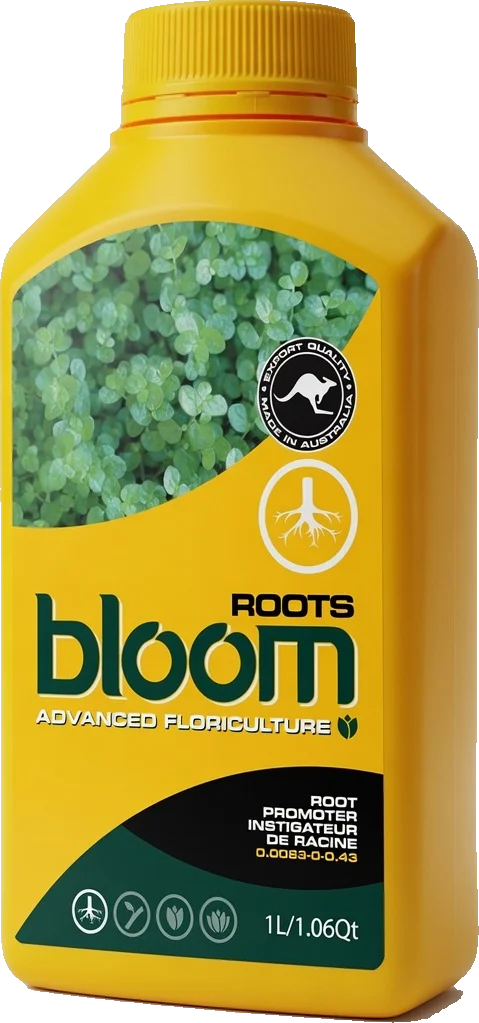
Bloom ROOTS doesn’t claim to deliver a rooting hormone, because its label doesn’t declare one — a Guaranteed Analysis of 0.0083-0-0.43, derived from Durvillaea potatorum seaplant extract, with 0.075% humic acid (from Leonardite) and 0.054% thiamine hydrochloride (vitamin B1) as the declared non-plant-food ingredients. What it does claim is a fixed, repeatable rate: 0.5 mL per liter as a feed addition, 1 mL per liter as a dip. Run that same dilution on the same bench every time, and whatever benefit the seaplant extract and humic acid provide, you get it consistently — cutting after cutting, bench after bench.
On a propagation bench specifically
Cut-flower and ornamental propagation runs on consistency more than almost any other stage of growing — a bench of chrysanthemum or lavender cuttings that roots unevenly is a scheduling problem as much as a horticultural one. A DIY rooting aid with no fixed concentration introduces exactly the variability a bench can’t afford: one batch of bark steeped longer, one cutting dunked in a stronger brew than the next. A bottled input with a declared dose removes that variable entirely, whatever else it does or doesn’t do.
None of this is a claim that ROOTS will outperform a lab-dosed willow extract — nobody has run that head-to-head trial, and we’re not going to pretend otherwise. It’s a narrower, honest point: the one willow trial with a real result used a number no bucket can replicate, and a product built around a fixed, labeled rate is the more reproducible choice for a bench that depends on reproducibility.
It’s also worth noting that even the lab trial didn’t produce one clean number — it produced two crops responding differently to the same dilution. Chrysanthemum and lavender are both real propagation-bench candidates, and still didn’t behave identically under the same 1.06 µL/L treatment, which is a reminder that “willow extract” isn’t a single predictable input even under laboratory control. Add species-dependent salicin content on top of that — Salix purpurea running 4–8% total salicin against Salix alba‘s roughly 0.5%, with up to 25-fold variation measured between individual clones of the same species — and a backyard willow steep is stacking at least three unknowns on top of each other before it ever touches a cutting: which species, which clone, and how strong the steep actually came out.
A cut-flower or ornamental propagation operation running at any real volume doesn’t have room for three stacked unknowns per batch. That’s the practical case for a bottled input with one declared rate over a free ingredient with three.
Whatever you use on a propagation bench, ask what number made it work in the one trial that found anything — and whether you can actually hit that number again tomorrow.
ROOTS won’t give you a hormone claim, because its label doesn’t carry one. What it gives you is the same declared rate, the same two declared ingredients, every time you reach for the bottle.