
Product Spotlight · ROOTS
Roots Before Frost: Why Division Day Is a ROOTS Dip, Not a Feed
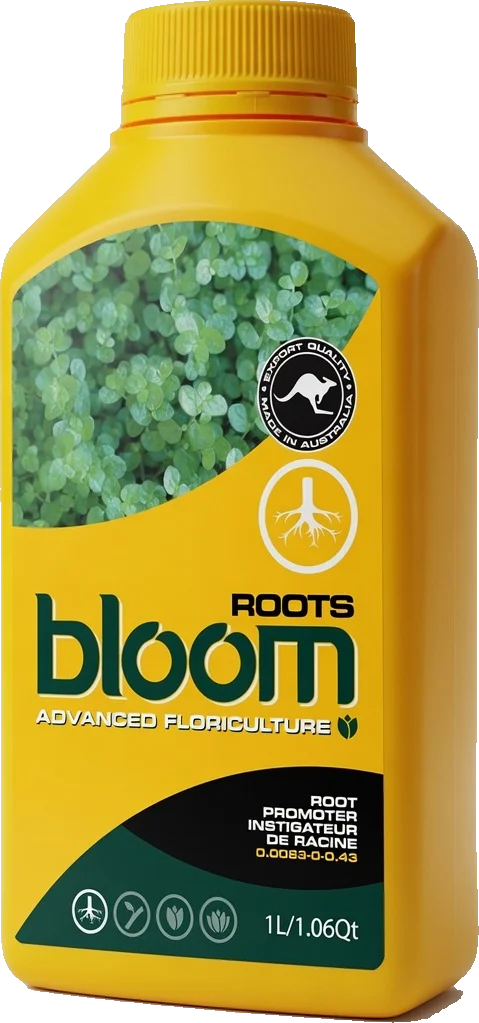
If you’re lifting and splitting hostas, daylilies, irises, or peonies this fall — or digging and replanting bulbs before the ground locks up — you’re handing the plant a pile of fresh-cut root tissue and asking it to reconnect with soil it’s never touched before. That’s a different job than feeding an established clump through the growing season, and it’s worth treating it that way.
ROOTS carries two rates on its own label for exactly this reason: 0.5 ml/L as an ongoing feed, and 1 ml/L as a one-time dip. Division and bulb-replanting day is a dip-rate day. Here’s the mechanism behind why, and why it matters more right now, heading into dormancy, than it does in June.
Top growth quits. Roots don’t — not yet.
Garden soil cools slower than the air above it. Once night frost knocks back foliage, soil a few inches down is often still sitting well above freezing, and root growth in most perennials and bulbs continues in soil down to roughly 40–45°F — it only really stops once the ground itself freezes. That gives a newly divided clump or a freshly set bulb several more weeks of root-building time after its leaves have already called it quits for the year.
That window is the whole point of fall division. A root system that gets itself re-established before freeze-up has a head start that a spring-divided plant, forced to rebuild roots and push top growth at the same time, doesn’t get. The priority this time of year genuinely is root establishment over top growth — there isn’t much top growth left to prioritize anyway.
Soil cools more slowly than air in fall. Root growth in most perennials and bulbs keeps going until soil hits roughly 40–45°F — well after top growth has stopped for the season.
What’s actually in the dip
ROOTS is built from seaplant extract — derived from Durvillaea potatorum — plus two declared non-plant-food ingredients: 0.075% Humic Acid, sourced from Leonardite, and 0.054% Thiamine Hydrochloride (vitamin B1). The guaranteed analysis is modest by design: Total Nitrogen 0.0083% (0.0021% ammoniacal, 0.0062% water-soluble organic) and Soluble Potash (K₂O) 0.43%. This isn’t a feeding product at dip strength — it’s a root-zone product, and the two non-plant-food ingredients are the ones doing the conceptual work at division time.
Humic acid, as a class, is a known soil conditioner with cation-exchange and chelating capacity — it holds and buffers nutrient ions in the root zone rather than letting them leach straight past a disturbed root ball. That’s a relevant property on division day specifically, because dividing a clump or lifting a bulb severs roots and disturbs whatever soil structure had built up around them; the replacement soil around a fresh division hasn’t had time to develop that buffering on its own.
Thiamine (B1) is a water-soluble vitamin that functions as a cofactor in several core plant enzymatic pathways, including carbohydrate metabolism. It’s a long-standing ingredient in transplant and rooting-dip formulations for that reason — it’s a basic metabolic input, not a growth regulator, and ROOTS’ label doesn’t make it one.
ROOTS’ declared guaranteed analysis and non-plant-food figures, label-verified. The 1 ml/L figure is the label’s one-time dip rate, not the 0.5 ml/L ongoing feed rate.
Putting it to use on division day
- Mix at 1 ml/L — the label’s dip rate, not the 0.5 ml/L feed rate — in a bucket sized to the job: a few liters for bulbs, more for a full perennial clump.
- Dip bare roots or bulb basal plates right after dividing, before they sit exposed and dry out, then replant promptly into prepared soil.
- Water in normally after replanting. This is a one-time application at the disturbance point — not a start to a weekly feed schedule for a plant that’s heading into dormancy anyway.
- Mulch as usual once soil temperatures drop toward the range where root activity finally stops, to protect the root zone through winter.
Where This Fits
This is a one-time dip at the moment of disturbance — for divided perennials, lifted-and-replanted bulbs, and new fall bulb plantings. It’s a different use case from ROOTS’ ongoing 0.5 ml/L feed rate for plants that aren’t being cut or transplanted, and from bare-root fruit tree and shrub transplanting, which is its own topic.
Bottom line: fall division hands a plant two problems at once — cut roots and a shrinking window before freeze. ROOTS’ label-stated dip rate, and the humic acid and thiamine declared on it, are built for that specific moment, not for a season-long feed.
Figures and ingredient names above are taken directly from the ROOTS product label (guaranteed analysis and non-plant-food declarations) as verified against label artwork. Not for use in organic crop or organic food production in the state of California, per the product label. Soil-vs-air cooling and the general fall root-growth window described here reflect standard horticultural understanding of soil thermal lag and dormancy biology, not a brand-specific trial.