

The Ratio That Changes Once a Bloom Sets Color
Floriculture & Ornamental · Science & Education
Every grower who’s pushed a feed hard through bud set has seen the same disappointing result: lush, dark, leafy growth and a bloom that’s slow to color up, or that opens pale and small on top of all that green. The instinct afterward is usually to feed harder, not less. The research on what a flowering plant is actually doing at that stage says the opposite move is the right one — not starving the plant, but changing what you’re still feeding it.
This isn’t a claim about any one crop or any one trick. It’s basic nitrogen physiology, and it applies to bedding annuals, potted bloomers and cut-flower benches the same way it applies to any flowering crop.
Senescence isn’t the plant failing — it’s the plant redistributing
A 2017 review in the Journal of Experimental Botany, surveying nitrogen remobilization from Arabidopsis through to crop species, lays out the mechanism plainly: leaf senescence is a controlled nitrogen-recycling program. As a leaf ages, the plant actively breaks down the nitrogen locked up in its proteins and chlorophyll and ships it out to wherever it’s needed most — in a flowering plant, that’s increasingly the bud and the opening bloom. The paper frames remobilization efficiency as something that genuinely affects the quality of what the sink — the flower, the seed, the fruit — ends up with.
That reframes what’s actually happening when older foliage on a flowering plant starts to yellow and thin out near bud break. It isn’t decline. It’s the plant pulling nitrogen out of tissue it no longer needs as much and sending it where the color and the bloom are forming. A feed that keeps dumping fresh nitrogen into that system works against the redistribution the plant is already trying to run — it gives the leaves a reason to keep holding nitrogen instead of releasing it.
This is also a different question from the one most growers think they’re asking. “Should I ease off feeding at the end of a cycle” usually gets answered as a yes-or-no on quantity — feed more, feed less, or stop. The remobilization research points at something more specific: it’s not really about how much you feed, it’s about which nutrient you keep topping up. Cutting everything equally treats nitrogen the same as every other nutrient the bloom still needs, when the physiology says nitrogen is the one actually in the way.
The point isn’t “stop feeding.” It’s “stop feeding nitrogen specifically.” A finishing bloom hasn’t lost its appetite — it still wants potassium, still wants the trace elements that support the color and sugar changes behind a good bloom. What it doesn’t benefit from is more fresh nitrogen competing with a recycling program it’s already running.
What a feed built for that window actually looks like on a label
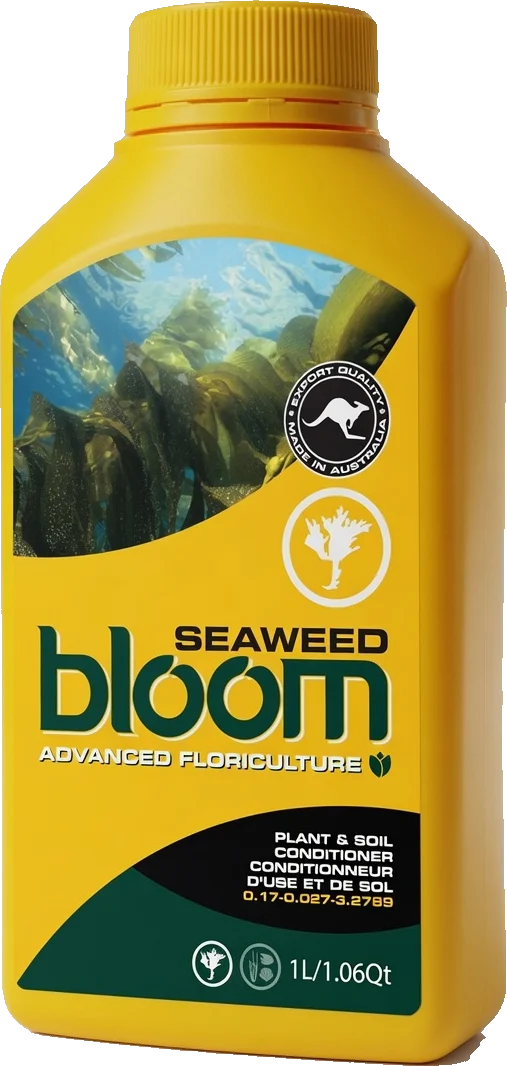
This is where it’s worth looking past the marketing language on a bottle and reading the guaranteed analysis instead. Bloom Seaweed’s label declares 0.17% total nitrogen, 0.027% available phosphate, and 3.278% soluble potash, derived from Durvillaea potatorum seaplant extract, fed at 1 ml/L. Run that ratio and the nitrogen all but disappears next to the potassium — roughly nineteen times more K₂O than N, by the label’s own numbers.
That’s not a formula built around a slogan — it’s just what a potash-forward, nitrogen-light input looks like once you print the actual numbers. For a bedding flat, a potted bloomer or a cut-flower bench moving from active growth into bud set and color development, a feed with that kind of ratio doesn’t ask the plant to keep managing incoming nitrogen on top of the nitrogen it’s already trying to relocate on its own.
The label also gives a dose, not a guess: 1 ml/L of nutrient solution for feeding, with a separate garden-scale rate table for broader applications. That’s the number that applies here — not a rate borrowed from a vegetative-stage feed, and not a rate stretched past what the label actually declares.
What this doesn’t promise
None of this is a claim that cutting nitrogen guarantees bigger or faster color, and it isn’t a claim that Bloom Seaweed is the only way to get there — a grower running a balanced program and simply easing off their own nitrogen source at bud set is working with the same physiology. What the Havé review actually supports is narrower and more useful: nitrogen remobilization during senescence is a real, documented process, and a feed that doesn’t keep re-loading nitrogen during that window isn’t fighting it. Read the label on whatever’s in the sprayer. The ratio printed there will tell you more about what stage it’s built for than anything on the front of the bottle.