
Root-Fed or Foliar-Sprayed: What the Big Seaweed Study Actually Measured
Cannabis & Indoor Hydro · Science & Education
Walk into any grow room and you’ll find two camps on seaweed extract: the ones who mix it into the reservoir and the ones who load up a pump sprayer and hit the canopy. Both will tell you it works. What almost nobody asks is whether the research backing seaweed extracts was actually measuring the same thing for both groups.
It wasn’t. The largest meta-analysis done on seaweed-extract biostimulants broke results out by exactly this variable, and the gap between application routes is bigger than most growers assume.
198 studies, three delivery routes, one clear winner
A 2026 meta-analysis in Frontiers in Plant Science pooled 198 peer-reviewed studies and 2,021 independent treatment-control comparisons of seaweed-extract biostimulants across crops. Beyond extraction method, the authors also split results by how the extract reached the plant. Soil-directed application — fertigation, drenching the root zone — produced yield gains of roughly 19–21%. Foliar spraying landed lower, around 15.5%. Combining both routes came in lowest of the three, at 14.2%.
That’s a real, sourced finding, not marketing copy: root-zone delivery outperformed foliar spraying and outperformed doing both at once. The authors don’t explain why combining routes underperformed root-feeding alone — it may simply reflect how the underlying trials were designed rather than some antagonism between methods — but the ranking itself, root > foliar > combined, is what the pooled data shows.
What the label already tells you to do
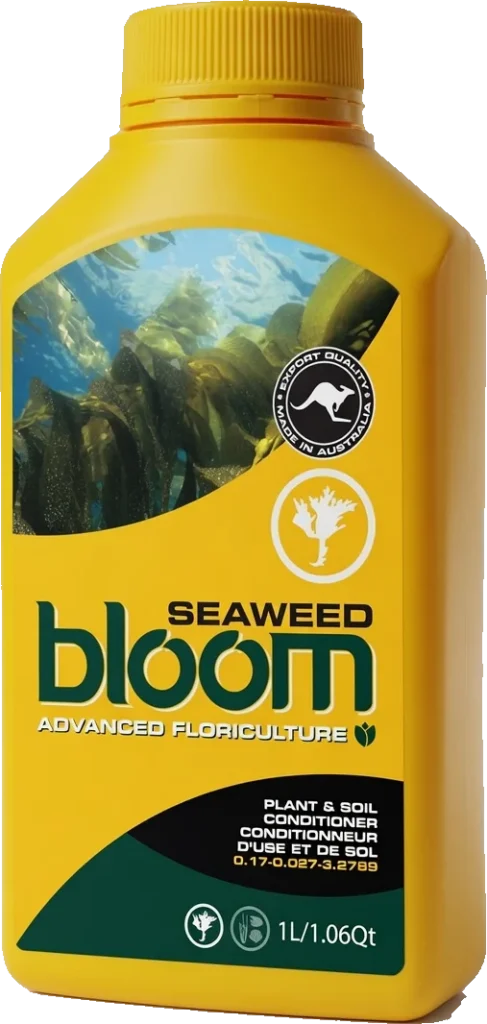
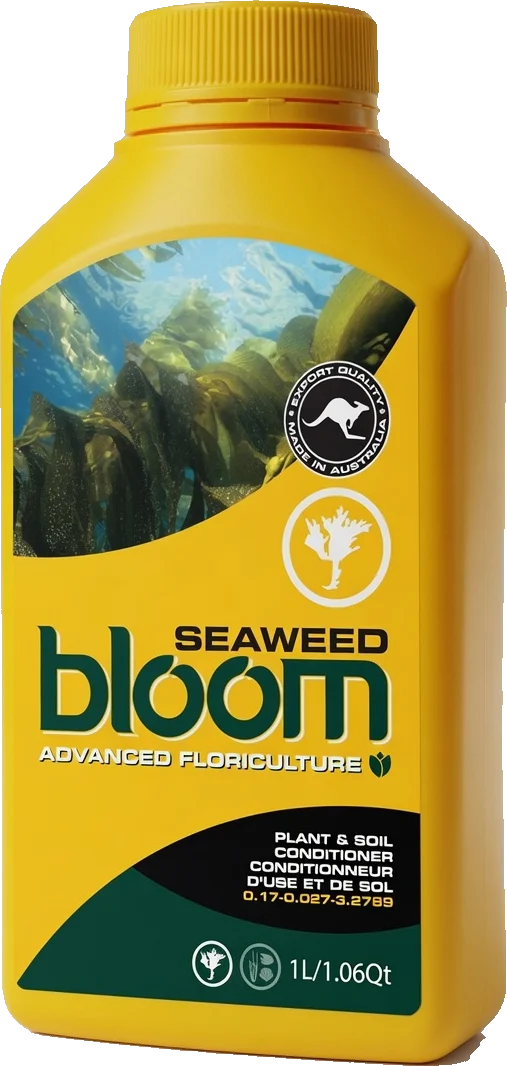
This is where it’s worth checking what’s actually printed on the bottle instead of guessing. Bloom Seaweed’s label declares 0.17% total nitrogen, 0.027% available phosphate and 3.278% soluble potash, derived from Durvillaea potatorum seaplant extract — and the stated rate is 1 ml/L of nutrient solution. That’s a fertigation instruction, not a foliar one. The label isn’t dosed as a spray-bottle dilution; it’s dosed as a reservoir addition, which happens to be the delivery route the pooled research found strongest.
Worth being straight about the limits here too: Durvillaea potatorum doesn’t have its own entry in that meta-analysis’s species breakdown — the species table is built around more heavily studied genera like Ascophyllum and Laminaria. So this isn’t a claim that Bloom Seaweed specifically produced a 19–21% gain in a trial. It’s narrower and more useful than that: when researchers tested how seaweed extracts generally get applied, root-zone feeding won, and that’s the route this product’s own label already tells you to use.
A grower deciding between a foliar seaweed spray and a reservoir dose isn’t choosing between two equally-supported options. The pooled evidence favors the reservoir, and that’s exactly where a 1 ml/L feed-solution rate puts it.
Why the gap probably isn’t about absorption alone
It’s tempting to assume foliar loses because leaves absorb less of a dilute spray than roots absorb from a reservoir bathed in it continuously — and that’s plausible, but it isn’t the only mechanism in play. Root-zone application also puts the extract’s polysaccharide and polyphenol fraction in direct, sustained contact with the rhizosphere, where microbial activity and root architecture respond over the whole feeding cycle rather than during the brief window after a spray dries. The meta-analysis doesn’t isolate which mechanism does the work — it only measures the outcome. That’s an honest gap, not a reason to overstate the explanation.
None of this says foliar seaweed sprays don’t work — a 15.5% average gain across hundreds of studies is still a real effect. It says that if you’ve got a bottle dosed for the reservoir, the research happens to back the exact route the label already asks for, and there’s no evidence basis for adding a foliar pass on top expecting it to do better than the reservoir alone.
What this actually changes about a feeding routine
For an indoor grower choosing where to spend time and product, this is a practical answer, not just an academic one. A reservoir dose stays in contact with the root zone for the whole span between water changes — days, not minutes — while a foliar pass dries on the leaf surface within an hour or two. The meta-analysis doesn’t prove that contact time is the whole explanation, but it’s consistent with it: the route with the longest sustained exposure to the root system is also the route with the strongest pooled result.
That also means a grower weighing whether to add a foliar seaweed spray on top of an already-dosed reservoir should know the pooled data gives no reason to expect a boost from doing both. The combined-route figure, 14.2%, sits below either route run on its own. If the budget or the time only stretches to one application method, the research says put it in the tank, not in the sprayer — which is exactly where a 1 ml/L feed-solution rate already puts it.