
Fall is when a lot of humic-acid amendment goes on broadacre ground ahead of next season’s planting — it’s a cheap, well-worn move for feeding soil biology and holding onto nutrients before winter. What rarely gets asked is a simple question with a real answer: which alkali pulled that humic acid out of the raw lignite or leonardite ore in the first place? It isn’t a cosmetic detail. At field scale, it’s the difference between a potassium amendment and a sodium one riding along on every application.
Humic acid doesn’t come out of the ground on its own
Raw humic acid sits in ore largely as insoluble calcium, iron and aluminum humates, locked in protonated form. USDA’s own technical evaluation of the material states plainly that humic acid “is not soluble in water under acidic conditions (pH < 2), but is soluble at higher pH values,” and names the commercial extraction routes as potassium hydroxide, water, or — rarely — ammonia. An alkali has to come in and deprotonate the humic fraction, displacing those bound cations before it’s usable in a liquid or soluble amendment. That alkali doesn’t disappear. It ends up declared on the label as the “derived from” source for whatever plant nutrient it contributes.
And the alkali you pick changes more than the label line — it changes yield. A 2024 extraction study pulling humic acid from lignite found sodium hydroxide produced 18–28.5% extraction yield, while potassium hydroxide produced 9.98–21.89% under otherwise comparable conditions. Route matters, and it isn’t a wash.
Why the difference is bigger on an acre than in a tank
A hydroponic grower using a KOH-derived humic product flushes the reservoir on a schedule — whatever cation came along for the ride gets replaced with the next mix. A broadacre field doesn’t get flushed. The same ground that gets a humic amendment this fall gets it again next fall, and the fall after that. Sodium is the one cation with a well-documented habit of building up in exactly that scenario: irrigation and soil-salinity guidance consistently treats sodium as a structural concern, not just a nutrient one, because it displaces calcium and magnesium from soil exchange sites and degrades infiltration as it accumulates — the same reason the metals and mineral-load framework and the sodium-adsorption-ratio concept exist for irrigation water in the first place. Potassium carries none of that structural baggage; it’s a nutrient a crop can actually use.
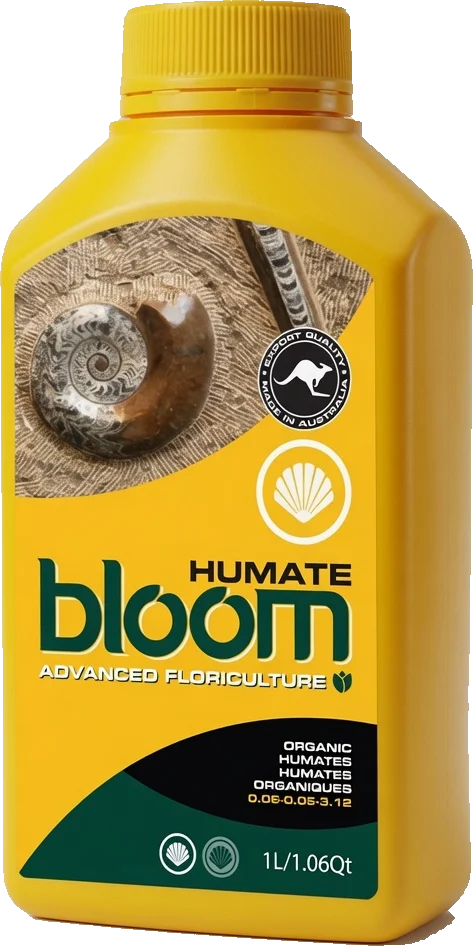
0-0-3.12
To be precise about what the label actually establishes: “derived from” names the source of the guaranteed plant nutrient — here, the 3.12% K₂O — not necessarily the exact reagent used at every step of processing. But it is accurate, and worth knowing, that Bloom Humate’s declared potash comes from potassium hydroxide, which means whatever alkali did the extracting left potassium in the bottle rather than sodium. That’s a real, label-backed fact, and for anyone amending the same broadacre ground year after year, it’s a more useful thing to check on any humic product’s label than the humic-acid percentage alone.
This isn’t an argument that every sodium-hydroxide-derived humic product is a problem at any rate — plenty of soils and crop rotations can absorb a modest sodium input without consequence, and extraction route is only one line on a label among several worth reading. It’s an argument for reading that line at all before a multi-year fall amendment program gets built around a product nobody checked. The rate that matters is on the bag, not in the pitch — same rule that applies everywhere else in this business.
It’s also worth being honest about what a field operation can and can’t verify on its own. A soil test can flag rising sodium or a climbing SAR over a few seasons, but it can’t tell you after the fact which fall amendment put it there if three or four different products went down in the same window. The label line is the only record that survives that ambiguity — it’s checked once, at purchase, rather than reconstructed years later from a soil report. For an operation already thinking in input-use-efficiency terms — getting more crop response per unit applied, not just more product applied — knowing which cation is riding along on a humic amendment belongs in that same column as fertilizer rate and placement timing. It’s a small line to check against a much larger, much slower-to-reverse outcome if it’s ignored for a decade of fall applications. The same habit of reading a label for what it explicitly does and doesn’t claim is worth applying to certification status, not just guaranteed-analysis figures, before a product goes into a multi-year field program.
Sources: USDA Agricultural Marketing Service, National Organic Program, Technical Evaluation Report on humic acid extraction chemistry. Paul et al., comparative lignite humic-acid extraction yields by alkali, 2024. Guaranteed analysis and derived-from statement per Bloom Humate label artwork.