Aloe vera shows up constantly in propagation-bench folklore — slice a leaf, squeeze the gel onto a fresh cut, and growers swear the cutting roots faster. There’s a real, if small, body of research behind that instinct. What gets skipped almost entirely is a separate question: does the aloe gel on your shelf, in a bottle, or scraped from a leaf that’s been sitting in the fridge for a week still contain what a fresh-cut leaf does?
What’s actually in the gel, and how fragile it is
Aloe gel is roughly 99% water. The remaining 1% carries the compounds people are actually after — amino acids, and hormones including auxins and gibberellins, though the research describing them stops short of quantifying how much is present. The molecule most often credited with aloe’s biological activity is acemannan, a polysaccharide, and it is not a stable one. Published work on its structure is explicit: alterations to acemannan can be induced by storage itself — light exposure, temperature, and oxygen exposure all degrade it, and the acetyl groups that make up part of its structure are sensitive to pH and to dehydration temperatures above 60°C. On top of that, the review notes aloe’s composition varies by cultivar, plant maturity, growing conditions and season before anyone even cuts a leaf.
None of those four conditions are exotic. They describe, almost exactly, how a lot of aloe product reaches a grower: processed, packaged, shipped, and stored on a shelf under a grow light for weeks before it’s used. A fresh leaf snapped off a potted aloe plant and used immediately skips all four. A bottled gel, a pre-mixed rooting dip, or even a fresh leaf that sat cut-open on a windowsill overnight does not.
The trial behind the claim, and what it can’t tell you
The most-cited positive result for aloe as a rooting aid comes from a pomegranate cutting trial: aloe vera gel produced 100% rooting, matching a fermented-manure extract and beating a commercial IBA rooting hormone’s 93.3% and an untreated control’s 66.7%. It’s a genuinely interesting result, and it’s also a small one — ten cuttings per treatment, sixty cuttings total, one greenhouse, one season. At that sample size the gap between aloe and IBA is a single cutting. The paper also doesn’t specify the aloe concentration, how it was prepared, or how long the cuttings soaked in it — which means the trial can’t tell a propagator what, specifically, made it work, only that something in freshly applied gel did.
What this means on a cut-flower propagation bench
If a grower wants to try aloe on a propagation bench, the honest version of that experiment is a freshly cut leaf, used the same day, not a bottle that’s been open for a month or a gel scraped from a leaf that’s been sitting on a counter. That’s not a claim that fresh aloe reliably works — the underlying trial is too small and too thinly documented to promise that — it’s a narrower, more defensible point: whatever a fresh leaf might be doing, storage time, light, heat and pH are all working against it reaching the cutting intact.
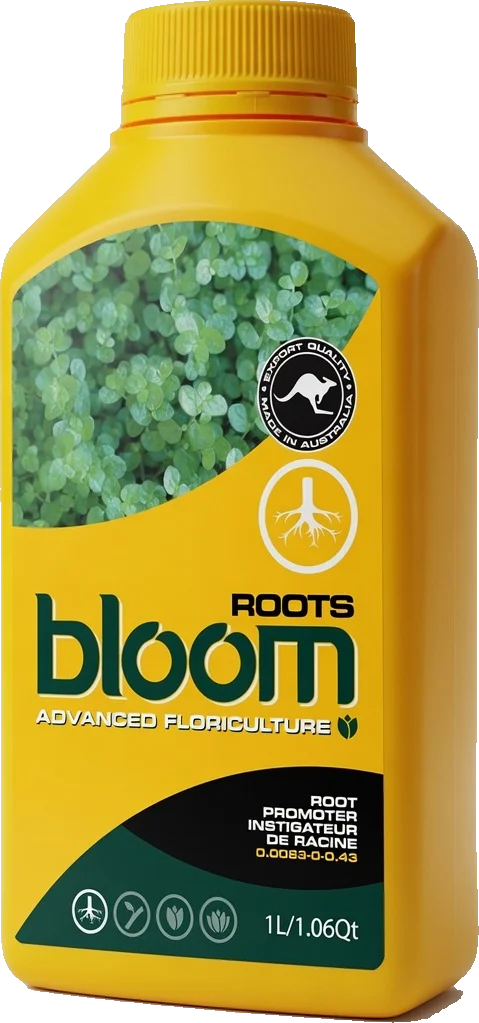
That’s part of why a propagation program built around a bottled input looks for something different — declared ingredients at a stated concentration, from a process that doesn’t depend on how long the bottle sat under a light before it got opened. ROOTS declares seaplant extract (Durvillaea potatorum), humic acid and thiamine hydrochloride at fixed percentages on the label, dosed at 0.5–1 ml/L. It makes no hormone claim, which sidesteps the acemannan-degradation question entirely — there’s no fragile active ingredient on the label to worry about losing between the bottle and the tray. That’s a different kind of consistency than “use it fresh,” and for a propagation bench running the same recipe week over week, it’s the one that’s easier to repeat.
None of this settles whether aloe belongs in a propagation program at all — the evidence is too thin for that either way. What it does settle is a narrower, more useful question: if you’re going to try it, freshness isn’t a nice-to-have, it’s close to the whole premise. A gel that’s degraded on the shelf is being asked to do a job the one supporting trial never actually tested it doing.