
Every few summers, someone in a gardening forum swears by hauling a few gallons of seawater home and pouring it on the beds — “full of minerals,” the thinking goes, “and plants love silicon.” The silicon part is true: it’s a real, well-studied element for crop vigor. The seawater part has two separate problems, and both of them are mechanical, not mythical.
How a plant actually gets silicon
Plants don’t absorb silicon as “silicon.” They absorb it as dissolved silicic acid — Si(OH)₄ — pulled into the root by a dedicated transporter (Lsi1), pushed toward the vascular tissue by a second one (Lsi2), and moved up into the shoot by a third (Lsi6). Once it arrives and the plant loses water through transpiration, that silicic acid polymerizes into solid silica gel inside the tissue — which is why, once it’s in, it doesn’t move back out. This is a well-mapped uptake pathway, not a guess (Kaur & Greger, Plants, 2019).
Most soil silicon never gets that far. Something like 50–70% of the silicon in ordinary soil sits locked in solid silicon dioxide — sand and clay minerals — which the plant can’t touch. Availability tracks the dissolved silicic acid fraction, not the total silicon content of the ground underneath it.
Why seawater comes up short on silicon in the first place
Here’s the part most garden-forum advice skips: the ocean’s own surface silicon is already spoken for. Diatoms — a huge, silica-shelled group of marine phytoplankton — pull dissolved silicic acid out of the water to build their own skeletons, continuously, at a scale that measurably depletes it near the surface. Recent oceanographic modeling even points to surface waters in some regions running silicon-limited well before any human influence (Taucher et al., Nature, 2022). A bucket dipped from the shore isn’t a silicon concentrate; it’s water that plankton have already been competing over for silicon all season.
The honest version: no one has published a surface-seawater silicic-acid concentration low enough or high enough to make a specific claim here — what’s well established is the mechanism (diatoms deplete it) and the direction (it’s scarce, not abundant). That alone rules out “the ocean is a silicon source.”
And even where silicon exists dissolved, it needs the wrong pH to stay that way
This is the part that would sink the seawater theory even if the depletion problem weren’t real. Manufactured liquid silicon products — potassium silicate — are made one of two industrial ways: fusing silica sand with potash above 1,000°C, or dissolving silica sand directly in potassium hydroxide solution. Either way, the resulting silicate ion only stays stable and dissolved in a narrow, strongly alkaline window — roughly pH 11 to 12. Drop below pH 9 and solubility collapses fast; most of the dissolved silica falls out as an amorphous gel (USDA Agricultural Marketing Service technical evaluation, 2014).
Seawater’s pH sits around 8.1 — comfortably below the point where silicate chemistry falls apart. So the two problems compound rather than cancel: seawater has little dissolved silicon to begin with, and its own chemistry wouldn’t hold much of it in solution even if there were more. Any grower who has tried mixing their own silicate booster and watched it cloud up or gel in the jug has already met this chemistry firsthand — it’s the same collapse, just triggered by a weak-acid tank mix instead of by the ocean’s own pH.
What real silicon correction looks like at scale
For comparison, when silicon deficiency is real and worth fixing at field scale, the correction is agronomic, not a splash from a bucket. Calcium silicate soil amendments go on at 1 to 6 tons per acre. Field trials show a benefit once soil tests above roughly 40 mg/L available silicon — against a New Jersey state average of 14 mg/L. Rice, one of the most responsive crops, can carry up to 10% silicon in its shoot tissue by dry weight (Rutgers Fact Sheet FS1278, 2017; Kaur & Greger, 2019). None of that scale has anything to do with a backyard bucket — it’s there to show how far “agronomic silicon correction” is from “a splash of ocean water,” not as a recommendation for a home garden.
The takeaway
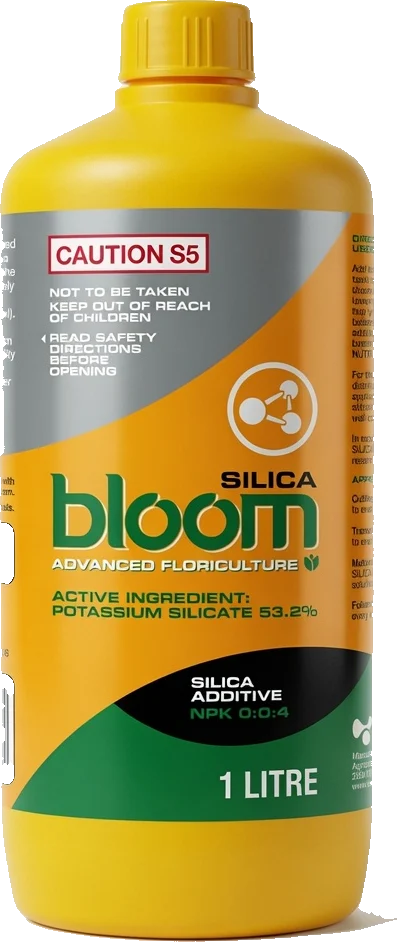
Silicon is a real, well-documented input for plant vigor — just not one seawater can deliver. Diatoms have already been competing for whatever silicic acid is near the surface, and the chemistry that keeps dissolved silicate in solution needs a pH seawater doesn’t have. If silicon is something you want to supplement deliberately, that’s a job for a product built around it, not a bucket from the coast — the same logic behind reading what’s actually on a Bloom bottle’s garden rate table before guessing at a dose. Bloom carries a dedicated Silica product for growers who want exactly that — we’re not printing a dose figure here, because that belongs on the label, not in a blog post, and it’s a figure we’re still in the process of pulling directly off that label ourselves.