
Before You Add a Silicon Supplement to a Reservoir That Never Gets Flushed
Fall is when a lot of semi-hydro and LECA growers stock up and start layering in one more input before the slower winter stretch — and silicon is a common one to reach for. Before it goes into a passive reservoir that might sit for weeks between full changes, it’s worth understanding the one piece of chemistry that decides whether a silicon product actually stays usable once it’s diluted and sitting.
Why silicate chemistry is pH-sensitive in the first place
Manufactured potassium-silicate products are made one of two ways: fusing silica sand with potash above 1000°C, or dissolving silica sand directly in potassium hydroxide solution, per a USDA technical evaluation of the process. Either way, the finished concentrate only stays soluble in a narrow, strongly alkaline window — stable, soluble silicate ions exist mainly above roughly pH 11–12. Solubility drops sharply at pH 9, and below that most of the dissolved silica precipitates back out as amorphous gel. That’s the concentrate on the shelf. What happens once it’s diluted into a reservoir running a normal growing pH of 5.5–6.5 is a different question, and it’s the one that actually matters to a grower.
This is also why silicon products carry such specific mixing instructions compared to most other bottled inputs. A concentrate sitting at pH 11–12 meeting a reservoir sitting at pH 5.5–6.5 isn’t a small adjustment — it’s crossing the entire collapse zone in one step, in whatever small volume of water first contacts the concentrate before it’s fully diluted. That local, momentary mixing environment is where premature precipitation tends to actually happen, even in a batch that tests fine once it’s fully stirred.
The part the chemistry doesn’t fully answer
Here’s where honesty matters more than a tidy number. A frequently cited hydroponics industry source states that elemental silicon held below roughly 20 ppm in a finished, diluted nutrient solution tends to stay stable without re-precipitating, even once the solution has dropped well out of the alkaline window the raw concentrate needs. That’s useful as a rough practical guide — but it traces to an unpublished test and uncited figures on one industry page, not an independently verified study, and should be treated as industry guidance rather than settled science. The underlying mechanism — strong pH-dependence of silicate solubility — is well established; the specific 20 ppm practical ceiling is not something we can independently confirm.
What that means for a reservoir that sits for weeks
A passive, unflushed system is exactly where this matters most: there’s no regular dump-and-refill to carry away anything that’s quietly precipitated out of solution and settled where roots can’t use it. Mixing order counts too — a concentrated silicate product added directly into an already-acidic reservoir, rather than pre-diluted on its own first, is the fastest way to trigger that drop-out before the silicon ever reaches a root. None of this is a reason to avoid a silicon supplement going into the fall stock-up. It’s a reason to check your own product’s handling instructions for mixing order and dilution before adding one more input to a system that isn’t getting flushed again anytime soon — the chemistry doesn’t care how long the reservoir has been sitting, but what settles out of solution in week one will still be sitting there in week four.
Practically, that argues for the same habit good hydroponic growers already use for other concentrates: dilute the silicate product on its own first, in a separate container of plain water, before it ever meets the rest of the reservoir’s nutrient mix — rather than dosing it straight into an already-mixed, already-acidic feed. It’s a small extra step, but it’s the one that keeps the collapse zone from happening in a tight, undiluted pocket right where the concentrate first lands.
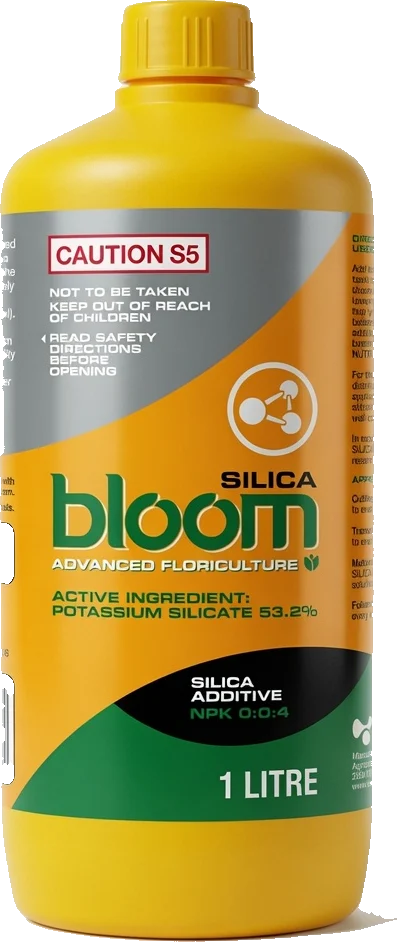
Bloom’s own silicon product, Silica, doesn’t yet have a label pulled into our own fact-checking reference for this series — so we’re not printing a Bloom-specific guaranteed analysis or dose rate here, deliberately. The chemistry above applies to potassium-silicate products generally, and it’s worth checking against whatever product is actually going into your reservoir this fall.