
Which Part of the Cutting Did You Steep? A Willow Trial Found It Changes the Answer
For a bonsai bench with one root-zone volume and no room for a failed strike, “willow water” turns out to depend on which part of the tree ended up in the jar.
A bonsai pot never gets bigger. We’ve written before about what that fixed root-zone volume means for a declared, repeatable input like ROOTS. This piece is about the opposite case — a home remedy whose active ingredient changes depending on a detail most growers never think to control.
A trial on olive cuttings tested extracts made from four different parts of a willow tree — bark, shoot, leaf, and wood — against the same cultivar, same conditions, same timing. The results were not close to interchangeable. A 48-hour bark soak produced 46.9% rooting. A 4-hour shoot extract raised callusing to 61.3%. Root counts came in at 3.9 for shoot extract, 3.6 for leaf extract, and 4.4 for bark extract. The wood extract — the part of a willow branch most people would reach for first, since it’s the sturdiest and easiest to cut — was reported ineffective.
That’s four different outcomes from four parts of the same species of tree, on the same cuttings, in the same trial. None of this is a surprise once you know what “willow water” is actually extracting. The compounds in question — salicin and its relatives, not free salicylic acid and not a true auxin — are concentrated unevenly through the plant, and bark-to-wood ratios shift the result before species or clone variation even enters the picture. We’ve covered separately how salicin content itself varies 0.5% to 8%+ by species, and how salicylic acid’s effect on rooting is biphasic — helpful in a narrow low window, counterproductive above it. This trial adds a third variable on top of both: which part of the plant you cut from.
Why that matters more on a bench with no margin
A field grower who gets an inconsistent willow brew can replant and try again next season. A bonsai propagator working a single, fixed-volume pot on a slow-growing specimen doesn’t get that many attempts, and a weak strike can mean losing a season of training work on material that took years to develop. That’s the practical stakes behind choosing a declared input over a jar of steeped clippings whose active ingredient concentration depends on which branch got cut.
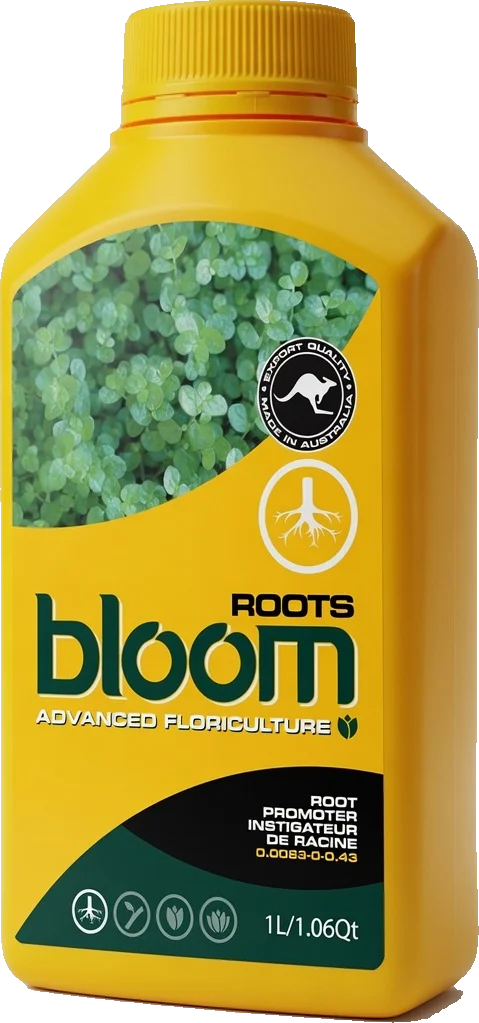
Bloom ROOTS doesn’t contain a hormone at all, by design — its label declares Durvillaea potatorum seaplant extract as the nitrogen and potash source, plus 0.075% Humic Acid and 0.054% Thiamine Hydrochloride (B1) as non-plant-food ingredients. The general rate is 0.5 ml/L, with 1 ml/L used as a dip. That’s the whole point of a guaranteed analysis: the ratio on the bottle is the ratio in the bottle, every time, regardless of which part of which plant it came from. A willow soak can’t make that promise, because the source material itself is the variable.
None of this is a claim that ROOTS causes rooting the way a hormone does — it isn’t one, and we don’t say it is. It’s a claim about consistency, which is a different thing entirely, and arguably the thing a slow-grown specimen with one shot at a strike actually needs most.
It’s worth being precise about what this olive trial does and doesn’t establish for a different species. Olive and bonsai material propagate differently, and a result measured on ‘Nabali’ olive cuttings isn’t a guaranteed match for juniper, ficus, or elm. What the trial does establish cleanly, because it held the cultivar and conditions constant across all four extracts, is the internal comparison: part-of-plant is a real variable in willow-based rooting aids, independent of species or dose. That’s the piece worth carrying into any specialty-niche propagation bench, regardless of what’s actually being rooted.
There’s a practical angle here too. A grower reaching for a willow branch in the yard has no easy way to tell bark from shoot from wood once a cutting is a few inches long and stripped of leaves — the visual cues that matter in a controlled trial blur fast in a backyard harvest. That ambiguity is exactly the kind of variable a labeled, single-source input removes from the equation.
Sources: Al-Amad I, Qrunfleh M. Effect of Babylon weeping willow (Salix babylonica L.) extracts on rooting of stem cuttings of olive (Olea europaea L.) ‘Nabali’. Acta Horticulturae 1130:391–396 (2016). Bloom ROOTS label artwork (verified guaranteed analysis and derived-from statement).