
Silicon supplements have a strong reputation in cannabis growing — thicker stems, stronger cell walls, better stress tolerance. Most of that reputation was built on crops that have almost nothing in common with cannabis botanically: rice, sugarcane, wheat, turf grass. Before assuming the same effect size carries over, it’s worth asking a basic question — is cannabis even the kind of plant that takes up much silicon in the first place?
Plants don’t all handle silicon the same way
Silicon research sorts plants into three rough tiers by how much silicon ends up in their shoot tissue, measured as a percentage of dry weight: low accumulators stay under 0.1%, intermediate accumulators run around 1%, and high accumulators exceed 5% — rice shoots can reach as much as 10%. The high end of that range is dominated by two plant families: Poaceae (the grasses — rice, wheat, sugarcane, turf) and Cyperaceae (sedges), which typically exceed 4%. Cannabis belongs to neither family.
Why the mechanism matters before the dose does
Silicon uptake isn’t passive. Plants that do accumulate it rely on dedicated root transporters — an influx transporter (Lsi1) that brings dissolved silicic acid into root cells, and efflux transporters (Lsi2, Lsi6) that move it toward the shoot. How much of that transporter machinery a species expresses, and how actively it runs, is exactly what separates a 10%-silicon rice plant from a 0.1%-silicon low accumulator. A high-accumulator result from a grass trial doesn’t automatically predict what happens in a species whose transporter expression hasn’t been characterized the same way.
What’s settled, and what isn’t
What the sourced research actually supports: silicon is taken up as dissolved silicic acid, not as solid silica; soil silicon is mostly locked up as silicon dioxide and isn’t available to roots regardless of how much total silicon a soil contains; and accumulator capacity varies enormously by plant family, with grasses at the documented high end. What it doesn’t support is a cannabis-specific accumulator classification, or a cannabis-specific effect size for any of the headline grass-trial numbers.
Intermediate: ~1%
Low: <0.1%
Cannabis: not placed on this scale
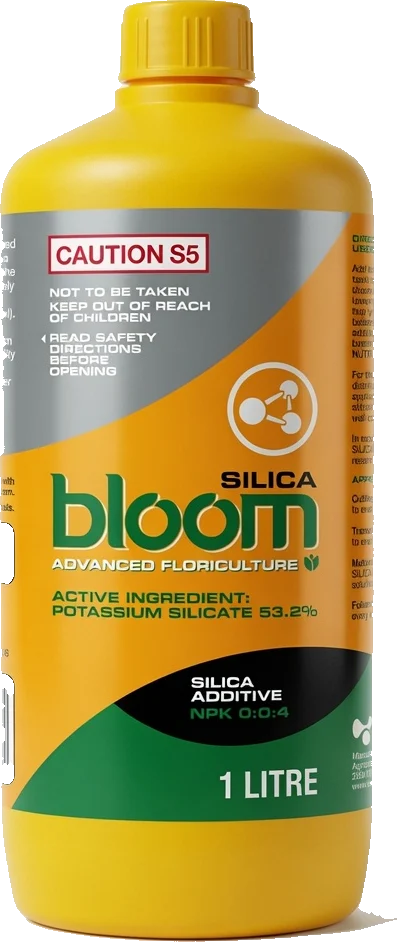
That’s not a knock on silicon products generally — plenty of growers run them and are happy with the results, and nothing here says that’s wrong. It’s a case for reading “silicon helps plants” and “silicon helps this plant, at this rate” as two different claims, and only printing the one you can actually back up.
Why the uptake side matters more than the dose side
A lot of grower conversation about silicon jumps straight to dosing — how many milliliters per gallon, how often, at what stage. That skips a step. Dose only matters once the plant in front of you can actually move dissolved silicic acid from the root zone into shoot tissue at a meaningful rate. A low accumulator given the same silicon concentration as a high accumulator isn’t necessarily under-dosed; it may simply not be built to take up and deposit silicon the way a grass is. Nothing in the research reviewed here tells us where cannabis actually sits on that spectrum — which means a dosing table borrowed from a rice or wheat trial is borrowing an assumption, not a result.
The honest version of a cannabis silicon story isn’t “it doesn’t work” or “it definitely works at this rate.” It’s narrower and more useful: the accumulator-tier research that backs up silicon’s biggest headlines was built on a specific group of plants, cannabis isn’t in that group, and nobody has published the data that would tell us whether it behaves more like a grass or more like a typical dicot. Until that data exists, any specific effect size quoted for cannabis is someone’s extrapolation, not a measurement.