
Ask most gardeners what “fish fertilizer” means and they’ll describe the same thing: a bottle of emulsion, usually with a reputation for smell. That mental picture isn’t wrong, exactly — it’s just not the whole category anymore. A 2019 USDA survey of OMRI-listed fish-based fertilizers found that hydrolysate products now make up roughly as much of the market as emulsion-style solubles. “Fish fertilizer” has quietly become two different kinds of product, and they’re not made the same way.
Two routes, two names, two products
Emulsion is the older, more familiar process: fish byproduct — heads, guts, bones, scraps — is cooked at high heat, pressed, and the oil is centrifuged off the top. What’s left after the oil comes off is called “stickwater,” which gets concentrated down in an evaporator into the thick, strong-smelling liquid most people picture. Hydrolysate takes a different route entirely: instead of heat, it uses enzymes to break the fish protein down, with no cooking step involved.
What “stickwater” actually is
The emulsion route’s base material has a documented composition: roughly 4.5% protein, 1.2% fat, 88.5% moisture, and 0.8% ash, by one patent’s worked example. It’s mostly water. A phosphoric acid stabilizer is typically added to keep it from spoiling, and some “amended” emulsions add urea on top to boost the nitrogen number on the label. None of that makes emulsion a bad product — it’s a legitimate, long-standing category — it just means the bottle is doing more formulation work than “concentrated fish” implies.
~45% of surveyed products: hydrolysate
~43% of surveyed products: solubles/emulsion
Why the split matters more than the smell
The emulsion-vs-hydrolysate split isn’t just a manufacturing footnote — it changes what actually survives in the bottle. Heat-and-acid processing is harder on certain amino acids than enzymatic digestion is, and it’s a documented fact that acid routes can convert some amino acids from their biologically active L-form into the D-form, which plants can’t use the same way. Enzymatic hydrolysate skips that heat step specifically to avoid cooking those compounds off in the first place. That’s the actual reason the two categories exist side by side rather than one simply replacing the other — they’re not aiming for the same thing.
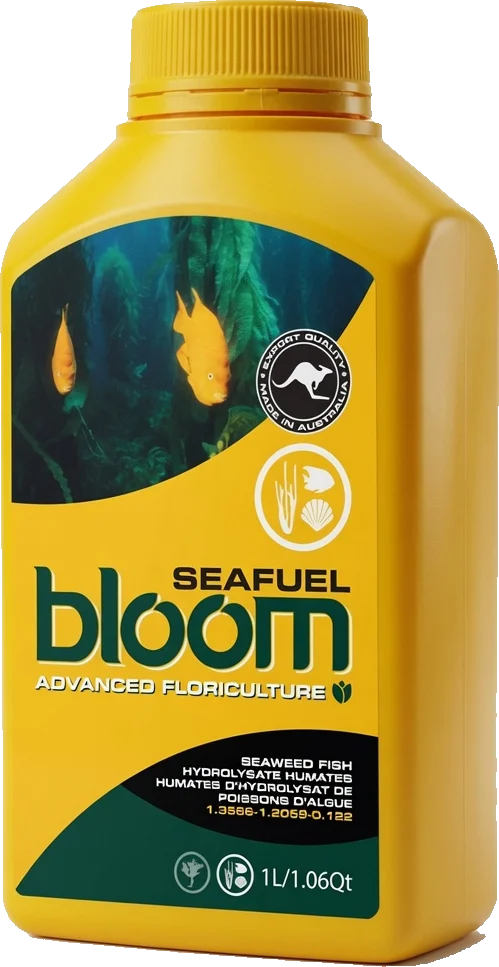
There’s also a practical reason this split matters for a backyard garden specifically: the two categories don’t necessarily smell, store, or dose the same way, and a bottle that doesn’t say which one it is leaves a gardener guessing. Emulsion’s cooked, oil-skimmed stickwater base and hydrolysate’s enzyme-digested base aren’t two names for the same liquid — they start from the same raw fish and end up as genuinely different products with different compositions. Reading the label’s process word, not just the guaranteed analysis numbers, is the only way to know which one is actually in the bottle.
Where Bloom Seafuel sits
Bloom’s own Seafuel label calls its fish component a hydrolysate, not an emulsion — that’s the word printed on the artwork, not a marketing description layered on afterward. The label also lists 0.075% humic acid from Leonardite as a non-plant-food ingredient, dosed at 1 ml/L. None of that tells a home gardener which process is “right” for their garden — that’s a judgment call, not a lab result. But it does mean that when the bottle says “hydrolysate,” there’s a specific, documented process behind that word, not just a label choice.
The next time “fish fertilizer” comes up at the garden center, it’s worth remembering there isn’t one answer to “how is this made.” There are two, and reading past the smell to the word on the label — emulsion or hydrolysate — tells you more about what’s actually in the bottle than the scent ever will.
None of this is an argument for throwing out a bottle of emulsion that’s been working fine in a raised bed for years. It’s an argument for knowing which category a new bottle belongs to before assuming it behaves like the last one, especially if a gardener is switching products or trying to match a routine they read about online that didn’t specify which kind of “fish fertilizer” it meant.