
The Cheat Sheet Said 4 ml/L. The Feed Chart Says 1. Here’s Which One We’d Trust With Our Own Reservoir.
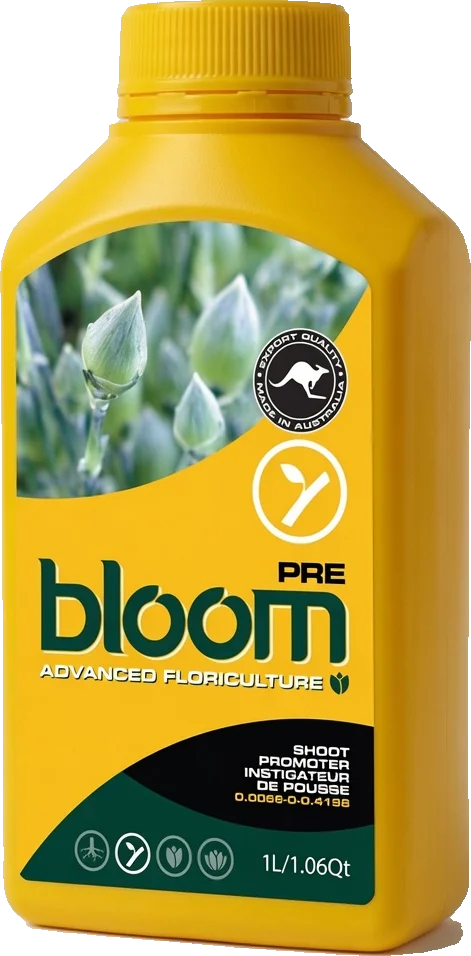
A grower messaged us a photo of two Bloom documents open side by side: our own cheat sheet, printed with a 4 ml/L dose for Pre, and our own feed chart, printed with 1 ml/L. Same product, same company, two different numbers. He wanted to know which one was wrong before he ran it in an 8-tent room. Fair question. Here’s the honest answer, and the rule we use internally to settle it every time this happens.
Pre is built to do one specific job: bridge the stretch between vegetative growth and the start of flowering, when a plant’s internal chemistry is shifting faster than almost any other point in its life. That’s a narrow window, and like most of our boosters, Pre is formulated to be added in small, precise amounts on top of an existing base program — not to replace it, and not to be eyeballed.
The short version: the feed chart is right. 1 ml/L is the rate we stand behind. The 4 ml/L figure on some printed cheat sheets is a documentation error we’re correcting — not a formulation change, and not a case where “more is fine.”
Why we don’t just pick whichever number is friendlier
We work off a simple internal rule whenever two Bloom documents disagree: the label wins over the feed chart, and the feed chart wins over anything else — a cheat sheet, a one-pager, a line on the website. It’s a hierarchy of how carefully each document was built, not a popularity contest. A guaranteed analysis on a label is legally reviewed. A feed chart is built and checked against that label. A cheat sheet is a marketing leave-behind, written for speed, and the easiest of the three to typo or to leave un-updated after a chart changes.
That’s exactly what happened here. Pre’s feed chart rate is 1 ml/L. At some point, a cheat sheet was printed with 4 ml/L and never corrected against it. Four times the intended dose, repeated across a feed schedule, isn’t a rounding error — it’s the difference between a precise transitional input and a plant getting hit with a concentration it was never formulated around.
What this means if you’ve been running the 4 ml/L number
We’re not going to tell you nothing happened — we don’t have a controlled trial on what 4x the intended Pre dose does across different strains, media, and runoff setups, and we’re not going to invent one. What we can tell you is that a transitional booster dosed at four times its intended rate is being asked to do a job it wasn’t formulated for, in a window of plant development where the margin for a formulation change you didn’t ask for is already thin. If you’ve been running the higher number, the fix going forward is simple: match the feed chart, not the cheat sheet, and watch the next cycle the way you’d watch any dose change — same as you would if you corrected a nutrient calculator or a reservoir size error.
This isn’t a story we’re printing because it’s flattering. It’s the kind of mismatch that’s easy to let sit quietly in a drawer of old marketing material. We’d rather a grower reading a feed chart on our own site catch the right number than catch the wrong one on a laminated sheet from a trade show two years ago.
The source-authority order we use, every time two Bloom documents disagree:
If you’re running Pre and you’ve only ever seen the cheat-sheet number, this is your correction: 1 ml/L of nutrient solution, on top of your existing base program, timed to the veg-to-flower transition. If a different Bloom document ever quotes you a different number again, the rule doesn’t change — go with whichever one sits closer to the label.
This isn’t unique to Pre
Pre and Final share this exact documentation gap — both show the same uncorrected 4 ml/L figure on older cheat-sheet copies, and both have a correct, confirmed 1 ml/L rate on their feed charts. If you run both boosters in the same room, the fix is the same for each: match the feed chart, ignore the laminated sheet, and don’t assume the two documents were ever meant to agree just because they came from the same company at the same time.
It’s also a reasonable habit to carry into any other product you run from any brand, not just ours. If a marketing sheet and a feed chart from the same manufacturer ever disagree, don’t average the two numbers and don’t assume the bigger one is “just to be safe.” Go to the most carefully checked document you can find — for us, that order is label, then feed chart, then everything else — and treat the rest as drafts that haven’t caught up yet.