
Eighteen Types of Gibberellin, and Only One in Twenty Is Doing Anything
Floriculture & Ornamental · Science & Education
Gibberellins are the hormone class most directly tied to flower development — bud break, stem elongation, bloom timing. So it’s no surprise that “seaweed extract contains gibberellins” gets repeated often around cut-flower benches and greenhouse growers. What’s less often repeated is what the actual lab work found when someone measured how many of those gibberellins were doing anything at all.
The industry’s own lab work makes the point
A 2014 study in the Journal of Applied Phycology ran a full hormone panel on a commercially available seaweed extract made from Ecklonia maxima — a different seaweed than Bloom’s declared Durvillaea potatorum, and not a Bloom product. We’re citing it here for one reason: it’s the most detailed published measurement of gibberellin content in a commercial seaweed extract that exists, and the result cuts against the “loaded with active hormones” story rather than supporting it.
The researchers found total gibberellins ranging from 187.54 to 565.96 picograms per millilitre of extract — spread across eighteen separate types of gibberellin. Of those eighteen, the biologically active forms made up less than 3% of the total. The other 97%-plus were gibberellin-family molecules the plant’s own receptors don’t respond to.
This matches what the industry’s own trade body says
The European Biostimulants Industry Council — the seaweed-extract category’s own trade organization, not a critic of it — reached the same conclusion from a different angle in a 2023 white paper. Reviewing a decade of research on seaweed-extract mode of action, EBIC states plainly that “many scientific publications over the past 10 years have demonstrated that plant hormones are not responsible for the plant biostimulant effects observed in crops,” and that “very low (if any) phytohormones are found in seaweed extracts,” well below the levels that would trigger a physiological response at typical field rates.
That’s a notable thing for a trade body to say about its own product category. It means the gibberellin numbers measured above aren’t an outlier or a weak batch — they’re consistent with what the field’s own researchers have been finding across seaweed extracts generally.
If gibberellins aren’t the active mechanism, what is? The research points toward the polysaccharide and polyphenol fraction — and toward the extract’s effect on the plant’s own hormone signalling pathways, rather than the extract supplying a meaningful dose of hormone itself.
A 2020 review in the same journal (general seaweed-extract research, not a test of Bloom Seaweed) lays out what that signalling-led mechanism looks like at the gene level: root-applied seaweed extract activates the cytokinin-responsive ARR5 promoter and switches on the IPT3, IPT4 and IPT5 genes involved in cytokinin production, rather than simply delivering a premade hormone dose. The authors are blunt about why this matters: “hormone concentration in the seaweed extracts is low and only relatively small amounts of extracts are applied to plants,” so the effect has to come from somewhere other than a direct hormone payload — most likely the extract’s own polysaccharides prompting the plant to run its own hormone machinery differently.
Where Bloom Seaweed’s own label actually lands
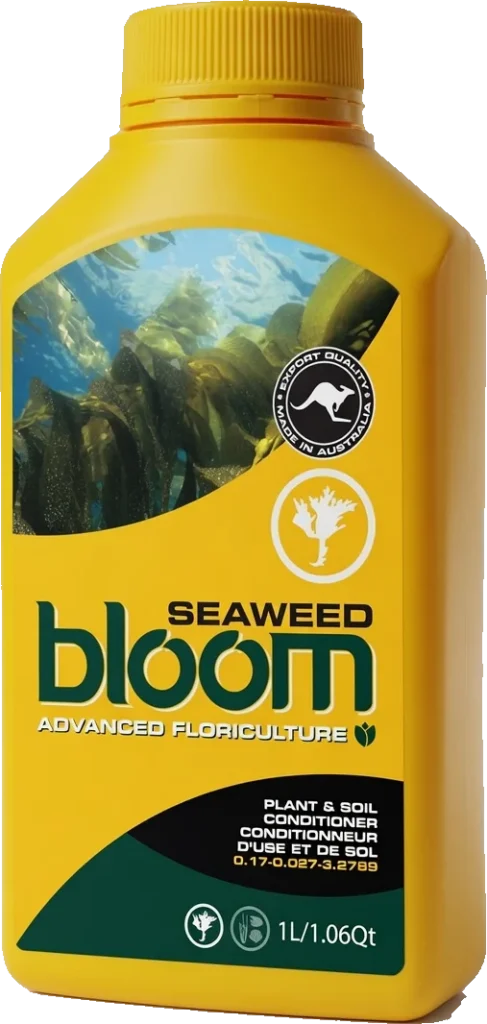
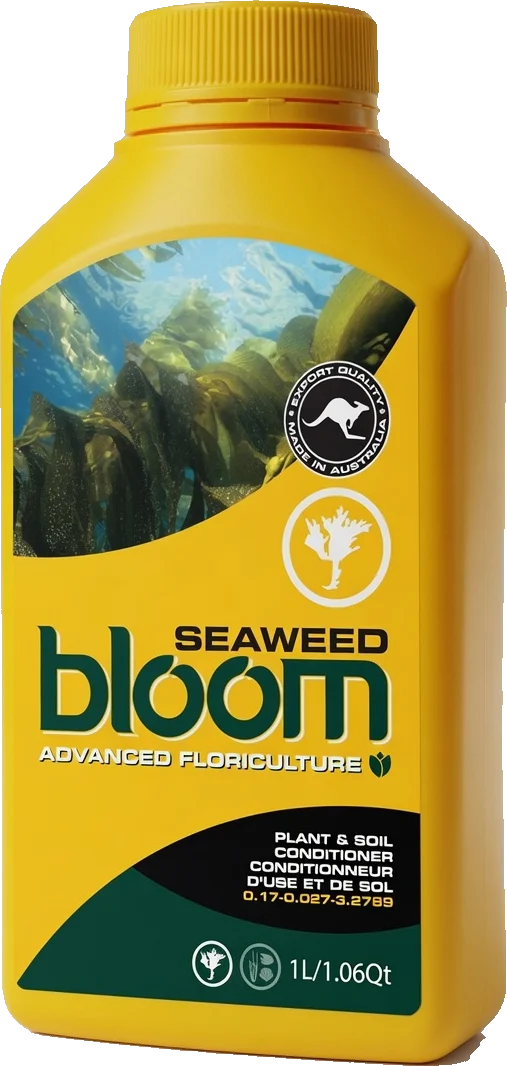
Bloom Seaweed’s guaranteed analysis declares 0.17% total nitrogen, 0.027% available phosphate and 3.278% soluble potash, derived from Durvillaea potatorum seaplant extract, dosed at 1 ml/L. No hormone of any kind is declared — not gibberellin, not auxin, not cytokinin. That’s consistent with the research above, not a gap in the label. If the active fraction in a seaweed extract were mostly gibberellin, a guaranteed analysis declaring none of it would be a problem. Since the best-measured commercial extract in the category shows gibberellin activity sitting under 3% of total content, a label built around nitrogen, phosphate and potash — the nutrients it actually declares and measures — is the more honest document, not a less impressive one.
For a cut-flower or ornamental grower timing bloom development, the practical takeaway isn’t “seaweed extract won’t help with flowering.” It’s that whatever help it provides almost certainly isn’t coming from a dose of gibberellin hiding in the bottle — because the most detailed measurement anyone’s published says there isn’t enough of it there to matter.
It also reframes a question growers sometimes ask when a bloom booster’s results seem to vary season to season: “did this batch just have less hormone in it?” Based on what’s actually been measured, that’s probably the wrong question. If the active fraction across the whole category sits under 3% of total gibberellin content, batch-to-batch variation in a seaweed product’s performance is more likely tied to the polysaccharide and polyphenol load, growing conditions, or application timing than to any hormone swing — because the hormone fraction was never large enough to swing much in the first place.